
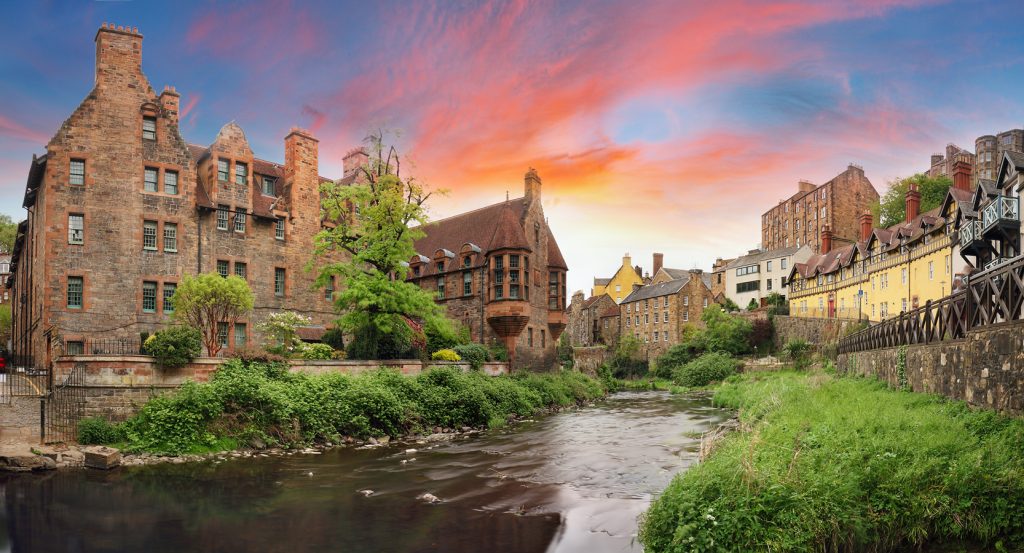
Why Dean Village matters.
Dean Village isn't just a neighborhood, it's a living postcard of old Edinburgh, a storybook corner where cobblestone lanes wind along the Water of Leith beneath ivy-covered stone cottages.
Once a thriving grain milling hamlet dating back to the 12th century, Dean Village now feels like a peaceful secret hidden just minutes from the city's heart. The air hums with the quiet sound of the river as it curls beneath arched bridges, its banks framed by mossy walls and flower-filled terraces. The old mill buildings, with their crow-stepped gables, sundials, and carved stone plaques, still whisper of the workers who once hauled grain and ground flour here for the city's bread. The architecture blends rustic charm with faded grandeur: pastel facades reflected in the slow-moving water, steep stairways leading to tucked-away gardens, and narrow paths where every turn feels like a painting in motion. Standing on the Dean Bridge, you see a panorama of rooftops and greenery that feels worlds apart from the thriving Royal Mile above. Dean Village isn't just scenic, it's the kind of quiet beauty that rewires your pace, inviting you to listen to the heartbeat of history still echoing through its cobblestones.
What defines Dean Village.
Behind its serenity lies a story of survival, renewal, and rediscovery that mirrors the soul of Edinburgh itself.
For over 800 years, Dean Village thrived as the industrial core of the city's grain trade, with eleven working mills powered by the Water of Leith. But by the late 19th century, as industry shifted elsewhere, the area fell into decay, its mills abandoned, its cottages neglected. In the 1970s, however, a quiet renaissance began. Conservationists and locals recognized the area's unique character, restoring its historic buildings and transforming it into one of Edinburgh's most treasured enclaves. Today, subtle details still tell its layered history, the carved stone plaque reading “VILLAGE OF THE DEAN 1695,” the former tollhouse by the bridge, and the mill wheels preserved in hidden courtyards. The village also connects to the broader story of Edinburgh's artistry: the nearby Dean Cemetery holds the graves of writers, scientists, and architects who shaped Scotland's cultural legacy, while the Scottish National Gallery of Modern Art lies just a short stroll downstream. What began as a working-class milling settlement has evolved into a sanctuary of calm and beauty, a rare place where the pulse of the past flows quietly beside the present.
How Dean Village fits.
To experience Dean Village is to slip gently between worlds, from the urban hum of modern Edinburgh to the stillness of another century.
Start the walk from Princes Street and head down Dean Bridge, pausing halfway for a breathtaking view of the village tucked in the valley below. Descend into the narrow lanes that trace the Water of Leith, following the sound of rushing water until you reach the heart of the village at Well Court, the red-brick showpiece built in the 1880s for mill workers, now lovingly restored. Wander slowly along the riverside path, where reflections of stone and sky ripple together, and take in the sight of weeping willows leaning over the water. For an extended stroll, continue along the Water of Leith Walkway toward the galleries at Belford Road or in the opposite direction toward Stockbridge, another charming neighborhood rich with cafés and markets. Visit in the golden light of morning or the soft hush of evening, when the village feels suspended between dream and memory. Dean Village in Edinburgh isn't just a place to see, it's a moment to feel, a pause that reminds you how quietly the past can endure.
Where your story begins.
Foresyte Travel reveals places that feel extraordinary long before you arrive.
Enjoy editorial crafted for luxury travelers.
Foresyte may earn a commission when you book.














































































































