
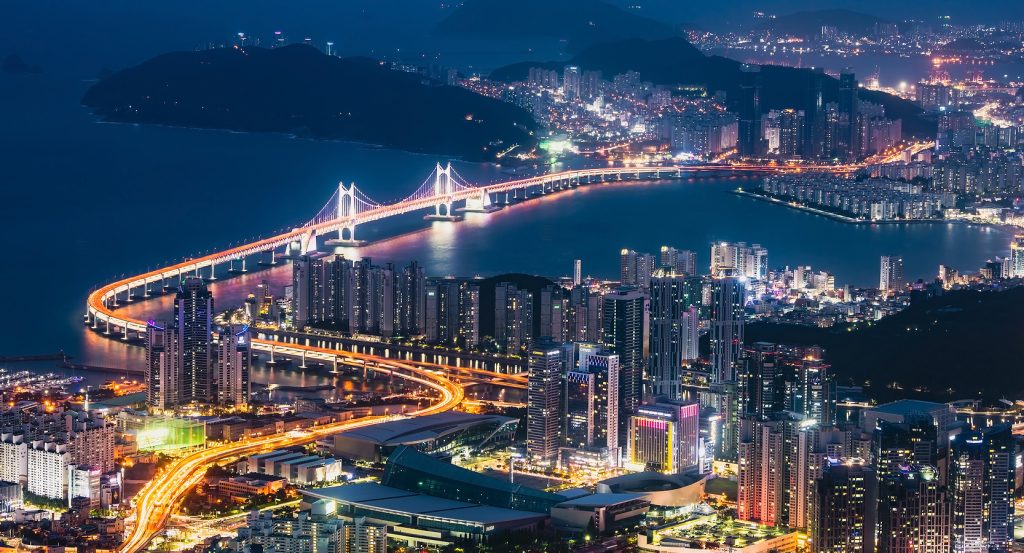
Why Dining Room Park Hyatt Busan matters.
Dining Room Park Hyatt Busan is a contemporary steak and seafood restaurant where Marine City's waterfront development meets the architectural vision of Daniel Libeskind, the interior craftsmanship of Japanese design firm Super Potato, and the culinary traditions of Korean charcoal grilling.
Occupying the thirty-second floor of Park Hyatt Busan above Suyeongman Yacht Marina, Dining Room overlooks the western approaches to Haeundae Beach, with Gwangan Bridge extending across the bay, Dongbaekseom rising along the eastern waterfront, and the residential towers of Marine City surrounding the hotel. Floor-to-ceiling windows follow the building's curved glass exterior, creating broad sightlines across the harbor and the mountainous coastline beyond. The dining room combines contemporary furnishings with architectural elements derived from traditional Korean houses, including reclaimed timber, weathered roof tiles, aged brickwork, and decorative objects associated with domestic life. Wooden beams and columns contribute warmth to the interior, complementing the subdued lighting and substantial dining tables. Traditional Korean masks, ceramic vessels, and small percussion instruments provide cultural detail within the otherwise restrained setting. An open kitchen incorporates charcoal grilling stations, allowing diners to observe the preparation of premium meats and seafood. The restaurant's elevated position also distinguishes the changing appearance of the surrounding waterfront, with daylight revealing the harbor's geography and evening illumination defining the suspension bridge and neighboring towers. The result is a sophisticated hotel restaurant whose Korean architectural references, open-fire kitchen, and expansive coastal setting establish a distinctive presence within Busan's contemporary dining culture.
What defines Dining Room Park Hyatt.
Dining Room Park Hyatt Busan is best known for combining premium charcoal-grilled steaks and seafood with a restaurant interior conceived by Super Potato as part of the international architectural collaboration behind Park Hyatt Busan. The restaurant's development originated in Hyundai Development Company's investment in a luxury waterfront hotel within Marine City, a district transformed through the redevelopment of former coastal and industrial land. Hyundai Development Company had previously partnered with Hyatt on Park Hyatt Seoul, establishing a commercial relationship that supported the expansion of the hospitality brand into South Korea's second-largest city. On February 29, 2012, Hyatt Hotels Corporation announced the Busan project, identifying the hotel as the fifth Hyatt-branded property planned for South Korea. The development represented a significant addition to the Park Hyatt portfolio, extending the brand's presence into a city whose international significance rested on shipping, manufacturing, finance, and major cultural events. Architect Daniel Libeskind designed the thirty-three-story building, developing a curved exterior associated with the movement of ocean waves and the form of the camellia, Busan's symbolic flower. His architectural career had already achieved international prominence through projects including the Jewish Museum Berlin and the master plan for the reconstruction of the World Trade Center site in New York. The Busan commission connected his expressive architectural approach with a prominent waterfront setting overlooking one of the city's principal maritime corridors. Tokyo-based Super Potato received responsibility for the interiors, bringing the firm's established expertise in hospitality design and the adaptation of traditional Asian craftsmanship to contemporary commercial spaces. Founded by Takashi Sugimoto in 1973, Super Potato had developed an international reputation through restaurants, hotels, and retail environments distinguished by reclaimed architectural components and carefully composed interiors. The firm's vice president, Norihiko Shinya, contributed to the Busan project, developing interior spaces that incorporated Korean construction traditions and objects associated with domestic culture. Dining Room became a particularly concentrated example of this approach through its incorporation of salvaged building components into a formal restaurant setting. The design combined recovered woodwork, antique tableware, and traditional decorative objects with the building's contemporary glazed architecture, connecting the restaurant's physical character with the cultural heritage of its host city. Park Hyatt Busan began welcoming guests on February 18, 2013, ahead of its official opening on February 26. Marc von Arnim served as the opening general manager, overseeing the introduction of the property's hospitality and dining operations. The hotel became the second Park Hyatt in South Korea and the tenth property under the brand in the Asia-Pacific region. Dining Room formed the principal formal restaurant within a broader hospitality program incorporating Living Room, Lounge, and a dedicated patisserie. Its original culinary organization included an open kitchen and sushi bar, emphasizing premium grilled meats, fresh seafood, and Japanese preparations alongside the restaurant's extensive coastal views. The opening attracted attention from major Korean newspapers and international hospitality publications, particularly for the relationship between Libeskind's architecture and Super Potato's interpretation of Korean domestic traditions. The restaurant subsequently developed its culinary direction around charcoal grilling, seasonal seafood, Korean beef, and formal multi-course dining, retaining its position as the hotel's principal steak and seafood establishment. Its significance emerges through the collaboration of internationally recognized designers, the expansion of luxury hospitality into Busan's redeveloped waterfront, and the adaptation of traditional Korean craftsmanship to contemporary restaurant architecture.
Super Potato's interior composition provides the setting for a culinary program centered on open-fire cooking, premium ingredients, and the relationship between European steakhouse traditions and Korean dining customs. The charcoal grill forms the kitchen's principal technical feature, exposing selected cuts of meat and seafood to concentrated radiant heat that develops browning and roasted aromas across their surfaces. Korean Hanwoo beef occupies an important position within the restaurant's selection, connecting the menu with the country's longstanding cattle-rearing traditions and its preference for carefully graded domestic beef. The meat's intramuscular fat contributes tenderness and richness, requiring controlled grilling to develop an evenly browned exterior while preserving the desired interior texture. American prime beef introduces another established steakhouse tradition, with its marbling and substantial cuts supporting preparations centered on direct heat. Australian lamb contributes a separate character through its distinctive fat composition and suitability for roasting over charcoal. The kitchen combines these meats with seafood associated with Busan's maritime geography, including lobster, octopus, prawns, and seasonal fish. Their different structures require individual control of cooking temperature and duration, allowing the grill to develop the natural sweetness of shellfish alongside the deeper roasted character of beef. The restaurant's assorted grill platter brings these ingredients together through a shared presentation, connecting the Korean tradition of communal dining with the conventions of a formal steakhouse. Its crab cake preparation develops another aspect of the seafood program through pan-seared king crab accompanied by apple and remoulade, combining the sweetness of shellfish with acidity and restrained spice. Classical French techniques contribute further depth through preparations such as caramelized onion soup enriched with Gruyère and Parmesan, establishing a relationship between European culinary foundations and the restaurant's principal grilled specialties. Korean cooking traditions occupy a distinct place within the weekday lunch program, where charcoal-grilled main courses accompany rice prepared in individual cooking vessels. The rice develops its texture through carefully controlled heat and moisture, complementing the concentrated flavors of the grilled ingredients. Formal evening menus extend the culinary program into sequential courses, with seasonal vegetables, seafood, premium beef, and composed desserts providing a structured dining occasion. The restaurant's wine program incorporates selected international producers, with pairings developed around the fat content, seasoning, and roasted characteristics of the principal dishes. Weekend lunch service introduces a broader selection of seafood and carved meats, maintaining the kitchen's emphasis on premium proteins and direct cooking. Dining Room's culinary character develops through this relationship between charcoal technique, Korean ingredients, European culinary foundations, and the formal service traditions of international luxury hospitality.
How Dining Room Park Hyatt fits.
Dining Room Park Hyatt Busan works as the centerpiece of an exploration connecting Busan's international sailing heritage, the development of its contemporary waterfront, and the diplomatic significance of its coastal architecture.
Begin at Suyeongman Yacht Marina, the substantial recreational harbor immediately west of the hotel. Constructed for the 1986 Asian Games and subsequently used during the sailing competitions of the 1988 Seoul Olympic Games, the marina became an important institution in South Korea's development as an international sporting destination. Its sheltered basin accommodates sailing vessels and recreational craft, connecting the surrounding waterfront with Busan's longstanding maritime economy. The marina's infrastructure includes extensive mooring facilities and specialized spaces supporting sailing activities, preserving the district's relationship with competitive water sports. Its construction also contributed to the transformation of the surrounding coastline into a major residential and commercial district. Continue to The Bay 101, the waterfront commercial complex occupying the eastern edge of Marine City near Dongbaekseom. Opened in 2014, the development brought restaurants, leisure facilities, and maritime activities together beside the sheltered waters of Haeundae Bay. Its outdoor terraces provide broad views toward the neighboring residential towers, whose illuminated façades create a distinctive evening skyline above the harbor. The complex's coastal position connects the dense architecture of Marine City with the lower wooded slopes of Dongbaekseom, establishing a transition between the developed waterfront and the surrounding natural landscape. Conclude at Nurimaru APEC House, the international conference venue occupying a wooded headland on Dongbaekseom. Constructed for the 2005 Asia-Pacific Economic Cooperation leaders' meeting, the building hosted representatives from twenty-one member economies on November 19 of that year. Its architecture draws from the form of a traditional Korean pavilion, incorporating a curved roof and twelve exterior columns within a contemporary glass-enclosed structure. The building's elevated position provides views across the coastline toward Gwangan Bridge and the surrounding mountains. Its preserved conference chamber contains furnishings associated with the diplomatic gathering, connecting the architectural setting with an important event in South Korea's international political history. The progression moves from Suyeongman Yacht Marina's Olympic sailing heritage through The Bay 101's waterfront development and culminates at Nurimaru APEC House's diplomatic architecture, connecting Dining Room Park Hyatt Busan with the maritime and international significance of the surrounding district.
Where your story begins.
Foresyte Travel reveals places that feel extraordinary long before you arrive.
Enjoy editorial crafted for luxury travelers.
Foresyte may earn a commission when you book.

















































































































