
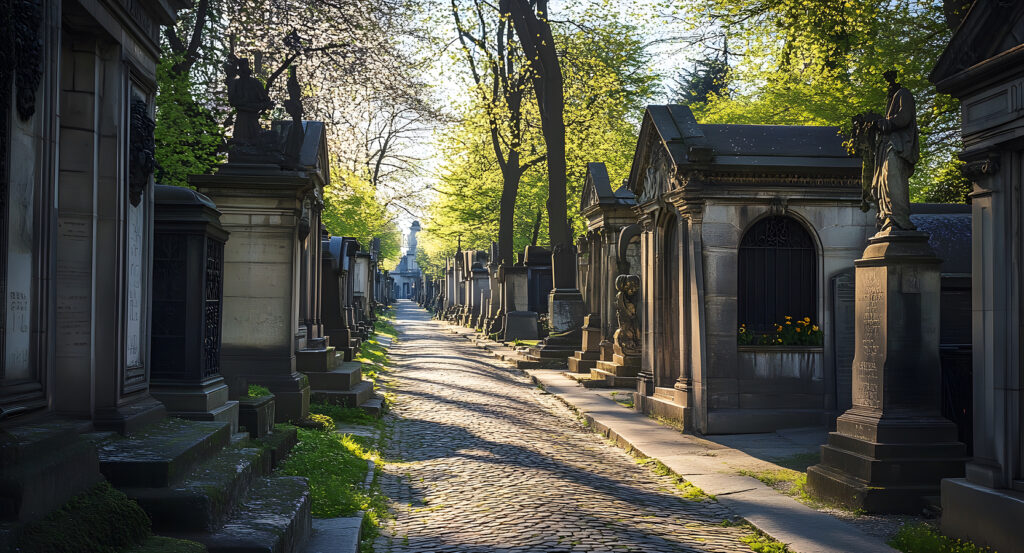
Why you should experience Edith Piaf's Grave in Paris, France.
Visiting Édith Piaf's grave is like stepping into the final verse of a love song, the kind that leaves you breathless, suspended between heartbreak and beauty.
Hidden among the labyrinthine paths of Cimetière du Père-Lachaise, her simple black marble tomb carries none of the theatricality that defined her life, yet all the resonant weight. Here lies La Môme Piaf, the “Little Sparrow,” whose voice once echoed through postwar Paris, stitching together a city's fractured soul. The grave draws admirers who still hum “La Vie en Rose” under their breath, moved by a woman who sang not for fame, but for survival. The scent of fresh roses and the quiet hum of visitors lend the site a strange electricity, one born of resilience and romance. To stand here is to confront the paradox of Piaf herself: fragile yet indomitable, broken yet luminous, her life an aria of defiance and desire that outlived her own body.
What you should know about Édith Piaf's Grave.
What few realize is how closely Piaf's story remains interwoven with the city's mythology, and how this modest grave conceals a lifetime of reinvention.
Her final resting place was chosen not for grandeur but for intimacy, shared with her daughter Marcelle and her last husband, Theo Sarapo. During her life, Piaf's existence played out like a chanson: orphaned young, discovered singing on Paris streets, and thrust into stardom as both muse and martyr. But her legacy didn't end with her death in 1963. The church initially refused her a funeral because of her scandalous reputation, yet 40,000 mourners filled the streets, halting Paris itself. That contrast, moral judgment versus human adoration, defines her even now. The flowers left here aren't offerings to a saint but tributes to a woman who lived without pretense, who loved recklessly and forgave slowly, and who taught the world that pain, when sung with honesty, could become art.
How to fold Édith Piaf's Grave into your trip.
To fold Piaf's grave into your Paris itinerary, make it the crescendo of an afternoon steeped in Montmartre romance and memory.
Begin at Rue Lepic, where Piaf once lived, and let the neighborhood's cobblestone pulse guide you toward Père Lachaise. Bring a small speaker or headphones and play “Non, Je Ne Regrette Rien” as you walk, the song transforming your steps into rhythm. At her grave, don't rush; let silence do the speaking. Then, afterward, wander into a nearby café for a glass of red wine, something she would have approved of, and watch the day fade over the cemetery walls. In those quiet moments, you'll understand that visiting Piaf isn't just an homage; it's a discussion between your heart and hers, a reminder that even in death, she sings through the city she loved.
Where your story begins.
Foresyte Travel reveals places that feel extraordinary long before you arrive.
Experience premium editorial crafted for luxury travelers.














































































































