
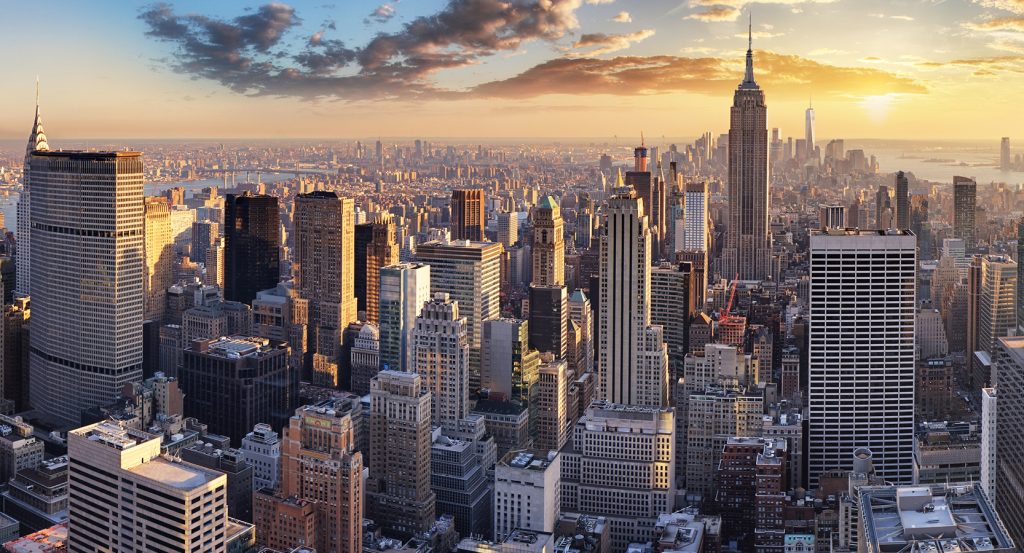
Why you should experience Fitzpatrick Grand Central in New York, NY.
Fitzpatrick Grand Central is a convivial Irish hotel where Midtown East's railway heritage, transatlantic character and tightly woven social culture converge within a family-run address across from one of Manhattan's defining transportation spaces.
Set along East 44th Street near Lexington Avenue and just steps from Grand Central Terminal, the hotel occupies a ten-story, 75,000-square-foot building whose position opposite the terminal places Irish hospitality directly within the architectural world created around Terminal City. The Wheeltapper gives that relationship physical expression through a traditional Irish pub built in Ireland and shipped to Manhattan, with railway imagery, timber detailing, intimate drinking nooks and two bars connecting the Fitzpatrick family's country of origin with the neighborhood's transportation identity. An enclosed courtyard behind the pub creates an unusually secluded outdoor room within the dense East 44th Street streetscape, extending the property's club-like social character beyond the building itself. The resulting hotel feels inseparable from its setting, pairing an Irish-built pub and family hospitality tradition with the constant movement, railway architecture and compressed urban energy surrounding Grand Central Terminal.
What you should know about Fitzpatrick Grand Central.
Fitzpatrick Grand Central is best known for opening in August 1998 as a $27 million, 155-room hotel and the first new hotel to debut in the Grand Central district in 15 years, with Mayor Rudolph Giuliani and Fitzpatrick Hotel Group chief executive John Fitzpatrick cutting the ribbon alongside Pulitzer Prize-winning author Frank McCourt and Tony Award-winning Irish actress Anna Manahan. The property became the Fitzpatrick family's third New York hotel following its initial Manhattan arrival in 1991 and subsequent East 55th Street expansion, extending a hospitality business founded by Paddy and Eithne Fitzpatrick in Ireland into another strategically important Midtown address. The opening created 100 permanent jobs and introduced a room program whose published rates began around $245 for guestrooms and $295 for suites, positioning the family-owned operation within the late-1990s revival of New York hospitality. John Fitzpatrick led the American expansion after growing up within the family business, turning the Fitzpatrick name into an enduring Irish presence in Manhattan while retaining direct family leadership across its New York properties.
Frank McCourt's presence at the opening connected the property immediately with the Irish literary culture then commanding international attention, since Angela's Ashes had received the 1997 Pulitzer Prize for Biography or Autobiography before McCourt joined Fitzpatrick and Giuliani for the East 44th Street debut. Anna Manahan brought a parallel theatrical connection after receiving the 1998 Tony Award for Best Featured Actress in a Play for Martin McDonagh's The Beauty Queen of Leenane, placing two prominent Irish cultural figures beside the Fitzpatrick family at the inauguration. The ceremony joined John Fitzpatrick's hospitality expansion with McCourt's Irish American literary voice and Manahan's acclaimed interpretation of contemporary Irish theater during a period when all three were shaping distinct expressions of Irish culture in New York. McCourt, Manahan and Fitzpatrick gave the 1998 opening a cultural dimension extending well beyond a hotel launch, embedding the property within the Irish American networks that had already become central to the family's Manhattan identity.
How to fold Fitzpatrick Grand Central into your trip.
Fitzpatrick Grand Central works as the anchor for an afternoon tracing railway ambition, Art Deco verticality and diplomatic history through the architectural concentration surrounding East 42nd Street.
Begin at Grand Central Terminal, where Reed & Stem and Warren & Wetmore's terminal opened at 12:01 a.m. on February 2, 1913 after a decade-long reconstruction that buried the tracks, replaced steam with electric operations and created a 70-acre rail complex containing 32 miles of track, with more than 150,000 people passing through on opening day. Continue to Chrysler Building, where William Van Alen designed Walter P. Chrysler's Art Deco skyscraper with automobile-derived ornament and a stainless-steel crown whose secretly assembled spire was raised into position during the fierce late-1920s contest to construct the world's tallest building, allowing the tower to claim that title upon completion in 1930. Conclude at United Nations Headquarters, where an international design board led by Wallace K. Harrison and including Le Corbusier and Oscar Niemeyer developed the East River complex after John D. Rockefeller Jr. contributed $8.5 million toward acquisition of the site, translating postwar internationalism into one of Manhattan's defining architectural ensembles. The progression moves from the engineering that created modern Grand Central through Van Alen and Chrysler's skyscraper-age ambition into Harrison, Niemeyer and Le Corbusier's architectural expression of international diplomacy, revealing the railway, commercial and global institutions surrounding Fitzpatrick Grand Central within a compact Midtown East sequence.
Where your story begins.
Foresyte Travel reveals places that feel extraordinary long before you arrive.
Experience premium editorial crafted for luxury travelers.







































































































