
Why Floating Flower Garden matters.
Floating Flower Garden is an enveloping kinetic artwork where Toyosu's waterfront reinvention meets living horticulture, responsive movement and a suspended garden that continuously reshapes itself around the people moving beneath it.
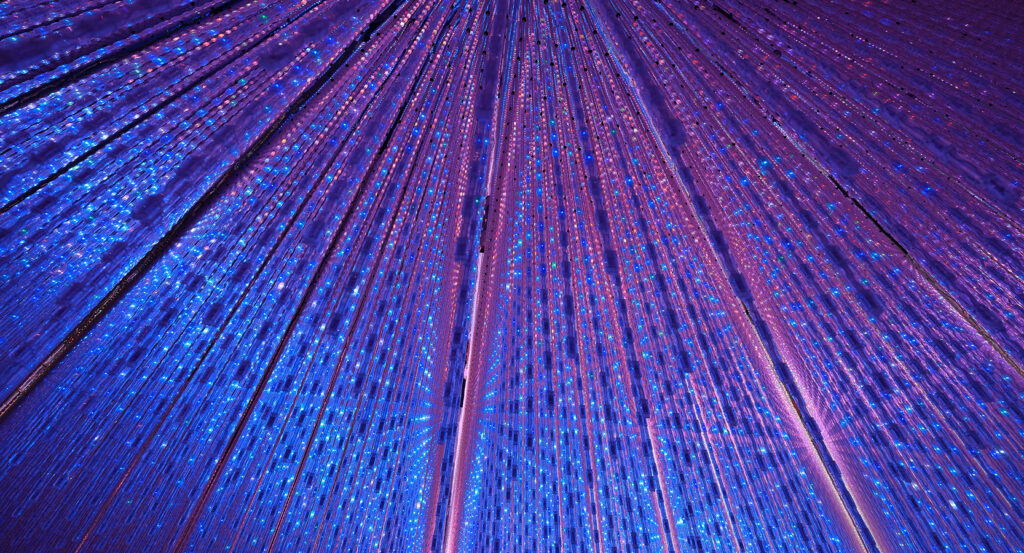
Set within teamLab Planets near Shin-Toyosu Station and just steps from the waterfront spaces of southern Toyosu, the installation occupies a luminous chamber reached through the museum's sequence of large-scale immersive environments. Thousands of blossoms hang overhead in a dense three-dimensional field, descending close enough to compress the room into a floral canopy before mechanical suspension systems begin opening pathways through it. As a person advances, nearby clusters rise and create a temporary clearing centered on the moving body, then descend after that position has been vacated. Encounters between people alter the geometry again, joining their individual clearings and changing the volume of open space available inside the suspended mass. The result is a garden encountered through reciprocal movement, with each passage through the room producing a temporary physical configuration that disappears as soon as its occupants move elsewhere.
What defines Floating Flower Garden.
Floating Flower Garden is best known for extending a teamLab installation first created in 2015 into the Garden Area added to teamLab Planets during the Toyosu museum's third-anniversary expansion. The work carries the full title Floating Flower Garden: Flowers and I are of the Same Root, the Garden and I are One and is an endless interactive installation with sound by Hideaki Takahashi. An early version appeared during teamLab's 2014 to 2015 exhibition at the Museum of Emerging Science and Innovation, where more than 2,300 living flowers formed the suspended installation. The project subsequently traveled internationally, including a presentation at Maison&Objet in Paris in September 2015, establishing the underlying system as an artwork capable of being reconstructed at different scales and locations. teamLab Planets introduced its substantially enlarged Toyosu incarnation when the new Garden Area opened on July 2, 2021, pairing Floating Flower Garden with a second botanical installation built around moss and responsive ovoid sculptures. The Toyosu work incorporated more than 13,000 living flowers, turning an installation previously presented in temporary exhibitions into one of the permanent-scale environments within teamLab Planets. A further botanical intervention arrived six days after the opening when the installation introduced teamLab's original blue Phalaenopsis, a unique cultivated specimen unveiled publicly there on July 8. Floating Flower Garden connects teamLab's earlier exhibition practice with the expansion of Planets, carrying a kinetic artwork developed years before the Toyosu museum into a far larger horticultural environment created specifically for its Garden Area.
The biological logic of the installation centers on epiphytic orchids, plants whose capacity to live away from soil allows the suspended garden to function as a growing floral environment rather than a static arrangement of cut blooms. Many members of the orchid family absorb moisture from the air, allowing roots to remain exposed as plants continue developing above the floor. Flowering plants account for more than 220,000 of the 250,000 terrestrial plant species discussed in teamLab's conception of the work, and the collective positions floral diversity as a consequence of evolutionary selection. Orchidaceae pushes that diversity especially far, representing close to one tenth of plant species within the biological argument developed around the installation. Pollination adds another mechanism: orchid flowers have coevolved with insect partners, and their fragrance intensifies in relation to the activity periods of those insects. The concentration of plants associated with nocturnal pollinators makes the floral scent particularly strong at night, meaning the biological state of the installation changes across morning, afternoon, evening and darkness. teamLab connects that living system with the Zen kōan Nansen's Flower and the concept that heaven, the self and all things share a common root, giving the work's title a direct philosophical source. Plant physiology, pollinator relationships, changing fragrance and the Zen text converge on a garden whose conceptual foundation depends on living processes continuing independently of its mechanical movement.
How Floating Flower Garden fits.
Floating Flower Garden works as the anchor for a Toyosu route through three nearby sites that move from the district's shipbuilding inheritance through surviving freight infrastructure and into the wholesale market that transferred centuries of Tokyo food commerce onto the reclaimed waterfront.
Begin at i-muse IHI HISTORY MUSEUM, where the industrial history behind modern Toyosu connects with a company whose ancestry reaches Hirano Tomiji's establishment of Ishikawajima Hirano Shipyard in 1876. IHI later developed shipbuilding, machinery, aviation and aerospace businesses, and its Toyosu museum places that corporate history beside full-scale engineering objects, including a jet engine, and models of rocket-related products. The surrounding district carries a particularly direct relationship with that history: an IHI shipyard occupied Toyosu during the early Showa period, making heavy industry one of the principal forces shaping the waterfront before its conversion into offices, housing, parks and cultural destinations. Continue to Harumi Bridge, where the former Tokyo Metropolitan Government dedicated freight railway preserves another piece of the industrial transport network that served the reclaimed islands. Freight trains crossed the bridge from the Showa into the Heisei period, and its recent conversion into a pedestrian route retained visible rails within the restored structure, preserving railway engineering as part of the contemporary waterfront. Conclude at Toyosu Market, whose history reaches far beyond its present buildings to the seafood traders of Nihombashi in the early seventeenth century. Tokugawa Ieyasu summoned 34 fishermen from Osaka to supply Edo Castle, and the market that grew around that relationship later moved to Tsukiji after the Great Kanto Earthquake before capacity pressures drove planning for another relocation. Tokyo selected Toyosu in 2001, and the new market opened in 2018 on reclaimed land partly formed with rubble from the earthquake that had helped force the earlier move from Nihombashi. The progression moves from i-muse IHI HISTORY MUSEUM's preservation of Toyosu's shipbuilding inheritance through Harumi Bridge's surviving freight infrastructure into Toyosu Market's continuation of Tokyo food commerce across successive urban centers, placing Floating Flower Garden within a waterfront repeatedly reshaped by industry, transportation and large-scale metropolitan change.
Where your story begins.
Foresyte Travel reveals places that feel extraordinary long before you arrive.
Enjoy editorial crafted for luxury travelers.
Foresyte may earn a commission when you book.

















































































































