
Why Fondation Louis Vuitton matters.
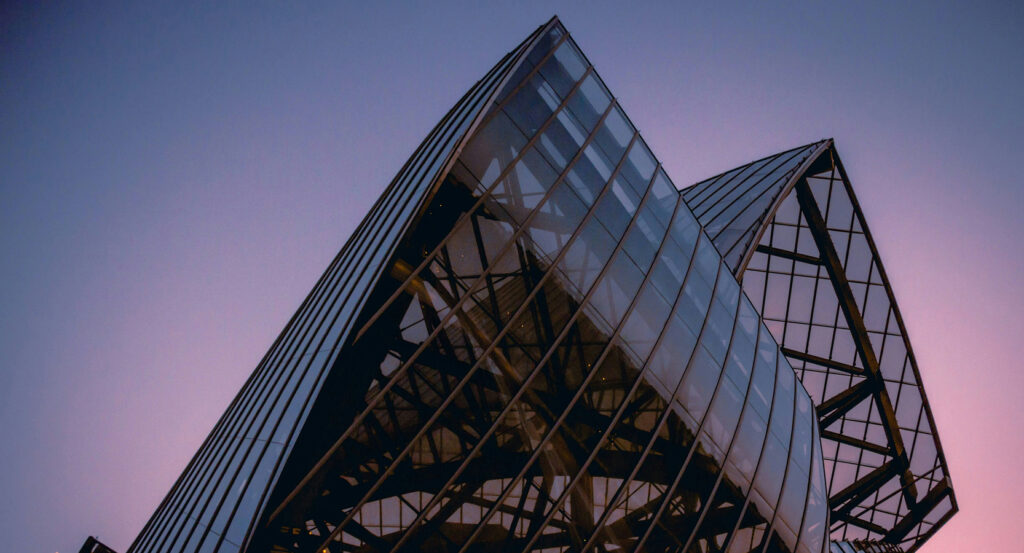
Fondation Louis Vuitton is a soaring contemporary museum where Bois de Boulogne's landscaped character meets Frank Gehry's twelve glass sails, white sculptural volumes and an art institution conceived as architecture in motion.
Set along Avenue du Mahatma Gandhi near Route de la Porte des Sablons and just steps from Jardin d'Acclimatation, the museum occupies the wooded eastern edge of Bois de Boulogne where century-old trees, lawns and winding park paths surround a water basin supporting Gehry's immense glass composition. Twelve curving transparent sails rise above interlocking white volumes nicknamed the iceberg, allowing trees, sky and reflections from the water to remain visible through overlapping layers of glass. Exterior stairways and elevated terraces carry movement upward between the sails, progressively opening views across the tree canopy toward Central Paris and La Défense. Gehry's irregular silhouette changes substantially around the building as individual sails separate, overlap and disappear behind the solid gallery volumes. The result is an unusually theatrical museum approach where water, woodland, glass and changing viewpoints make the building's architecture inseparable from its position inside the Bois de Boulogne.
What defines Fondation Louis Vuitton.
Fondation Louis Vuitton is best known for Frank Gehry's technically ambitious museum commissioned by Bernard Arnault after the two met in 2001 following Arnault's visit to Gehry's Guggenheim Museum Bilbao. Bernard Arnault and Louis Vuitton president Yves Carcelle publicly announced the project in October 2006 with Gehry, Paris mayor Bertrand Delanoë and culture minister Renaud Donnedieu de Vabres. An agreement with the City of Paris that December provided a one-hectare site under a 55-year occupancy arrangement, placing the future institution beside the Jardin d'Acclimatation. Gehry drew inspiration from nineteenth-century glass garden architecture and developed the project through numerous physical models in wood, plastic and aluminum before the final model was scanned into a digital design. Construction began with earthworks and diaphragm walls in March 2008, and the structural work reached completion in 2011 before installation of the exterior shells and glass sails advanced during 2012. Engineering the twelve sails required 3,600 individually formed glass panels curved with millimeter precision, supported through work involving RFR and T/E/S/S. Beneath them, 19,000 unique panels of fiber-reinforced Ductal concrete cover the white iceberg volumes containing the principal interior spaces. SETEC Bâtiments developed structural engineering, STUDIOS Architecture advanced Gehry Partners' architectural conception in Paris, Eiffage Construction Métallique worked on the sail structures and VINCI directed construction. The completed building was received in February 2014 before opening to the public on October 27, establishing a new Paris institution through a commission whose architectural ambition depended directly on advances in digital modeling, glass fabrication, structural engineering and individualized component production.
Artist commissions developed another mechanism for turning Gehry's building into part of the institution's artistic program. Ellsworth Kelly received a commission in 2012 for the future auditorium and conceived Spectrum VIII as the centerpiece of a group of works calibrated to both its visual and acoustic conditions. The installation combines twelve colored elements across the stage curtain, joined by six monochrome Colored Panels distributed through the auditorium. Gehry developed the flexible performance room with dUCKS Scéno and Nagata Acoustics, allowing the auditorium to operate simultaneously as a concert venue and a permanent setting for Kelly's work. Olafur Eliasson created Inside the Horizon for the lower passage adjoining the water, using mirrored columns, yellow light and reflections to extend the architecture into an installation governed by movement through the building. Daniel Buren subsequently transformed the exterior in 2016 with L'Observatoire de la lumière, covering the 3,600 glass panels across Gehry's twelve sails with colored filters interrupted by his alternating white and transparent stripes. Buren's intervention treated the architectural envelope itself as the working surface, changing the appearance of the sails as daylight passed through the filters. These commissions established a sustained relationship between Gehry's architecture and artists working directly with its auditorium, circulation spaces, water and glass envelope.
How Fondation Louis Vuitton fits.
Fondation Louis Vuitton works as the anchor for a daytime exploration through western Paris using three nearby sites that move from a Second Empire experiment in landscaped recreation through an early Modernist house designed around a private art collection into the museum holding the world's largest collection of Claude Monet's work.
Begin at Jardin d'Acclimatation, created across 19 hectares of former marshland as part of Napoleon III's remaking of Paris and opened by the emperor and Empress Eugénie on October 6, 1860. The project drew upon the London parks Napoleon III had encountered during his years in Britain and a later visit with Eugénie, with Jean-Pierre Barillet-Deschamps shaping a landscape of winding paths, lawns and planted watercourses at the edge of Bois de Boulogne. Scientific ambitions initially joined recreation through the acclimatization of animal and plant species, and the grounds developed into a prominent Second Empire social destination. Damage during 1870 and 1871 preceded a shift toward entertainment, and surviving architecture including the Grande Volière and Maison Eugénie preserves physical components of the nineteenth-century garden beside the site Gehry would occupy more than a century later. Continue to Maison La Roche, designed by Le Corbusier and Pierre Jeanneret between 1923 and 1925 for Swiss banker and modern-art collector Raoul La Roche. The commission paired La Roche's house with an adjoining residence for Le Corbusier's brother Albert Jeanneret, yet La Roche's portion received a distinct program dividing private rooms from a gallery for his Cubist and Purist collection. Reinforced concrete enabled Le Corbusier to develop free facade, free plan, horizontal windows, roof garden and pilotis before codifying those principles among his Five Points in 1927. Movement through the gallery became an early architectural promenade, using ramps, changing heights and controlled views to bind the art collection to circulation through the house; La Roche later bequeathed the property to the Fondation Le Corbusier, and the ensemble entered UNESCO's transnational World Heritage inscription devoted to Le Corbusier in 2016. Conclude at Musée Marmottan Monet, whose transformation from Paul Marmottan's Empire collection into a major Impressionist museum accelerated when Michel Monet made it his universal legatee. The museum had opened under the Académie des Beaux-Arts in 1934 and received Impression, soleil levant in 1940, placing the 1872 painting that supplied Impressionism with its name inside the collection. Michel Monet's death in 1966 brought more than one hundred works by his father, including large Water Lilies retained by the family after Claude Monet's death. Existing rooms proved too small for the grand canvases, prompting construction of a dedicated gallery beneath the garden before their presentation in 1970. The progression moves from Napoleon III and Barillet-Deschamps's nineteenth-century landscaped institution through Le Corbusier and Jeanneret's house organized around modern art into Michel Monet's bequest and the purpose-built setting created for his father's late paintings, developing three successive relationships between landscape, architecture and artistic display across western Paris.
Where your story begins.
Foresyte Travel reveals places that feel extraordinary long before you arrive.
Enjoy editorial crafted for luxury travelers.
Foresyte may earn a commission when you book.














































































































