
Why Jardin d'Acclimatation matters.
Jardin d'Acclimatation is an enchanting historic park where Bois de Boulogne's landscaped character meets Second Empire garden design, surviving nineteenth-century structures and more than 160 years of scientific and recreational reinvention.
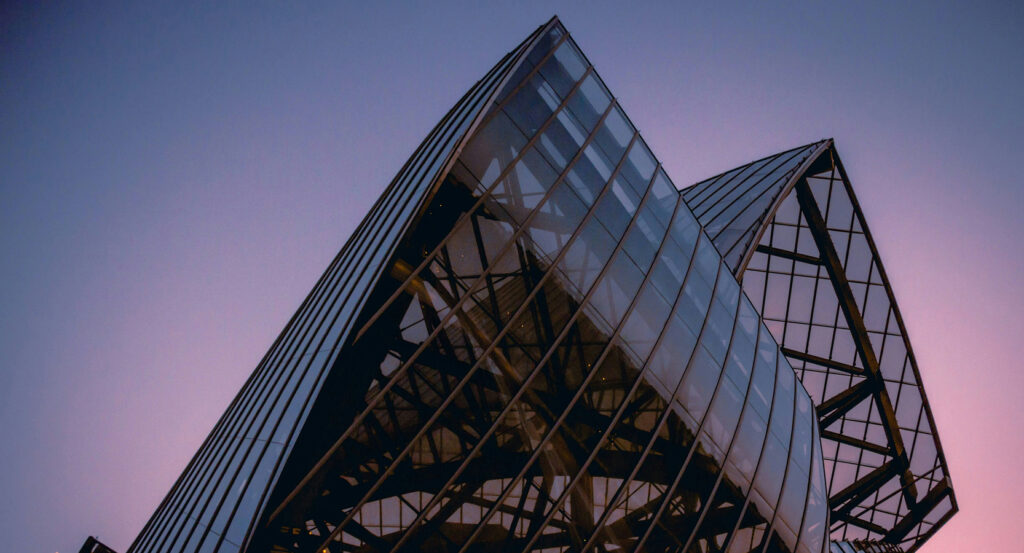
Set along Avenue du Mahatma Gandhi near Boulevard Maurice Barrès and just steps from Fondation Louis Vuitton, the park occupies 18 hectares along the northeastern edge of Bois de Boulogne where winding paths, lawns, mature woodland, ponds and historic structures create a landscaped transition between Neuilly-sur-Seine and the deeper forest. The Grande Volière, Pigeonnier, Grandes Écuries and Kiosque à Musique survive among later attractions, preserving architectural fragments of the nineteenth-century garden inside the present recreational landscape. Waterways and curving paths carry the English-garden principles of the original design through a terrain whose irregular planting conceals successive areas from one another. Frank Gehry's Fondation Louis Vuitton rises along the southern edge behind immense glass sails, introducing a contemporary architectural counterpoint to the garden's older structures and vegetation. The result is a richly layered Parisian park where Second Empire landscape design remains visible beneath generations of zoological, recreational and architectural change.
What defines Jardin d'Acclimatation.
Jardin d'Acclimatation is best known for beginning as Napoleon III's experimental zoological garden, conceived during the reconstruction of Bois de Boulogne as a place where imported animals and plants would be studied, bred and adapted to European conditions. Zoologist Isidore Geoffroy Saint-Hilaire directed the Société impériale zoologique d'acclimatation and persuaded Empress Eugénie to support a permanent public site devoted to that mission. Napoleon III's broader transformation of western Paris supplied the setting, drawing upon the landscaped parks he had encountered during his years in England and his 1855 visit to London with Eugénie. Baron Haussmann supervised development as Jean-Charles Alphand handled engineering, Jean-Pierre Barillet-Deschamps shaped the landscape and Gabriel Davioud designed architectural components. Their team converted 19 hectares of marshy ground known as Les Sablons into an English-inspired garden in fifteen months. Napoleon III and Eugénie inaugurated the Jardin zoologique d'acclimatation on October 6, 1860 before an audience that included Prosper Mérimée, Eugène Viollet-le-Duc and Jacques Offenbach. Thousands of animals entered a scientific program accompanied by lectures, concerts, horticultural displays and specialized facilities, with an aquarium opening in October 1861 as an early centerpiece. The Franco-Prussian War shattered that first decade when the park closed during the Siege of Paris and transferred part of its animal population elsewhere. Carrier pigeons operating from the grounds transported microfilmed communications during the siege, linking an institution founded for zoological experimentation with one of the era's newest communication techniques. Food shortages led to the slaughter of animals including the elephants Castor and Pollux in December 1870, and fighting between Communards and Versailles forces subsequently damaged buildings and planting. Public subsidy, international zoological assistance and gifts including Victor Emmanuel II's elephants Romeo and Juliet supported reopening in 1872, beginning a second period in which scientific ambitions increasingly shared the grounds with mass recreation.
The Jardin's later nineteenth-century history also contains a sustained series of ethnographic exhibitions inseparable from the racial theories and colonial expansion of the period. The first such presentation opened in 1877 with Nubian participants from Sudan, placing human beings before paying Parisian audiences under a pseudo-scientific program that treated physical difference as an object of classification. Jules Chéret produced advertising for the 1877 presentation, and surviving posters preserve the language through which people and animals were marketed within the same zoological institution. Similar events followed with Kali'na and Arawak people, Sámi, Kanak, Fuegian, Kalmyk, Ashanti and Somali groups, among others. The 1887 Ashanti presentation was already identified as the Jardin's fourteenth ethnographic exhibition, demonstrating how rapidly the format had become embedded in its programming. Roland Bonaparte studied and photographed Somali participants during the 1890 exhibition, connecting public performance with the period's anthropological classification practices. Around thirty ethnographic exhibitions took place at the Jardin before the practice ended, and some participants died after exposure to unfamiliar climate and disease. The institution itself now presents this chapter as a compromised period in its history and connects the exhibitions with European colonial expansion and racial hierarchy. That history complicates the Jardin's evolution from a zoological research project into a leisure park, preserving within the same institution the scientific ambitions, imperial assumptions and popular entertainment culture of late nineteenth-century Paris.
How Jardin d'Acclimatation fits.
Jardin d'Acclimatation works as the anchor for a daytime exploration across the western Bois de Boulogne and adjoining Passy using three nearby sites that move from an eighteenth-century royal pleasure garden through a private collection transformed by major artistic bequests into a château connected with royal history, aviation and postwar European cooperation.
Begin at Parc de Bagatelle, created after a wager between Marie-Antoinette and her brother-in-law, the Comte d'Artois, challenged the prince to produce a country retreat within two months. François-Joseph Bélanger prepared the design and more than 900 workers completed the pleasure pavilion in 64 days, with Scottish gardener Thomas Blaikie developing an Anglo-Chinese landscape of winding paths and staged views. Later owners altered the estate before the City of Paris acquired it in 1905 and entrusted Jean-Claude-Nicolas Forestier with its rehabilitation. Forestier converted productive sections into botanical displays and created the celebrated rose garden, which has hosted an international competition since 1907. Continue to Musée Marmottan Monet, whose mansion originated with a property purchased by Jules Marmottan in 1882 before passing the following year to his son Paul. Paul abandoned his administrative career and devoted himself to Consulate and Empire art, eventually leaving the residence and collection to the Académie des beaux-arts; the museum opened on June 21, 1934. Victorine and Eugène Donop de Monchy altered its trajectory through gifts between 1940 and 1947 that brought Impression, soleil levant and ten other Impressionist paintings from the collection of Georges de Bellio. Michel Monet's 1966 bequest added more than one hundred works by his father, including large Nymphéas, creating the world's largest Claude Monet collection and prompting construction of a dedicated gallery beneath the garden. Conclude at Château de la Muette, whose name reaches a royal hunting property converted into a small château for Charles IX 1572 and later rebuilt under Louis XV by Jacques and Ange-Jacques Gabriel. Pilâtre de Rozier and François Laurent d'Arlandes departed from its grounds in November 1783 on the first successful crewed free balloon flight, watched by the royal family and Benjamin Franklin. The old estate disappeared through subdivision, and Henri de Rothschild purchased 22,000 square meters in 1912 for the present residence. His heirs sold it to the Organisation for European Economic Co-operation in 1948; the convention transforming that body into the OECD was signed there on December 14, 1960. The progression moves from Bélanger and Blaikie's royal garden through the Marmottan residence and its unexpected emergence as a major center of Impressionism into a site connecting Bourbon court life, the Montgolfier era and twentieth-century international cooperation, extending the outing through three unusually dense chapters of western Parisian history.
Where your story begins.
Foresyte Travel reveals places that feel extraordinary long before you arrive.
Enjoy editorial crafted for luxury travelers.
Foresyte may earn a commission when you book.














































































































