
Why Fu He Hui matters.
Fu He Hui is a celebrated vegetarian fine-dining restaurant where Yuyuan Road's historic garden residences meet Tony Lu's modern interpretation of Chinese Buddhist culinary traditions, connecting seasonal agricultural ingredients, classical cooking techniques and an internationally recognized approach to plant-based gastronomy.
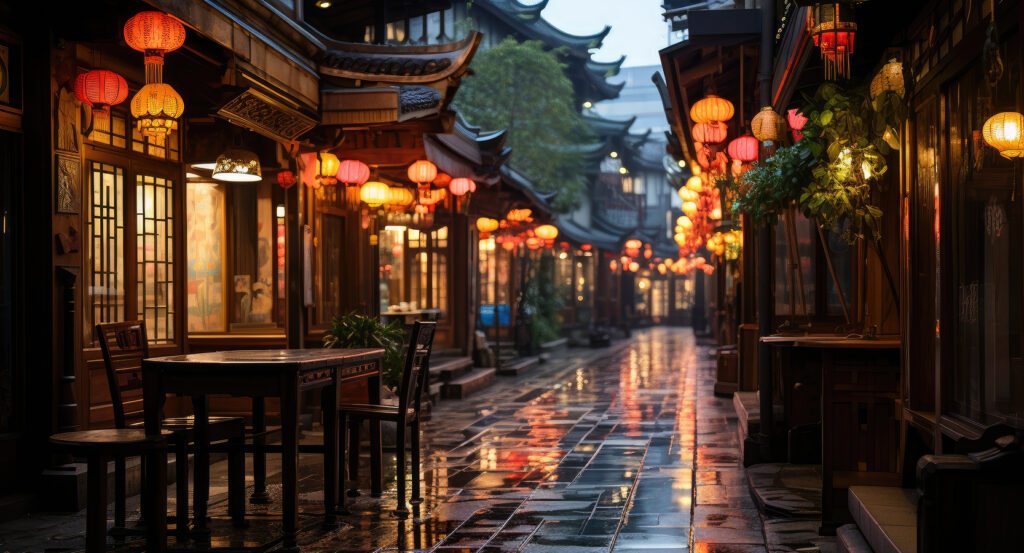
Yuyuan Road extends westward from Jing'an through Changning District, placing the restaurant at No. 1037 near Jiangsu Road amid mature plane trees, historic residential compounds and the surviving garden villas of Shanghai's early twentieth-century expansion. The restaurant occupies a secluded three-story villa whose restrained exterior preserves the domestic scale of the surrounding neighborhood. Stone surfaces, dark timber and natural materials establish an interior influenced by traditional Chinese architecture and Buddhist principles of simplicity. Private dining rooms occupy the building's different levels, with carefully controlled lighting, understated furnishings and limited ornament creating intimate spaces organized around the table. The result is a secluded restaurant whose historic residential architecture and minimalist interior establish a contemplative setting for one of China's most accomplished vegetarian kitchens.
What defines Fu He Hui.
Fu He Hui is best known for Shanghai-born chef Tony Lu and restaurateur Fang Yuan transforming the culinary heritage of their established Fu restaurant collection into an ambitious vegetarian fine-dining institution. The enterprise originated in 1992 when Fang Yuan's mother established Fu Yuan, beginning a family restaurant business associated with Shanghai's historic garden villas and traditional household cooking. Fang entered the business in 2005, applying his background in design to the renovation of an existing property that became Fu 1088. The restaurant developed a distinctive approach to Shanghainese hospitality through private dining rooms, carefully preserved residential architecture and dishes connected to the city's domestic culinary traditions. Subsequent expansion introduced Fu 1039 and Fu 1015, creating a collection of restaurants occupying historic residences along Yuyuan Road and nearby Zhenning Road. Tony Lu became central to the group's culinary development, bringing extensive knowledge of traditional Shanghainese cooking and a willingness to incorporate techniques from other Chinese regional cuisines. His work at Fu 1015 attracted international attention when the restaurant entered Asia's 50 Best Restaurants at No. 40 in 2013. Its advancement to No. 26 in 2014 established Lu among the Chinese chefs receiving prominent recognition from the regional restaurant industry. The success of these restaurants created the foundation for a more ambitious investigation into Chinese vegetarian gastronomy. Fang began developing Fu He Hui in 2013, entering a specialist dining category with deep religious and historical roots but limited representation among Shanghai's internationally recognized restaurants. The project extended the family business into a culinary tradition associated with Buddhist monasteries, seasonal agricultural ingredients and centuries of sophisticated vegetable preparation. Lu approached the concept through his established knowledge of classical Chinese cooking, adapting traditional methods to a menu devoted entirely to plant-based ingredients. The restaurant opened in 2014, joining the Fu collection as its vegetarian flagship and introducing a distinct culinary direction within the group. Its Chinese name, 福和慧, combines characters associated with good fortune, harmony and wisdom, expressing the cultural principles underlying the project. The kitchen drew upon preparations developed during the Ming and Qing dynasties, connecting historical Chinese culinary knowledge with contemporary presentation and carefully sourced regional produce. Lu also maintained a professional association with Yong Yi Ting at Mandarin Oriental Pudong, Shanghai, extending his influence into the hotel's Jiangnan culinary program. International recognition followed when Fu He Hui entered Asia's 50 Best Restaurants in 2018 at No. 30, placing a specialist vegetarian restaurant among the region's prominent dining institutions. MICHELIN recognition began with the inaugural Shanghai guide in 2017, establishing the restaurant within the city's first generation of internationally evaluated fine-dining establishments. Its standing developed further through the Black Pearl Restaurant Guide, which awarded Fu He Hui three diamonds, among the domestic Chinese restaurant industry's highest distinctions. MICHELIN promoted the restaurant to two stars in its 2025 Shanghai selection, recognizing the technical refinement of Lu's cooking and his sustained engagement with historical Chinese culinary methods. The promotion placed Fu He Hui among nine two-star restaurants in Shanghai that year, representing a significant achievement for an entirely vegetarian kitchen. Asia's 50 Best Restaurants subsequently ranked the establishment No. 15 in 2025, extending its recognition across both international evaluation systems. The restaurant advanced to No. 11 in the 2026 ranking, placing it among the highest-ranked vegetarian dining institutions in Asia. Fang's broader enterprise also received recognition through its other Fu restaurants, establishing a rare collection of independently operated Shanghainese dining establishments with MICHELIN distinctions. Fu He Hui occupies the most specialized position within that family enterprise, demonstrating how traditional Chinese vegetable cookery developed into an internationally competitive fine-dining discipline through the combined ambitions of an established Shanghai chef and a second-generation restaurateur.
Tony Lu's vegetarian cooking begins with the natural character of individual plants, using seasonal selection and classical Chinese techniques to develop substantial flavor from vegetables, fungi, grains and flowers. His approach draws upon agricultural regions across China, treating the differences between Yunnan mushrooms, Guangdong root vegetables and Jiangxi bamboo as the foundation for the tasting menu's experience. Seasonal changes govern the selection of ingredients, with forty percent of the menu revised between successive periods to accommodate new produce and preparations. The kitchen organizes its eleven-course format a principal vegetable, fruit or flower in each course, allowing the character of that ingredient to determine the surrounding cooking techniques. This structure places considerable importance on extraction, fermentation, steaming and controlled heat, methods that reveal sweetness, bitterness and savory depth already present within the plant. Mushrooms provide a particularly effective foundation because their natural glutamates develop concentrated umami during careful cooking. Porcini served inside a glass vessel filled with smoke from a grapevine introduces another dimension, allowing the aromatic character of the smoke to surround the mushroom before the first bite. The preparation links the fungus's earthy flavor with the fragrance of heated wood, creating a progression from aroma to texture and concentrated savoriness. Lu extends this attention to vegetable structure through ingredients such as tofu skin, whose layered texture absorbs seasoning and develops a substantial presence within the meal. Cordyceps flowers, black fungus, daylily buds and Mongolian leek contribute different forms of tenderness, elasticity and aromatic intensity, allowing the principal ingredient to develop through contrasting botanical components. The kitchen also incorporates traditional Chinese medicinal and culinary ingredients into preparations whose textures require careful management. Bamboo pith contributes a delicate porous structure capable of absorbing broth, and tremella introduces a softer gelatinous quality. Lotus seeds, coix seeds and yam establish more substantial textures, creating a balance between tender vegetables and the concentrated flavors developed through cooking. Chinese tea becomes a central component of the meal through pairings selected to accompany the changing characteristics of the ingredients. Different infusions introduce floral, roasted, vegetal and mineral qualities, supporting the progression from delicate preparations toward deeper savory flavors. Tea also connects the meal with Buddhist cultural traditions, in which preparation and consumption carry associations with contemplation and disciplined attention. The dessert sequence preserves the kitchen's botanical approach through fruit, flowers and fungi. A preparation resembling a flowerpot combines roselle and apple ice cream beneath cocoa powder, with a dehydrated enoki mushroom flower introducing an unexpected structural element. The arrangement develops the same interest in natural forms that governs the savory courses, carrying the relationship between plants, texture and careful presentation into the final stage of the meal. Fu He Hui's culinary distinction emerges from this sustained investigation of Chinese agricultural diversity, historical cooking methods and the changing physical properties of plants, establishing a sophisticated tasting-menu progression through the ingredients themselves.
How Fu He Hui fits.
Fu He Hui works as the concluding destination for a western Shanghai itinerary connecting the religious heritage of Jing'an, the entertainment architecture of the Republican era and the residential streets that preserve the district's early twentieth-century character.
Begin at Jing'an Temple, the Buddhist institution occupying the intersection of West Nanjing Road and Huashan Road. The temple traces its origins to the Three Kingdoms period, when a Buddhist establishment was founded during the reign of Sun Quan in the third century. Its original location lay near the Wusong River, and the institution subsequently moved to its established position during the Southern Song dynasty in 1216. The relocation connected the temple with the expanding settlement patterns of the Shanghai region, establishing a religious institution that survived successive periods of political and urban change. Its surviving architectural complex incorporates substantial halls, elaborate rooflines and gilded Buddhist decoration, preserving the ceremonial character of a traditional Chinese monastery within one of the city's principal commercial districts. The temple's modern restoration followed extensive damage and changing institutional uses during the twentieth century, with reconstruction returning religious functions to the site. Continue to Paramount Ballroom, the historic entertainment building at the intersection of Yuyuan Road and Wanhangdu Road. The ballroom opened in 1933 during Shanghai's extraordinary expansion as an international entertainment center, introducing an Art Deco venue associated with jazz orchestras, fashionable dancing and the city's cosmopolitan social elite. Chinese architect Yang Xiliu designed the building, incorporating modern materials and architectural forms associated with the period's international commercial culture. Its celebrated sprung dance floor and sophisticated interior established a prominent destination for Shanghai's nightlife during the Republican era. The building became associated with prominent performers, wealthy patrons and the changing relationship between Chinese social customs and Western popular entertainment. Paramount underwent substantial restoration during the twenty-first century, preserving its architectural character and returning public attention to its historical role in Shanghai's entertainment culture. Conclude at Yuyuan Road Historic District, the residential corridor extending westward through Changning toward Jiangsu Road. The street developed during the early twentieth century as Shanghai expanded beyond its original commercial center, attracting affluent residents, intellectuals and prominent political figures to newly constructed garden houses and residential compounds. Plane trees established a distinctive canopy above the roadway, and architectural development incorporated European-influenced villas alongside traditional Chinese residential forms. The district became associated with writers, educators, artists and political figures whose residences contributed to the cultural history of modern Shanghai. Surviving historic properties preserve the relationship between private domestic architecture and the city's intellectual development during the Republican period. Neighborhood conservation projects have subsequently restored façades, pedestrian spaces and selected historic interiors, supporting the continued use of the street as a residential and cultural corridor. The progression moves from the Buddhist institution preserving Shanghai's religious heritage through the Art Deco ballroom associated with its interwar entertainment culture and culminates along the historic residential street whose garden villas established the architectural setting for Fu He Hui.
Where your story begins.
Foresyte Travel reveals places that feel extraordinary long before you arrive.
Enjoy editorial crafted for luxury travelers.
Foresyte may earn a commission when you book.

















































































































