
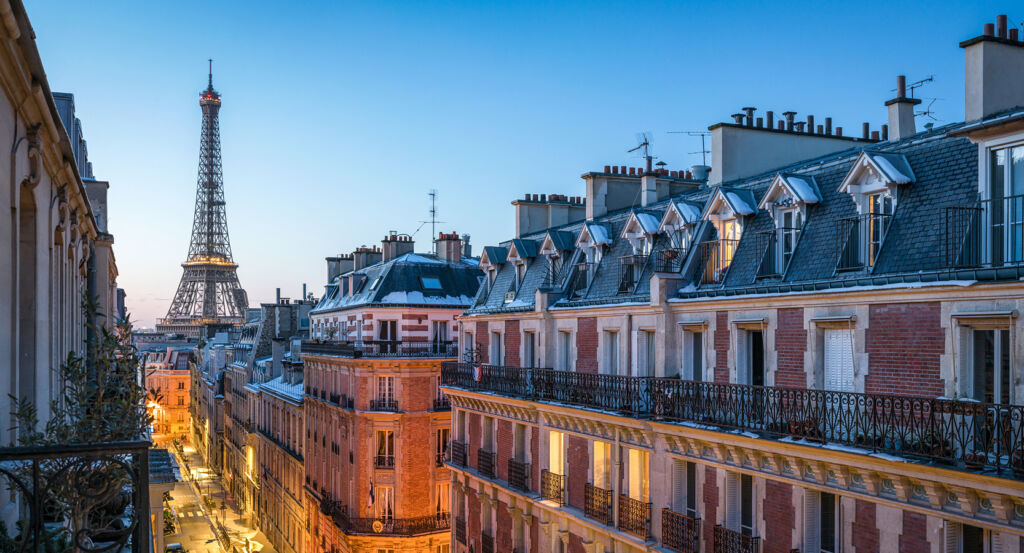
Why Gaillon matters.
Gaillon is an elegant enclave where the grands boulevards meet the Opéra district through disciplined nineteenth-century avenues, older streets inherited from the city's northern edge and an exceptional concentration of theatrical and commercial architecture.
Positioned between Place Vendôme, Vivienne, and Chaussée-d'Antin, the neighborhood occupies a Central Right Bank pocket where Avenue de l'Opéra, Boulevard des Capucines and Rue du Quatre-Septembre impose broad metropolitan axes across a finer network of streets descending toward the Palais-Royal. Avenue de l'Opéra establishes the dominant physical scale through an unusually long, uninterrupted perspective, its uniform stone facades and broad roadway carrying the eye northwest toward Charles Garnier's opera house. Rue Gaillon and Rue de la Michodière shift the encounter into shorter corridors where restaurants, theaters and residential facades recover the tighter proportions of the quarter before the great avenues arrived. Rue de la Paix adds a distinct spatial mechanism through the straight ceremonial axis running from Place Vendôme toward the boulevards, binding the district to a sequence of architecture whose disciplined elevations amplify the formality of Central Paris. The grands boulevards then open the northern edge into a wider band of theaters, cafés and commercial buildings created on ground once occupied by the city's fortifications. The result is a neighborhood whose compressed streets and metropolitan avenues expose several stages of Parisian expansion at once, preparing a history that begins when Gaillon stood close to the northern boundary of the early modern city.
What defines Gaillon.
Gaillon is best known for occupying territory once organized around the Porte Gaillon, a northern gateway incorporated into the fortifications begun under Charles IX and expanded through the seventeenth century as Paris pushed beyond its medieval limits. Rue Gaillon preserves the name of an hôtel that stood in the area, and the street itself existed by the late fifteenth century under the name Ruelle Michaut-Riegnaut before acquiring successive designations as surrounding property changed hands. The fortified boundary placed this territory at the meeting point between the built city and land extending north toward the future grands boulevards. Louis XIV ordered the obsolete ramparts replaced with planted promenades after military expansion rendered the defenses unnecessary, initiating the conversion of a defensive perimeter into the boulevard system that reoriented northern Central Paris. Porte Gaillon disappeared 1700, removing the physical gateway but leaving the inherited street network connected to its former position. Development intensified as aristocratic residences and speculative construction spread through the surrounding quarter during the eighteenth century. Rue de la Michodière opened in 1778 across property associated with the former Hôtel de Lorge, adding another street close to the vanished gate. By the eve of the Revolution, Gaillon had moved from a peripheral zone beside fortifications into a dense extension of Central Paris, establishing the compact street structure that later interventions would cut across.
Imperial and nineteenth-century reconstruction supplied a second mechanism for giving Gaillon its present metropolitan scale. The former Couvent des Capucines had occupied ground north of Place Vendôme after the religious community moved there in 1688, with François d'Orbay designing its new complex. Revolutionary suppression emptied the convent, and demolition in 1806 cleared the route for Rue Napoléon, renamed Rue de la Paix after the Bourbon Restoration. That straight axis linked Place Vendôme with the boulevards and established a powerful north-south route through the western edge of the quarter. A more extensive transformation followed under Napoleon III as the creation of a direct avenue between the Louvre and the new opera house required major demolition through the dense Right Bank. Avenue de l'Opéra emerged from that campaign with a regulated building line and an unobstructed view toward the theater, its unusually disciplined perspective changing both movement and architectural scale across Gaillon. Rue du Quatre-Septembre supplied another broad east-west artery during the same period, binding the Opéra district to the commercial territory around the Bourse. These interventions placed the surviving older streets inside a new metropolitan grid, producing the sharp alternation between intimate corridors and ceremonial avenues that distinguishes Gaillon.
How Gaillon fits.
Gaillon works as the anchor for an afternoon connecting an Art Deco theater shaped by major figures of boulevard comedy, a lyric institution whose successive halls carried French musical theater across three centuries and a former cardinal's palace transformed into the historic home of the national library.
Begin at Théâtre de la Michodière, where architect Auguste Bluysen and decorator Jacques-Émile Ruhlmann created a new theater inaugurated on November 16, 1925 with Jacques Natanson's L'Infidèle éperdue. Victor Boucher assumed direction in 1927 and established Édouard Bourdet as a central house playwright, before Yvonne Printemps and Pierre Fresnay became decisive figures in the theater from 1937 and later brought writers including Jean Anouilh and André Roussin into its repertory. François Périer joined their leadership in 1950, presiding over runs that included 1,200 performances of Bobosse and 1,500 of Gog et Magog, extending the Michodière's association with Parisian boulevard theater across the postwar decades. Continue to Opéra-Comique, whose troupe emerged from Paris's fair theaters in 1714 and gained royal status under Louis XV in 1762 before moving into the first Salle Favart in 1783, a theater designed by Jean-François Heurtier on ground supplied by the duc de Choiseul. Fire destroyed successive halls in 1838 and 1887, and the state selected Louis Bernier from 88 competitors to design the third Salle Favart, inaugurated in 1898 with a puddled-iron structure, electric lighting and decoration involving Jean-Joseph Benjamin-Constant, Henri Gervex, Albert Maignan and Christofle; the institution's stages introduced works including Bizet's Carmen, Massenet's Manon, Delibes's Lakmé and Debussy's Pelléas et Mélisande. Conclude at BnF Richelieu, where the seventeenth-century Palais Mazarin became inseparable from the royal collections after the Bibliothèque du Roi entered the complex in 1721. Robert de Cotte adapted the palace during the 1730s, Henri Labrouste later created the great reading room for printed works, Jean-Louis Pascal continued expansion toward the Salle Ovale, and Michel Roux-Spitz added another twentieth-century architectural layer; the resulting complex joins the former Hôtel Tubeuf and Galerie Mazarin to reading rooms and collections accumulated through centuries of French scholarship. The progression moves from Bluysen and Ruhlmann shaping interwar boulevard theater through successive generations of composers, architects and artists building the Opéra-Comique into a national musical institution into Mazarin's palace becoming a centuries-long architectural home for the royal and national collections, concentrating performance, design and scholarship around Gaillon.
Where your story begins.
Foresyte Travel reveals places that feel extraordinary long before you arrive.
Experience premium editorial crafted for luxury travelers.
Foresyte Travel may earn a commission when you book through the link on this page.














































































































