
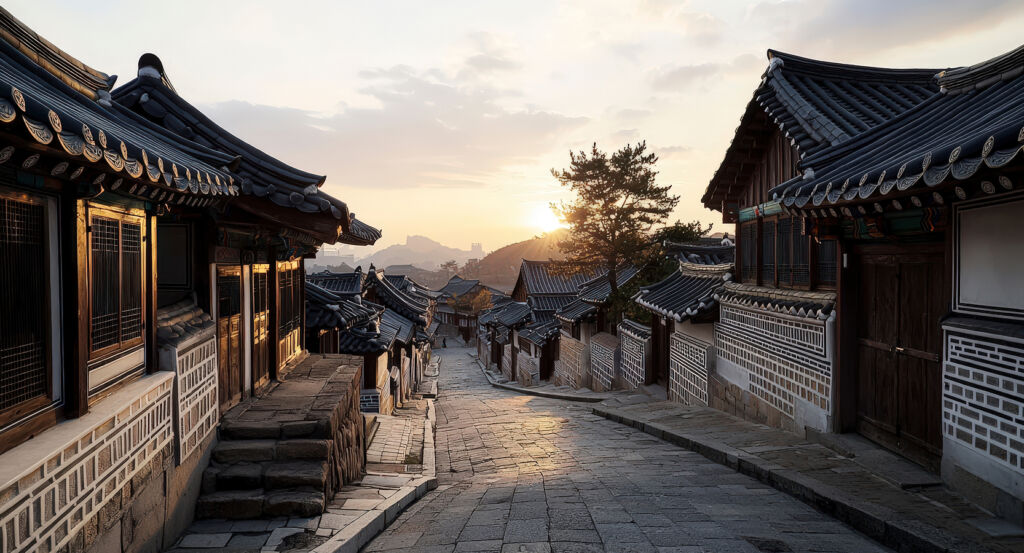
Why you should experience Gangdong-gu in Seoul, South Korea.
Gangdong-gu is a district of heritage and growth, where prehistoric history, riverside landscapes, and residential Seoul converge along the eastern edge of the capital.
Broad boulevards, residential communities, ecological parks, cultural facilities, archaeological sites, commercial centers, and Han River landscapes create a district shaped by both deep history and modern expansion. Long before Seoul became a global metropolis, people settled this area because of its access to fertile land and river resources. As the city expanded eastward during the twentieth century, Gangdong-gu developed into a major residential district while preserving important historical and natural assets. Families, educators, planners, entrepreneurs, and residents helped shape a neighborhood defined by stability, livability, and community. Today, the district offers a quieter perspective on Seoul, balancing urban convenience with access to parks, heritage sites, and open spaces. Its character is rooted in continuity, connecting some of Korea's earliest inhabitants with one of the country's most modern cities. To the west, Gangnam-gu's celebrated business centers, luxury corridors, and cultural landmarks extend naturally from Gangdong-gu across one of Seoul's most important development axes, highlighting the contrast between Seoul's residential and commercial landscapes.
What you should know about Gangdong-gu.
Gangdong-gu is best known for being home to the Amsa-dong Prehistoric Settlement Site, the largest Neolithic archaeological site discovered in Korea.
Dating back 6,000 years, the site preserves evidence of one of the earliest known settled communities on the Korean Peninsula. Archaeologists uncovered pit dwellings, pottery, tools, and other artifacts that provided unprecedented insight into prehistoric Korean life. The discovery fundamentally expanded understanding of early settlement patterns, agriculture, and social organization in ancient Korea. Today, the site remains one of the nation's most important archaeological landmarks and serves as a direct link to Korea's distant past. Few districts possess a historical resource that reaches so far back into the origins of Korean civilization.
How to fold Gangdong-gu into your trip.
Gangdong-gu is best experienced through the landmarks that reveal its unique blend of ancient history, green space, and modern community life.
Begin at Amsa-dong Prehistoric Settlement Site, where the district's defining connection to Korea's earliest inhabitants immediately comes into focus. Continue toward Gildong Ecological Park, whose preserved natural landscapes reveal the environmental character that shaped the area for generations. From there, make your way to Hangang Citizen's Park Gwangnaru, where riverside pathways, recreational facilities, and expansive views provide a broader perspective on the quality of life that continues to define Gangdong-gu today. Along the route, you'll encounter archaeological treasures, ecological preserves, community parks, cultural facilities, riverside landscapes, public gathering spaces, and neighborhood destinations that reveal the district's distinctive character. The progression moves naturally from prehistoric settlement to ecological sanctuary to waterfront landmark, illustrating the forces that continue to shape eastern Seoul.
Where your story begins.
Foresyte Travel reveals places that feel extraordinary long before you arrive.
Experience premium editorial crafted for luxury travelers.

















































































































