
Why Golden Gai matters.
Golden Gai is an intimate nightlife enclave where Kabukicho's after-dark character meets postwar Tokyo, literary bar culture and a dense labyrinth of tiny drinking rooms preserved at an almost domestic scale.
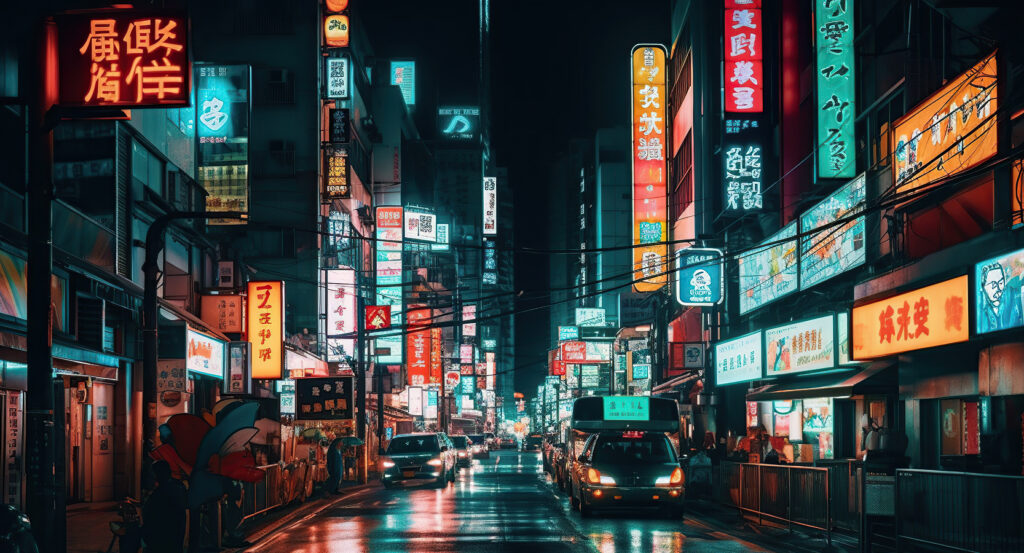
Set along the eastern edge of Kabukicho near Yasukuni-dori and just steps from Hanazono Shrine, the district compresses more than 280 bars and eateries into 6,600 square meters of low wooden row houses divided by six narrow east-west lanes and a crossing north-south passage. Most establishments occupy spaces of only 10 to 15 square meters, with counters accommodating a handful of people behind doors that reveal almost nothing about the room beyond them. Exterior staircases climb above alley level, signs overlap beneath cables and awnings, and upper-storey windows press close enough across the lanes to give the district an enclosure almost absent from contemporary Central Tokyo. Darkness intensifies that compression as illuminated signboards, doorway light and conversations spilling from tiny rooms turn several compact blocks into a sequence of distinct micro-worlds, many shaped around music, film, literature or the personality of a particular proprietor. The result is a nightlife district whose extraordinary power comes from proximity, with hundreds of individually authored rooms occupying a surviving urban scale that makes movement between one counter and the next feel inseparable from Golden Gai itself.
What defines Golden Gai.
Golden Gai is best known for transforming a postwar market settlement into one of Tokyo's most consequential gathering places for writers, editors, filmmakers, actors and underground artists. Its physical origins trace to the vast informal markets that emerged around Shinjuku Station after the 1945 destruction of the district, including the Wada-gumi market between the station's east and south exits. Occupation authorities ordered street stalls removed in 1949, and merchants displaced through the subsequent war-damage land readjustment moved into newly constructed nagaya on ground that developed into Golden Gai. The settlement entered another phase as an unlicensed prostitution district, with drinking establishments downstairs and private rooms above across a zone police maps marked in blue. Enforcement of the Anti-Prostitution Act in 1958 eliminated that economy and pushed the tiny premises toward bars and pubs. Literary bars multiplied during the politically charged 1960s and early 1970s, bringing journalists and editors into the same confined rooms as novelists, theater practitioners and filmmakers connected with the rise of Art Theatre Guild and Shinjuku's underground stage culture. National attention intensified in 1976 when Golden Gai regular Kenji Nakagami received the 74th Akutagawa Prize and fellow regular Ryuzo Saki received the 74th Naoki Prize, associating the alleys with two of Japan's most prestigious literary honors in the same award cycle. Golden Gai emerged from that sequence as a cultural institution produced through the conversion of postwar commercial structures themselves, with the minuscule rooms inherited from market-era land division becoming the physical setting for decades of artistic exchange.
The asset-price boom of the 1980s threatened the physical survival of this culture when soaring Shinjuku land values brought intense pressure to consolidate Golden Gai's fragmented properties for redevelopment. Bar owners responded by forming the Association to Protect the Shinjuku Hanazono Golden Gai, creating an organized defense of a district whose small parcels and independent operators had previously resisted centralized control. Rising fears of arson during 1986 pushed proprietors toward collective action, with members guarding the neighborhood, consulting lawyers and raising campaign funds through T-shirts designed by cultural supporters. A year-end mochi-pounding festival publicly asserted the continued presence of the community amid the dispute. Economic collapse subsequently removed much of the speculative pressure, yet Golden Gai entered the 1990s with aging proprietors, empty premises and infrastructure requiring renewal. Changes to Japan's land and building lease system 2000 helped older owners rent premises to a new generation without relinquishing the underlying property, accelerating an influx of younger operators and new concepts. Fire again exposed the vulnerability of the tightly packed wooden district on April 12, 2016, damaging several buildings and prompting closer cooperation between local associations and Shinjuku City. The resulting preservation effort has treated the survival of Golden Gai as inseparable from both its physical fabric and its decentralized culture of independent bars, allowing postwar row houses to continue accommodating successive generations of proprietors without erasing the urban conditions that produced them.
How Golden Gai fits.
Golden Gai works as the anchor for a Kabukicho route through three nearby sites that deepen Shinjuku's relationship with popular performance, postwar entertainment and the preservation of local history before the alleys reach their fullest intensity after dark.
Begin at Hanazono Shrine, Shinjuku's historic guardian shrine and a religious institution whose connection with performance predates the modern entertainment district surrounding it. The shrine was already established before the Edo period and moved to its present vicinity during the Kan'ei era, later gaining worshippers as the Naito Shinjuku post town developed nearby. Entertainment became part of its institutional survival when theatrical performances were staged to finance rebuilding after fires, establishing a relationship with performers that remains visible through Geino Asama Shrine and the names of entertainers inscribed around the precinct. Its November Tori-no-Ichi carries another Edo inheritance into contemporary Shinjuku through the sale of decorated kumade rakes associated with commercial prosperity. The shrine creates a particularly strong opening to Golden Gai since the transition between sacred precinct and postwar alleys occurs across only a narrow urban seam, revealing two radically different forms of Shinjuku culture occupying adjacent ground. Continue to Shinjuku Suehirotei, whose lineage reaches 1897 and whose present building dates to the immediate postwar reconstruction of 1946. It remains one of Tokyo's four principal yose theaters and the only one housed in a wooden building, preserving the intimate architectural conditions of rakugo performance inside a district transformed by department stores, rail infrastructure and high-rise development. Rakugo forms the core program alongside manzai, magic and acrobatics, continuing the yose tradition of assembling several popular performance forms under one roof. Broad-stroked yose-moji calligraphy covers exterior signs and lanterns, with performer names changing according to the theater's rotating bills and turning the facade into a working extension of the stage. Suehirotei provides the route's critical middle chapter: its survival demonstrates how small-scale entertainment architecture persisted through postwar Shinjuku before Golden Gai's bars became gathering rooms for another generation of performers, writers and cultural figures. Conclude at Shinjuku Historical Museum, where the neighborhood's compressed nightlife geography expands into the longer history of the ward that produced it. The permanent exhibition follows Shinjuku through archaeological settlement, the Edo-period Naito Shinjuku post station and the metropolitan transformations that accompanied railway growth and twentieth-century urbanization, placing the entertainment district within centuries of movement through Tokyo's western gateway. Local artifacts, maps and visual works preserve physical evidence of places repeatedly altered by fire, war and redevelopment, and the museum separately examines literary figures associated with Shinjuku, giving institutional form to a cultural history that Golden Gai preserved through bars and personal networks. Seeing those layers before returning toward Kabukicho makes Golden Gai legible as one surviving fragment of a city repeatedly rebuilt around it. The progression moves from Hanazono Shrine's long relationship with performers through Suehirotei's surviving yose culture into Shinjuku Historical Museum's preservation of the district's wider past, building a historical structure for the postwar alleys and cultural exchange that define Golden Gai after nightfall.
Where your story begins.
Foresyte Travel reveals places that feel extraordinary long before you arrive.
Enjoy editorial crafted for luxury travelers.
Foresyte may earn a commission when you book.

















































































































