
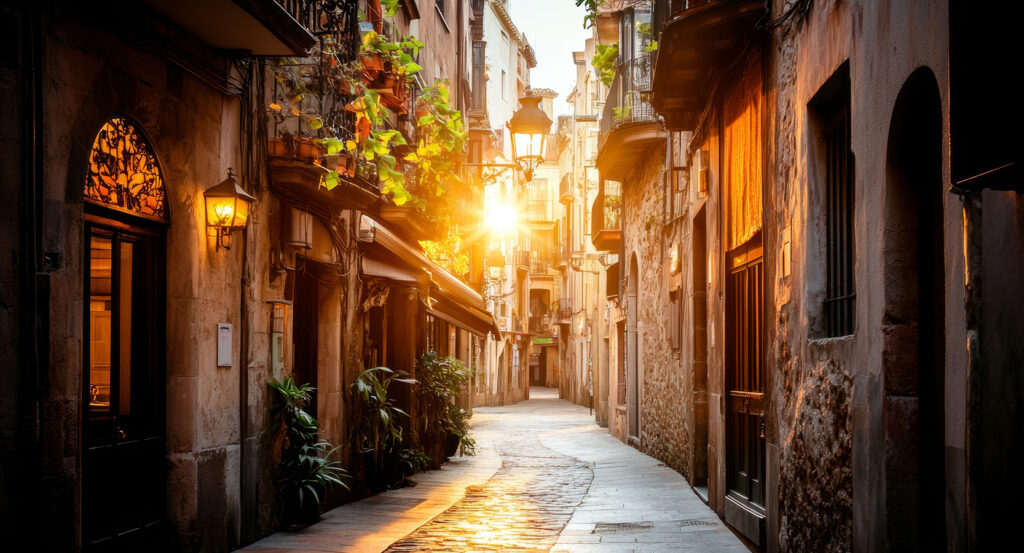
Why you should experience Roman Walls of Barcelona in Barcelona, Spain.
Roman Walls of Barcelona are the stone skeleton of the city's origin, a living reminder that beneath the Gothic spires and Catalan rhythm lies an ancient heartbeat.
Built nearly two thousand years ago to defend the Roman colony of Barcino, these formidable walls still snake quietly through the labyrinthine streets of the Gothic Quarter. Their weathered stones rise between medieval and modern facades, a seamless blend of past and present. Standing before the towers at Plaça Nova, where the twin semicircular bastions frame the entrance to the old city, you can imagine Roman soldiers keeping watch, the clang of armor echoing down the same narrow lanes that now buzz with laughter and espresso. The scale may be modest, but the sensation is profound, this is where Barcelona began, a city born from empire and endurance.
What you should know about Roman Walls of Barcelona.
Roman Walls of Barcelona were originally constructed in the late 1st century BCE, when the colony of Barcino was founded under Emperor Augustus.
What remains today is the result of a massive reinforcement in the 4th century CE, when the walls were expanded to twice their original height and strengthened with seventy-six defensive towers. Beneath the modern city, the Museu d'Història de Barcelona preserves extensive sections of these fortifications, allowing visitors to walk along ancient corridors that once braced the outer limits of the Roman settlement. The stones themselves are a mosaic of history, some taken from older Iberian structures, others inscribed with faint Roman symbols. Over the centuries, homes and palaces were built directly into the old wall, including the medieval bishop's palace, which still bears its curve. Even the Gothic Cathedral's apse was constructed atop Roman foundations. Few realize that every corner of the Gothic Quarter rests upon the geometry of Barcino, its streets still trace the perfect Roman grid that defined the city two millennia ago.
How to fold Roman Walls of Barcelona into your trip.
Exploring Roman Walls of Barcelona is a subtle adventure, less about performance, more about discovery.
Begin at Plaça Nova, just outside the Cathedral, where the most visible remains stand tall beside fragments of an ancient aqueduct. From there, wander down Carrer del Bisbe and Carrer de la Tapineria, watching how the old stone peeks out between layers of Gothic and Baroque architecture. Visit the Museu d'Història de Barcelona to descend beneath the streets and walk through the Roman ruins themselves, workshops, streets, and wine presses perfectly preserved in cool, echoing tunnels. Pause at Plaça Ramon Berenguer el Gran, where a majestic stretch of the wall stands illuminated against the equestrian statue of the Count of Barcelona. Come at sunset, when the golden light makes the ancient stones glow as if alive again. The Roman City Walls are not just ruins, they're the quiet structure holding the city together, proof that every era of Barcelona still leans on the strength of its first foundation.
Where your story begins.
Foresyte Travel reveals places that feel extraordinary long before you arrive.
Experience premium editorial crafted for luxury travelers.














































































































