
Why Great Mausoleum matters.
Great Mausoleum is an expansive memorial complex where Glendale's Forest Lawn memorial park meets terraced architecture, sculpture-filled interiors and an artistic program conceived on the scale of a major cultural institution.
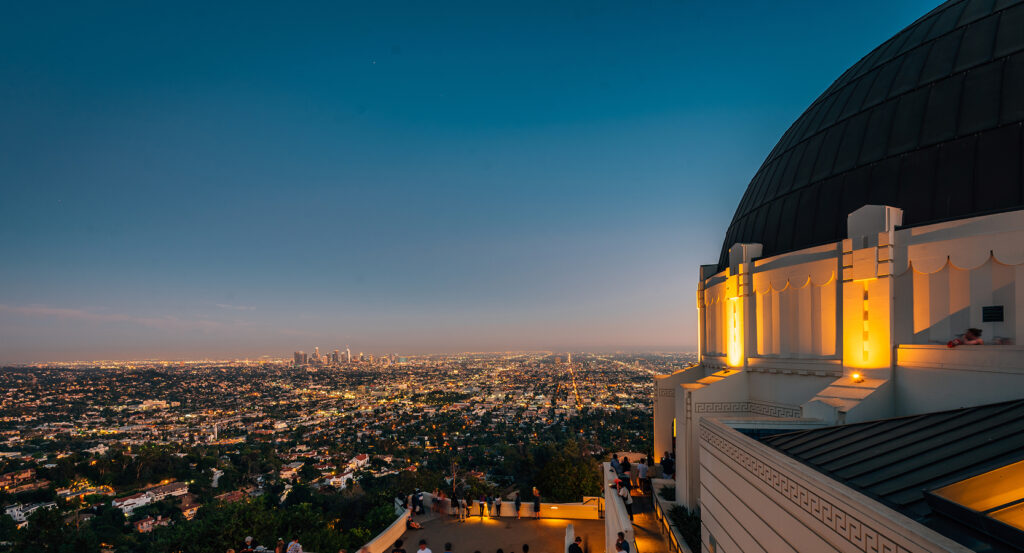
Set within Forest Lawn Memorial Park on the hills above Glendale near the park's central museum district and just steps from the Court of David, the mausoleum occupies a commanding position within a landscape of lawns, memorial architecture and statuary overlooking the Los Angeles basin. Eleven terraces now compose the immense building, extending its interior through interconnected courts, galleries, sanctuaries and columbaria developed across successive construction campaigns. Long interior corridors shift between intimate burial chambers and tall ceremonial spaces, with sculpture and architectural ornament integrated directly into the funerary setting. Exterior massing follows the hillside through accumulated wings and elevations, giving the complex a scale far beyond the modest structure envisioned during its earliest planning. The result is an unusually extensive memorial building whose terraced form, interconnected interiors, sculptural program and hillside scale place burial architecture at the center of Forest Lawn's physical character.
What defines Great Mausoleum.
Great Mausoleum is best known for translating Forest Lawn founder Hubert Eaton's ambitious conception of memorial architecture into a building that expanded for decades after construction began in 1917. Architect T. Paterson Ross developed the original scheme, and only one level had been completed when Forest Lawn dedicated the mausoleum on May 2, 1920. Early 1923 renderings envisioned four terraces beneath a rooftop garden, yet Eaton retained substantial creative control as the project changed dramatically during the middle of the decade. Frederick A. Hanson later became another important architectural figure at Forest Lawn and contributed to the Great Mausoleum during a career devoted extensively to the organization's buildings. Memorial Terrace arrived during the late 1920s, followed by the Memorial Court of Honor in 1931, extending the original mausoleum into an increasingly elaborate artistic complex. Construction continued through later phases into the 1970s, giving a project inaugurated in the early twentieth century a building history spanning more than half a century. The completed complex contains more than 100 stained-glass windows and dozens of sculptures, demonstrating how Eaton's initial funerary commission grew into one of Forest Lawn's principal repositories for art.
Hubert Eaton gave that artistic ambition its most concentrated form in the Memorial Court of Honor after traveling through Italy in June 1924 and seeing Leonardo da Vinci's deteriorated The Last Supper in Milan. A visit to Assisi exposed Eaton to Italian stained glass and led him to Rosa Moretti, whom he commissioned to recreate Leonardo's composition in glass for Forest Lawn. Moretti spent nearly seven years on the undertaking, brushing individual pieces with specially mixed pigments and repeatedly firing them in a kiln to fuse the painted surfaces. Technical failures demanded repeated fabrication of individual sections, with the figure of Judas breaking five times during production. The completed composition measures 30 feet long and 15 feet high, requiring substantial structural skill to support its own weight in addition to the precision demanded by its painted glass. Forest Lawn placed the work within the Memorial Court of Honor, where the surrounding artistic program assembled reproductions of major Michelangelo sculptures into the same ceremonial interior. A separate series on Dahlia Terrace deepened the glass program in another direction: Western Decorative Glass of Oakland fabricated the Poet's Windows installed in 1926, drawing subjects from works including The Village Blacksmith, Wynken, Blynken, and Nod, The Children's Hour and Home Sweet Home. Eaton's commissions turned the mausoleum into an artistic undertaking in which Italian Renaissance imagery, American stained-glass production and funerary architecture became permanent components of the same interior program.
How Great Mausoleum fits.
Great Mausoleum works as the anchor for a Forest Lawn outing connecting an English-inspired chapel, the memorial park's institutional art collection and a purpose-built hall containing two colossal religious paintings.
Begin at Little Church of the Flowers, Forest Lawn's first chapel, dedicated on Mother's Day in 1918 and modeled on the English village church at Stoke Poges in Buckinghamshire associated with Thomas Gray and his Elegy Written in a Country Churchyard. Forest Lawn's decision to place a chapel within cemetery grounds formed part of Hubert Eaton's larger conception for the memorial park, and the building subsequently acquired another role beyond funerals. Archie Milton Howes and Cora Wills held Forest Lawn's first wedding there in 1923, beginning a tradition that eventually extended to tens of thousands of marriages across the organization's chapels. Continue to Forest Lawn Museum, which opened in 1952 after an earlier institutional art program had developed through sculpture collecting in the 1920s and galleries inside the Great Mausoleum during the 1940s. Mary Hunt became the museum's first director, guiding an institution that grew from a small memento shop into a dedicated exhibition venue. Its permanent collection spans European and American art, and the museum has developed temporary exhibitions around subjects extending from stained glass and panorama painting to contemporary Southern California artists. The 2026 season marks its seventy-fifth-anniversary period alongside new archival presentations examining the development of Forest Lawn's collecting program. Conclude at Hall of Crucifixion-Resurrection, built specifically after Eaton and his colleagues located Jan Styka's enormous Crucifixion at the Chicago Civic Opera company in 1943. Styka had brought the 195-by-45-foot painting to the United States for the 1904 Louisiana Purchase Exposition but never succeeded in displaying it there, and Forest Lawn acquired the work after World War II before opening its dedicated hall on Good Friday in 1951. A 25-year search for a companion work later produced a competition won by American artist Robert Clark, whose 70-by-51-foot Resurrection was completed in 1965 and joined Styka's panorama inside the building. The progression moves from an English-derived chapel that expanded Forest Lawn's ceremonial ambitions through an art museum formalizing decades of collecting and culminates in a purpose-built hall whose immense paintings pushed the memorial park's artistic program toward architectural scale.
Where your story begins.
Foresyte Travel reveals places that feel extraordinary long before you arrive.
Enjoy editorial crafted for luxury travelers.
Foresyte may earn a commission when you book.





































































































