
Why Gwangalli Beach matters.
Gwangalli Beach is a celebrated urban beach where Gwangan-dong's coastal culture meets Busan's maritime engineering, international fireworks tradition, and illuminated waterfront overlooking one of South Korea's most recognizable sea crossings.
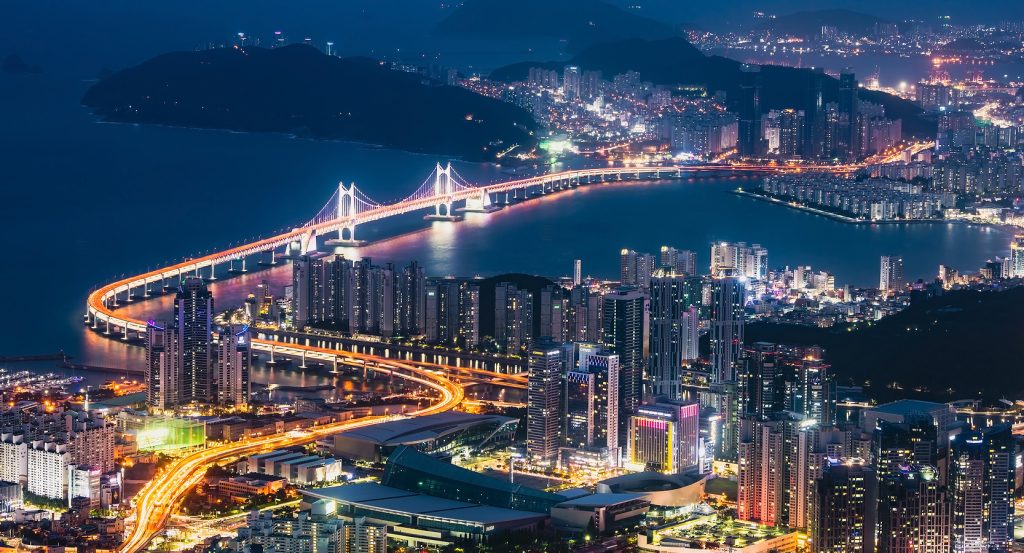
Curving along the southern shore of Suyeong Bay between Namcheon-dong and Millak-dong, Gwangalli Beach faces Gwangandaegyo Bridge across open water, with Geumnyeonsan rising behind the surrounding neighborhoods and the high-rise towers of Haeundae visible beyond the eastern headland. The crescent-shaped shoreline extends 1.4 kilometers, with fine sand forming a broad recreational frontage between the bay and the coastal boulevard. Beachfront cafés, restaurants, hotels, and entertainment establishments occupy successive blocks behind the promenade, creating an unusually close relationship between the waterfront and the surrounding city. The suspension towers and elevated roadways of Gwangandaegyo define the seaward panorama, framing an expanse of water that changes character as daylight gives way to the bridge's architectural illumination. Evening performances bring synchronized aircraft, projected imagery, and coordinated lighting into the same coastal setting, transforming the shoreline into an outdoor gathering place organized around the bay itself. The result is a distinctive metropolitan beach whose natural crescent, immense bridge panorama, and established nighttime culture have made Gwangalli one of Busan's defining waterfront destinations.
What defines Gwangalli Beach.
Gwangalli Beach is best known for its transformation into a major urban waterfront through the construction of Gwangandaegyo Bridge and the subsequent development of internationally prominent public celebrations along Suyeong Bay. The beach had already become an important recreational destination within Busan's expanding coastal districts before the bridge fundamentally changed its relationship with the surrounding city. Its location west of Haeundae placed the shoreline within an increasingly developed metropolitan corridor connecting established neighborhoods, emerging commercial districts, and the port city's eastern waterfront. A major engineering project began in December 1994 when Busan undertook construction of a double-deck marine crossing between Namcheon-dong and the developing Centum City district. The project required an investment of 789.9 billion won and produced a 7.42-kilometer roadway incorporating eight traffic lanes across two levels. Its central suspension section extends 900 meters between towers rising 105 meters, creating the distinctive architectural silhouette visible from the beach. Construction approached completion during preparations for the 2002 Busan Asian Games, when the bridge received a temporary opening associated with the international sporting event. Full inauguration followed on January 6, 2003, establishing a major transportation connection across Suyeong Bay and permanently altering Gwangalli's coastal panorama. The bridge acquired the English nickname Diamond Bridge in November 2008, strengthening the association between its illuminated structure and Busan's international waterfront image. Another defining chapter began on November 16, 2005, when the city staged a multimedia fireworks performance at Gwangalli Beach to commemorate the Asia-Pacific Economic Cooperation summit hosted in Busan. The original production incorporated fireworks, lasers, music, and theatrical imagery, including a representation of Admiral Yi Sun-sin's turtle ship and illuminated lettering celebrating the APEC gathering. The performance attracted an immense audience and became the foundation of the annual Busan Fireworks Festival. Its second edition in November 2006 drew 1.1 million spectators, demonstrating the scale of public interest in an event organized around the bridge and waterfront. The festival subsequently developed increasingly elaborate pyrotechnic arrangements, including cascading Niagara fireworks suspended from the bridge, large aerial shells, and synchronized displays extending across the bay. The 2025 twentieth-anniversary celebration incorporated performances by Japanese pyrotechnic specialists Hibikiya and a commemorative production featuring music by G-DRAGON. That edition expanded the offshore firing arrangement and coordinated displays across Gwangalli, Igidae, and Dongbaekseom, extending the performance across multiple coastal viewpoints. Gwangalli's development entered another technological chapter on April 2, 2022, with the inauguration of the Gwangalli M Drone Light Show, South Korea's first permanent weekly drone performance. The program transformed synchronized aerial illumination into a recurring waterfront attraction, establishing a Saturday evening tradition distinct from the annual fireworks celebration. The combination of marine engineering, international cultural programming, and coordinated aerial technology has given Gwangalli Beach a defining position within Busan's modern waterfront history.
Suyeong Bay's physical geography gives Gwangalli Beach a distinctive relationship with the sea, beginning with a sheltered coastal arc whose width varies between 25 and 110 meters. The beach's fine sand extends along a gently curving shoreline, allowing broad views across the water from successive positions along the promenade. Coastal environmental improvements included water purification work that helped restore ecological conditions in nearby river waters, strengthening the relationship between the recreational shoreline and its surrounding marine environment. The beachfront supports swimming during the designated summer season, with open-water activities extending into paddleboarding, surfing, and recreational yachting. Stand-up paddleboards place participants close to the water's surface, giving the bay's sheltered geography a recreational purpose distinct from the broad visual panorama encountered on land. Sailing and yacht excursions extend that relationship offshore, placing the bridge's suspended roadway and concrete towers against the surrounding mountains and urban skyline. The waterfront's nighttime character develops through an elaborate lighting environment centered on the bridge and its reflection across the bay. Gwangandaegyo's architectural illumination traces the roadway and suspension structure, turning the immense crossing into a continuous illuminated feature above the dark water. The Gwangalli M Drone Light Show extends that visual composition into the air through coordinated formations of 1,100 aircraft during regular performances. Special productions accommodate as many as 3,000 drones, allowing larger images and more complex animated sequences to occupy the sky above the shoreline. The aircraft form recognizable characters, commemorative symbols, and animated compositions through precisely coordinated movement and changing LED colors. Recent programming has incorporated laser projections, adding another visual dimension between the aerial formations and the bridge's illuminated structure. The weekly performances last twelve minutes and take place twice on Saturday evenings, with seasonal scheduling reflecting changes in daylight. The open beach functions as the principal viewing area, allowing spectators to encounter the formations across a continuous waterfront panorama. Restaurants and cafés along the coastal boulevard extend the evening beyond the performance itself, connecting illuminated views of the bay with Busan's established culture of waterfront dining and social gatherings. Gwangalli Beach combines a substantial natural shoreline with an unusually sophisticated program of marine recreation, architectural illumination, and synchronized aerial performance, giving the coastal setting a distinctive character across daylight and evening hours.
How Gwangalli Beach fits.
Gwangalli Beach works as the starting point for an exploration of Busan's fishing traditions, contemporary waterfront architecture, and coastal public spaces along the eastern edge of Suyeong Bay.
Begin at Millak Hoe Center, the seafood destination associated with the fishing community of Millak-dong and the longstanding importance of fresh fish in Busan's coastal food culture. The center connects seafood purchasing with restaurant preparation, allowing customers to select fresh fish before having it prepared as hoe, the Korean tradition of serving thinly sliced raw seafood. Sea bream, flounder, and rockfish belong to the species associated with its market trade, connecting the surrounding fishing waters with the city's established culinary practices. Restaurants on the upper levels overlook Gwangalli and the surrounding bay, creating a direct relationship between seafood dining and the maritime setting that supports it. The center preserves an important element of Busan's coastal economy within a district increasingly associated with recreation and contemporary hospitality. Continue to Millac The Market, a waterfront cultural and commercial destination whose architecture draws inspiration from the large warehouse buildings associated with Busan Port. Opened in 2022, the development received the grand prize at the Busan Architecture Awards that year, giving the project a significant place within the city's recent architectural development. Its large interior incorporates retail establishments, restaurants, cafés, cultural programming, and spaces devoted to contemporary creative activity. The Ocean View Stand organizes stepped seating around an expansive glazed waterfront elevation, placing the bridge and surrounding harbor directly within the building's architectural composition. The project connects Busan's industrial maritime heritage with a contemporary interpretation of public gathering and commercial activity along the coast. Conclude at Millak Waterfront Park, the extensive public landscape constructed between August 1992 and May 1997 along the shoreline east of Gwangalli. The park extends 543 meters along the coast and occupies 33,000 square meters, making it a substantial waterfront intervention within Suyeong-gu. Developed as South Korea's first park combining oceanfront recreation with public leisure facilities, the project incorporated a broad platform measuring 3,040 square meters beside the water. Its stepped coastal edge brings pedestrians close to the sea, with high tides allowing water to reach portions of the platform. Landscaped areas and open terraces provide uninterrupted views toward the surrounding shoreline, connecting the fishing harbor with the broader marine geography of Busan. The progression moves from Millak Hoe Center's seafood traditions through Millac The Market's contemporary interpretation of port architecture and culminates at Millak Waterfront Park, where the city's fishing heritage, commercial reinvention, and public coastal landscape converge along Suyeong Bay.
Where your story begins.
Foresyte Travel reveals places that feel extraordinary long before you arrive.
Enjoy editorial crafted for luxury travelers.
Foresyte may earn a commission when you book.

















































































































