
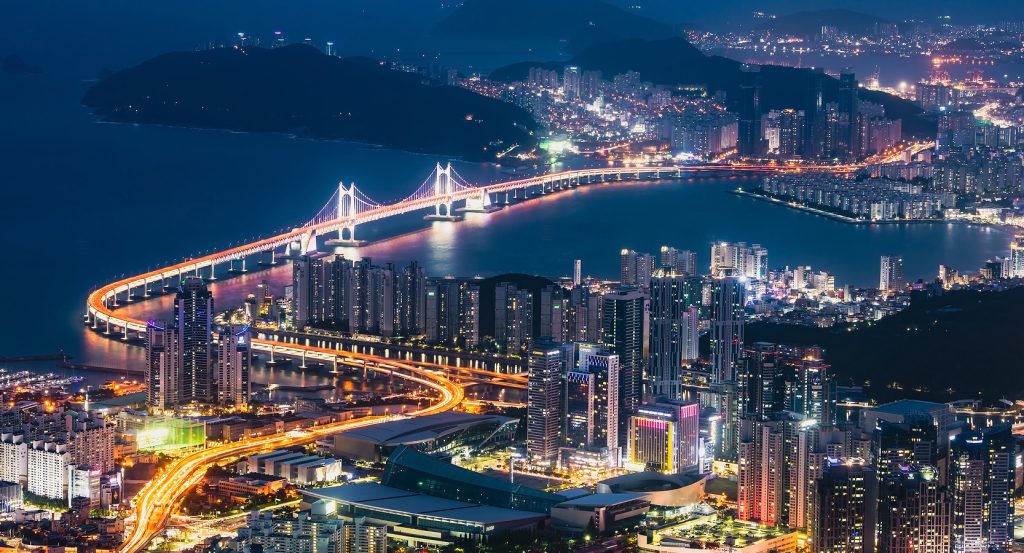
Why you should experience Gwanganri in Busan, South Korea.
Gwanganri is a waterfront neighborhood where beach culture, café-lined boulevards, and the illuminated performance of Gwangan Bridge converge to create South Korea's most iconic urban shoreline after dark.
Stretching along the curve of Gwangalli Beach beneath the soaring span of Gwangan Bridge, this coastal district occupies one of the most visually striking settings in the country. Oceanfront cafés fill with remote workers and conversation during the day. Paddleboarders drift across calm waters beneath the bridge. Runners and cyclists trace the shoreline while waves roll gently onto the sand. As evening approaches, the neighborhood undergoes a dramatic transformation. Restaurant patios fill with diners facing the water. The skyline begins to glow. Then the bridge illuminates the bay in shifting colors that reflect across the sea, creating one of Busan's defining nighttime landscapes. Unlike many waterfront destinations that rely solely on scenery, Gwanganri thrives because people genuinely inhabit it. Students gather along the beach, musicians perform near the promenade, and residents linger long after sunset. The result is a neighborhood where daily life and extraordinary views coexist with effortless confidence.
What you should know about Gwanganri.
Gwanganri is best known for offering the most celebrated views of Gwangan Bridge, South Korea's longest bi-level bridge and one of the country's most recognizable architectural landmarks.
Completed in 2002, the bridge fundamentally reshaped the character of the neighborhood, transforming the waterfront into one of Busan's most photographed and recognizable destinations. Spanning more than seven kilometers across the bay, the structure serves as both critical infrastructure and an iconic visual centerpiece visible from nearly every point along the beach. Over time, cafés, restaurants, hotels, and entertainment venues oriented themselves toward the water, reinforcing the neighborhood's reputation as one of the city's premier gathering places. While the bridge commands immediate attention, Gwanganri's enduring appeal stems from its ability to balance tourism with local life. The neighborhood remains deeply integrated into the daily rhythms of Busan, creating a waterfront experience that feels authentic. Few places demonstrate the relationship between urban design, public space, and coastal beauty as effectively as Gwanganri.
How to fold Gwanganri into your trip.
Gwanganri works as a day that unfolds alongside the water and culminates beneath one of Asia's most memorable urban skylines.
Begin at Gwangalli Beach, where broad stretches of sand and uninterrupted views across the bay establish the neighborhood's defining relationship with the sea. Continue toward Millak Waterfront Park, where residents gather along the shoreline to enjoy fresh seafood, harbor views, and one of the city's most relaxed public spaces. From there, make your way to Suyeongseong Fortress Site, whose historical significance provides context for the centuries of coastal activity that shaped this part of Busan long before the modern skyline emerged. As daylight fades, return to the waterfront and settle into one of the cafés, rooftop bars, or restaurants facing the bridge. The progression from beach to waterfront to history creates a fuller understanding of the neighborhood than the skyline alone can provide. Gwanganri remains one of Busan's most complete urban experiences, combining public space, coastal scenery, and architectural performance into a neighborhood that continues to define the city's modern image.
Where your story begins.
Foresyte Travel reveals places that feel extraordinary long before you arrive.
Experience premium editorial crafted for luxury travelers.

















































































































