
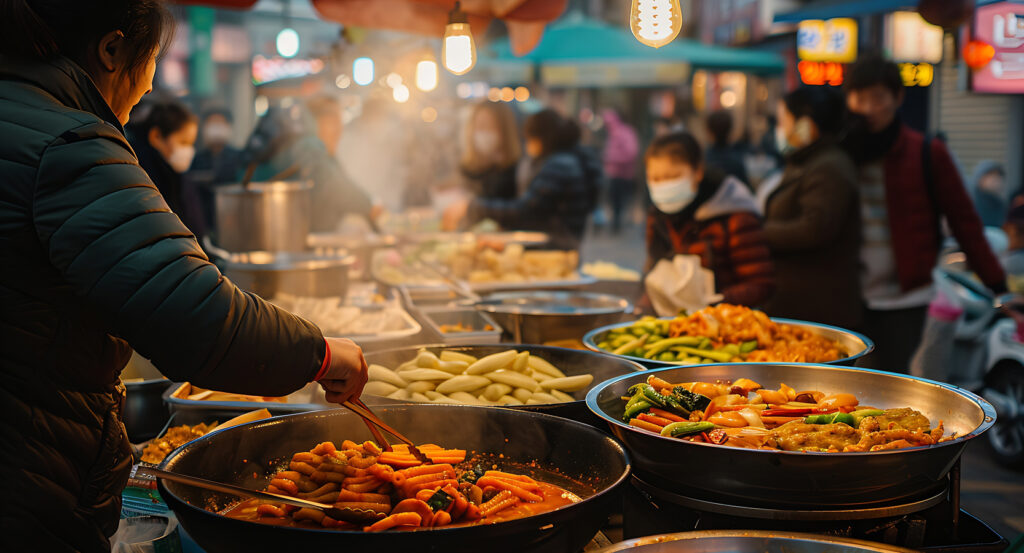
Why Gwangjang Market matters.
Gwangjang Market in Seoul is a feast for the senses, a glorious collision of sound, scent, and flavor where Korea's street food culture reaches its most authentic and unforgettable form.
Located near Jongno, this market has been the beating heart of Seoul's culinary and textile trade for more than a century. Established in 1905 as Korea's first permanent market, Gwangjang hums with energy from sunrise to midnight, its narrow aisles lined with sizzling griddles, gleaming brass bowls, and the endless chatter of merchants who've perfected their craft through generations. The market isn't polished or curated, it's raw and real, where the air smells of sesame oil and frying batter, and where every bite tells a story of tradition, resourcefulness, and pride. Whether it's the savory crunch of bindaetteok (mung bean pancakes), the tender chew of mayak gimbap (addictive mini seaweed rice rolls), or the comforting warmth of tteokbokki (spicy rice cakes), Gwangjang Market offers the kind of flavor that transcends language. Locals gather at narrow counters shoulder to shoulder, sharing food, laughter, and soju with strangers. To walk through Gwangjang is to taste the pulse of Seoul itself, fast, fiery, and full of soul.
What defines Gwangjang Market.
Behind the physical performance of Gwangjang Market lies a deeper story, among survival, adaptation, and community that mirrors Seoul's own evolution.
When the market was founded in 1905, Korea was in the midst of political upheaval and modernization, and Gwangjang quickly became a symbol of national resilience. Unlike the transient street stalls of its time, Gwangjang offered permanence, a roof under which traders, farmers, and craftspeople could thrive. During the Korean War, it became a refuge where families bartered food, clothing, and supplies amid chaos. In the decades that followed, as Seoul modernized, the market reinvented itself repeatedly, shifting from a focus on textiles and fabrics, still one of its hallmarks, to a world-renowned food destination. Today, it's a living time capsule of Korean culture, where handwoven hanbok silks coexist with modern fabrics, and where culinary traditions are preserved by women known as ajummas, many of whom have worked the same stalls for over 40 years. The market's food alley gained international fame after appearing in documentaries and travel series, but what those cameras couldn't fully capture is the intimacy of the experience: the way vendors remember returning customers, the rhythm of chopping scallions, or the sound of rain on the market's metal roof blending with laughter from the crowd. Few know that Gwangjang also operates as a community hub, supporting small producers, training young chefs, and ensuring that traditional recipes never fade from Korea's collective memory.
How Gwangjang Market fits.
To experience Gwangjang Market properly, come hungry, not just for food, but for connection.
Arrive in the late morning when the market is in full swing and sunlight filters through the glass ceiling, glinting off steaming pots and colorful produce. Begin with bindaetteok, freshly ground and fried before the eyes at one of the central stalls, crispy on the outside, nutty and tender within. Follow it with a paper plate of mayak gimbap, dipped in spicy mustard sauce, and chase it down with tteokbokki or a bowl of soondae (Korean blood sausage). As you eat, chat with the vendors, many love sharing stories about their recipes, family histories, or the celebrities who've visited their stands. Venture deeper into the textile section to browse silks, linens, and traditional hanbok fabrics, where tailors still measure by eye and cut by instinct. If you visit in the evening, the atmosphere transforms, neon lights flicker on, locals gather after work for pajeon (green onion pancakes) and makgeolli (rice wine), and the market hums with laughter that spills into the night. To avoid physical overload, step briefly outside to the Cheonggyecheon Stream nearby, where the city's rush softens to a whisper before you dive back in for one last bite. Gwangjang Market isn't just Seoul's oldest market, it's its most human, a place where every flavor, face, and moment blends into the living fabric of Korean life.
Where your story begins.
Foresyte Travel reveals places that feel extraordinary long before you arrive.
Enjoy editorial crafted for luxury travelers.
Foresyte may earn a commission when you book.

















































































































