
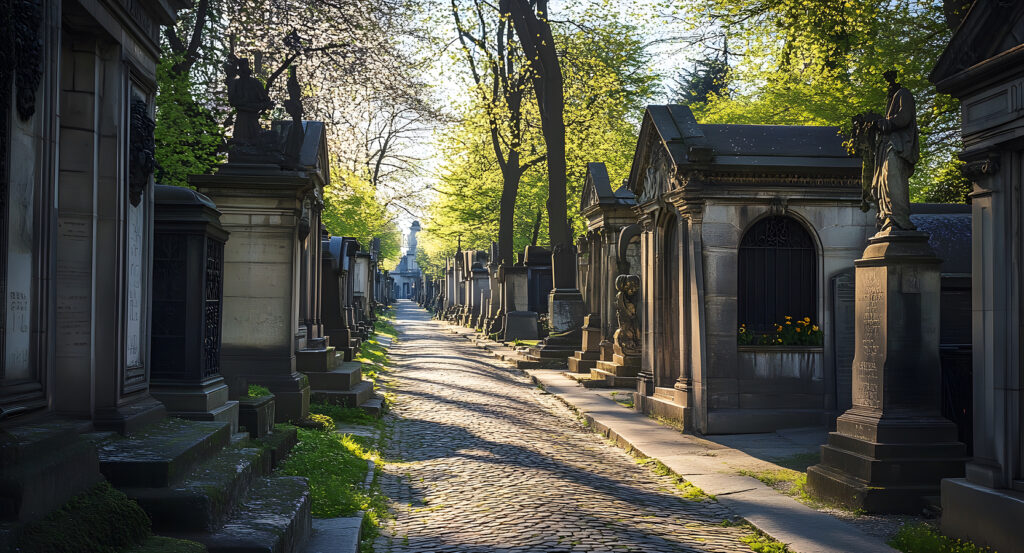
Why you should experience Héloïse and Abélard's Tomb in Paris, France.
The tomb of Héloïse and Abélard is one of Paris's most hauntingly romantic sites, a physical example of forbidden love turned eternal legend.
Tucked away within the shaded walkways of Père Lachaise, their resting place resembles a medieval chapel sculpted from longing itself. Beneath its gothic arches lie the remains of the philosopher and his student, lovers whose intellect and passion defied both the Church and the conventions of their time. Their story, among brilliance, scandal, and separation, continues to ripple through the centuries like a whispered prayer. Standing before their effigies, you sense both triumph and tragedy: two souls whose bond transcended humiliation and exile, their letters immortalized as the most eloquent correspondence of love and loss in medieval Europe. Visiting their tomb isn't just a historical act, it's a pilgrimage into the depths of human emotion, where devotion refuses to yield to circumstance.
What you should know about Héloïse and Abélard's Tomb.
Abélard, once a renowned philosopher and theologian, was castrated as punishment for his affair with Héloïse, who was forced into a convent. Yet even within cloistered walls, their letters rekindled their intellectual and resonant connection. Centuries after their deaths, admirers brought their remains together at Père Lachaise in 1817, claiming to finally reunite them in peace. But historians debate whether both lovers truly rest here, or whether, in a final cruel twist of fate, only one of them does. The tomb's elaborate design, however, makes the truth irrelevant. What matters is the illusion, the symbol of an undying bond that defied body and faith alike. It's a monument not only to love, but to the persistence of longing, crafted in stone for those who still dare to feel deeply.
How to fold Héloïse and Abélard's Tomb into your trip.
To fold this visit into your Paris experience, approach it not as a tourist stop, but as a meditation on love's endurance.
Arrive in the early morning when the mist still clings to the headstones, and read one of their letters aloud. You'll feel the atmosphere shift, the air thickening with the ache of words written centuries ago but still uncomfortably alive. Then wander through the surrounding avenues, where other great loves and losses are buried side by side: Piaf's voice, Chopin's heart, Wilde's wit. End your visit with a quiet walk to a café in the nearby 20th Arrondissement, penning a few words of your own, because standing before Héloïse and Abélard's tomb reminds you that the most enduring love stories are not the ones that end in happiness, but the ones that refuse to die at all.
Where your story begins.
Foresyte Travel reveals places that feel extraordinary long before you arrive.
Experience premium editorial crafted for luxury travelers.














































































































