
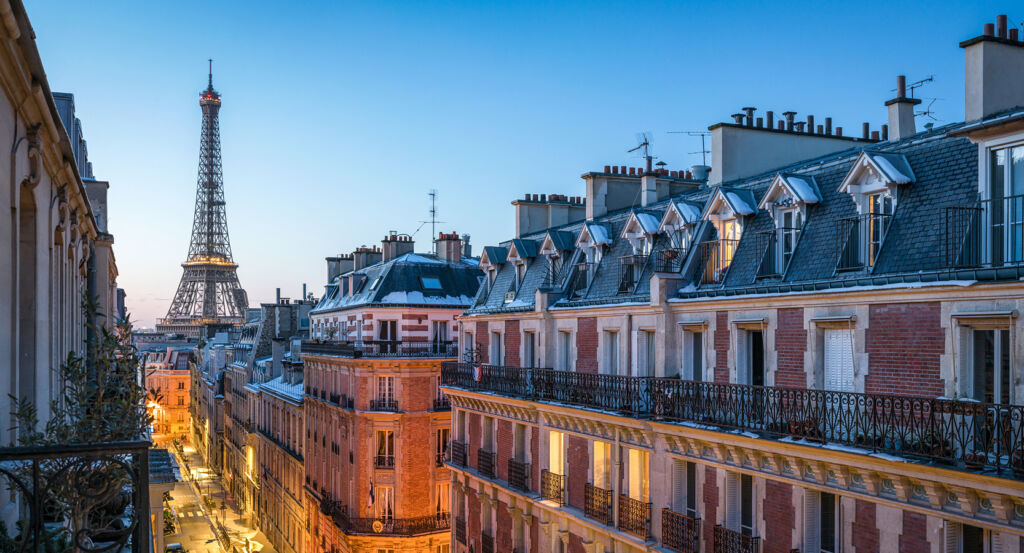
Why 20th Arrondissement matters.
20th Arrondissement is a hillside enclave where former villages meet eastern Paris through steep streets, intimate passages, old industrial ground and broad panoramas shaped by Belleville, Ménilmontant and Charonne.
Positioned between the 19th Arrondissement, the 11th Arrondissement, and the eastern communes of Bagnolet and Montreuil, the neighborhood occupies an elevated edge of Paris where Rue de Belleville, Rue de Ménilmontant and Rue de Bagnolet descend westward from terrain rising toward the city boundary. Sharp changes in elevation break the regularity associated with Central Paris, opening distant views between apartment buildings before lanes, stairways and former village streets compress the scale again. Belleville establishes the primary encounter through sloping streets where nineteenth-century buildings, small courtyards and later housing occupy terrain once covered by vineyards and suburban settlement. Ménilmontant adds another physical register through passages and hillside streets whose irregular alignments retain the imprint of development preceding incorporation into Paris. Charonne extends the experience south through older houses and streets formed around a village center whose distance from historic Paris once gave it a distinctly separate geography. The result is an Arrondissement whose hills, former villages and working districts remain individually legible inside the capital, preparing a history shaped by annexation and the extraordinary growth of communities that developed beyond the old customs boundary.
What you should know 20th Arrondissement.
20th Arrondissement is best known for bringing Belleville, Ménilmontant and Charonne into Paris during the great territorial expansion that took effect in 1860, joining communities with histories extending centuries beyond their incorporation into the capital. Medieval Belleville supported vineyards on relatively poor soil, and Charonne developed market gardening and wine presses farther south, with both territories supplying the Parisian market from outside the old city. Ménilmontant reached deeper into the early Middle Ages: Charles the Bald transferred its rural estate to the Abbey of Saint-Denis in 862, establishing an ecclesiastical connection that preceded its later dependence on Bagnolet. Religious and secular estates divided much of the wider territory, including holdings associated with Saint-Martin-des-Champs, Saint-Magloire and the seigneuries of Ménilmontant, Charonne and Bagnolet. Water provided another source of economic importance as springs across the heights fed collection basins and aqueduct systems serving Paris below. Population growth accelerated dramatically during the nineteenth century, particularly at Belleville, where inhabitants increased from 9,700 in 1831 to 57,700 in 1856 as artisans and workers arrived from rural France and from districts disrupted by reconstruction inside Paris. The law of June 16, 1859 carried the capital to the Thiers fortifications, and the new boundaries took effect the following year, combining Belleville, part of Ménilmontant, part of Charonne and territory formerly belonging to Saint-Mandé within the twentieth and final Arrondissement of the new spiral numbering system. Paris simultaneously expanded from 3,438 hectares to 7,802 hectares, turning these eastern communities from peripheral settlements into constituent parts of the enlarged capital.
Industrialization and organized working-class culture supplied a separate mechanism for the Arrondissement after annexation. Factories and workshops multiplied around Ménilmontant and Belleville as workers displaced from central districts joined an already substantial artisan population, reinforcing an eastern manufacturing belt with strong traditions of political organization. The Paris Commune of 1871 gave that culture a defining historical episode as Belleville and neighboring eastern districts became centers of Communard resistance during the final fighting of Bloody Week. Cooperative institutions later translated working-class organization into commerce, education and cultural activity. La Bellevilloise emerged in 1877 through mechanics seeking collective access to goods and knowledge, eventually supporting public meetings, performances, political activity and educational initiatives. Its headquarters was rebuilt in 1910, and another building erected by architect F. Guillouet between 1925 and 1927 expanded the cooperative with offices and a large conference hall for its fiftieth anniversary. Economic crises brought bankruptcy in 1936, yet the institution's long arc captures how labor in the twentieth developed beyond factory production into autonomous systems of commerce, political participation and popular education.
How 20th Arrondissement fits.
20th Arrondissement works as the anchor for a day crossing the former estates, village institutions and hydraulic infrastructure that preserve three different chapters of eastern Paris before its absorption into the modern capital.
Begin at Pavillon de l'Ermitage, the surviving fragment of the Château de Bagnolet estate acquired in 1719 by Françoise-Marie de Bourbon, daughter of Louis XIV and wife of Philippe d'Orléans. She enlarged the property and its gardens, commissioning three pavilions between 1723 and 1727; the Ermitage survived the château's disappearance and later passed to Baron de Batz, who used it during royalist efforts surrounding Louis XVI and Marie-Antoinette in the Revolutionary period. François Pomerel acquired the pavilion in 1820, and Assistance publique took possession in 1884, carrying an aristocratic garden retreat through radically different political and institutional lives. Continue to Église Saint-Germain-de-Charonne, whose fabric carries the chronology of the former village through construction campaigns spanning the later thirteenth century, later fifteenth century, seventeenth century and eighteenth century. A much older tradition connects the site with a meeting between Saint Germain and the future Saint Geneviève 430, linking the church to a foundation legend extending centuries before the surviving structure; the adjoining cemetery, established in its present form in 1833, preserves the rare Parisian conjunction of a parish church and burial ground. The church entered historic protection in 1923, safeguarding an architectural complex whose successive phases survived the village's incorporation into Paris. Conclude at Regard de la Lanterne, where a cylindrical stone structure from the end of the sixteenth or beginning of the seventeenth century provided access to the underground water network descending from the Belleville heights. Its lantern-shaped crown gave the structure its name, and its survival preserves physical evidence of the hydraulic system through which springs on the eastern hills supplied communities and religious establishments closer to Central Paris; historic protection followed in 1899, decades before the surrounding garden was created in 1975. The progression moves from a Bourbon estate and its surviving garden pavilion through the layered parish architecture of old Charonne into an engineered structure built to capture Belleville's hillside water, revealing the aristocratic, village and hydraulic histories that preceded the formation of the 20th Arrondissement.
Where your story begins.
Foresyte Travel reveals places that feel extraordinary long before you arrive.
Experience premium editorial crafted for luxury travelers.
Foresyte Travel may earn a commission when you book through the link on this page.














































































































