
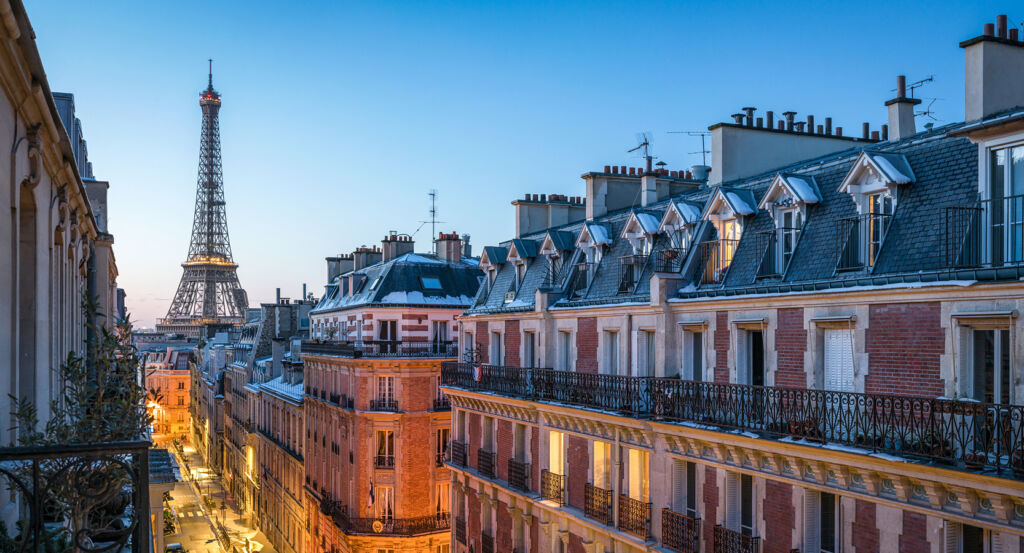
Why you should experience Holiday Inn Paris Gare de Lyon Bastille in Paris, France.
Holiday Inn Paris Gare de Lyon Bastille is a worldly four-star hotel where Quinze-Vingts's railway grandeur, Belle Époque optimism, southeastern gateway culture and enduring rhythm of arrivals converge inside a former palace hotel built during the neighborhood's transformation into one of Paris's great points of departure.
Set along Rue de Lyon near Avenue Ledru-Rollin and just steps from Gare de Lyon, the hotel occupies the former Paris-Lyon Palace, constructed in 1913 with carved stonework, wrought-iron ornament and a green-and-gold entrance that still gives the international flag an unexpectedly theatrical street presence. The property became a Holiday Inn in 1996 before a 2018 renovation reworked its 128 guestrooms while preserving high ceilings, molded cornices, arches and other surviving Belle Époque elements. That chronology places the hotel directly after Marius Toudoire's reconstruction of neighboring Gare de Lyon for the 1900 Exposition Universelle, when grand railway architecture recast this part of Paris around increasingly international movement. The result is a hotel where the Paris-Lyon Palace and a century of continuous hospitality give Quinze-Vingts's culture of departure a historical depth rarely associated with a contemporary Holiday Inn.
What you should know about Holiday Inn Paris Gare de Lyon Bastille.
Holiday Inn Paris Gare de Lyon Bastille is best known for occupying the former Paris-Lyon Palace, a Belle Époque hotel constructed in 1913 before joining Holiday Inn in 1996 and completing a substantial renovation of its 128 guestrooms in 2018 while retaining carved stonework, wrought-iron window ornament, molded cornices, high ceilings and elegant interior arches. The accommodation program extends from 19-square-meter Standard rooms through Premium configurations to larger suites, placing contemporary IHG rooms inside an architectural shell created during the final years of Paris's prewar grand-hotel expansion. The surviving green-and-gold portico establishes the building's strongest exterior signature, while antiqued mirrors, decorative moldings and preserved proportions allow the interior renovation to maintain continuity with the original Paris-Lyon Palace. Seven dedicated meeting spaces add a substantial second program, with five receiving natural light and the recently renovated Opera room accommodating 130 people in theater configuration beneath a glazed ceiling.
IHG develops that professional program across rooms named Opera, Louvre, Concorde, Bastille, Bercy, Luxembourg and Veranda, giving the hotel a meeting infrastructure extending considerably beyond what its 128-room scale might initially suggest. Opera anchors the collection at 130 theater-style seats, while Bastille accommodates 75, Luxembourg 64, Bercy 44, Concorde 39 and Louvre and Veranda 35 each, creating multiple configurations within the same Belle Époque property. Paris-Lyon Palace architecture provides the historical counterweight to that contemporary function through the ornamental stone façade, wrought iron, molded ceilings and arches retained across successive changes in ownership and branding. Together, Paris-Lyon Palace, IHG, the Opera room and the preserved 1913 fabric explain the property's unusual character, a century-old railway hotel whose original hospitality function has continued through architectural conservation, international branding and large-scale gathering.
How to fold Holiday Inn Paris Gare de Lyon Bastille into your trip.
Holiday Inn Paris Gare de Lyon Bastille works as the anchor for an afternoon tracing how railway engineering, artisanal reinvention and nineteenth-century infrastructure repeatedly reshaped the eastern edge of Central Paris.
Begin at Gare de Lyon, where François-Alexis Cendrier's 1848 terminus evolved into Marius Toudoire's thirteen-track station for the 1900 Exposition Universelle, complete with Jean-Baptiste Olive's destination frescoes and a campanile carrying four grand clock faces. Continue to Viaduc des Arts, where Émile Vuigner and Albert Bassompierre-Sewrin's 1859 Bastille railway viaduct lost its trains after the arrival of the RER A before Patrick Berger helped transform its surviving arches into workshops now occupied by 41 craftspeople. Conclude at Port de l'Arsenal, where the former Bastille defensive ditch evolved into the terminus of Canal Saint-Martin after the waterway's 1825 completion, shortening the journey toward Île Saint-Denis from 35 to 12 kilometers before the basin became a 230-berth marina. The progression moves from Toudoire turning railway travel into architectural performance through the conversion of nineteenth-century rail infrastructure into working craft studios and finally to a military ditch transformed by canal engineering, revealing the remarkable culture of movement surrounding Holiday Inn Paris Gare de Lyon Bastille.
Where your story begins.
Foresyte Travel reveals places that feel extraordinary long before you arrive.
Experience premium editorial crafted for luxury travelers.














































































































