
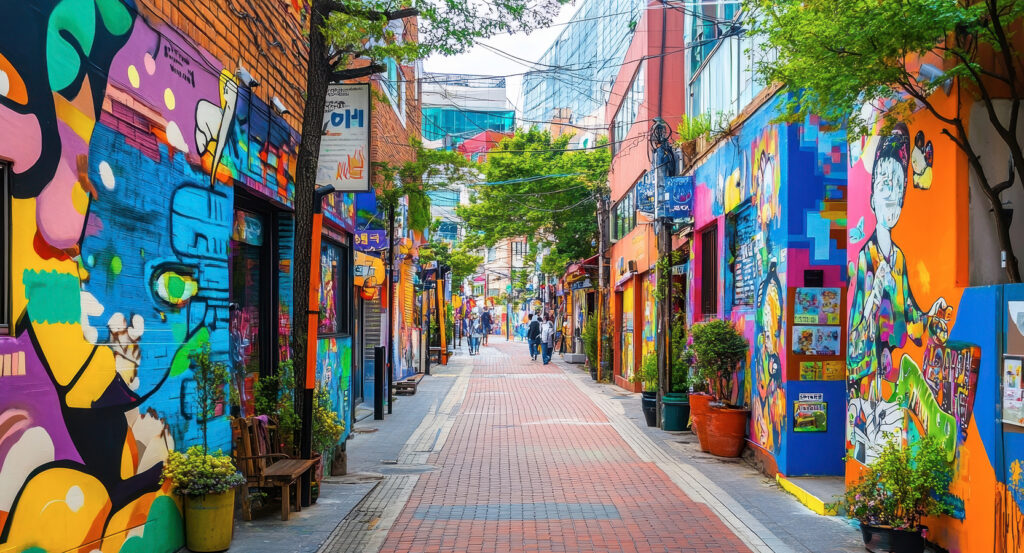
Why you should experience Hongik University Street in Seoul, South Korea.
Hongik University Street, known simply as “Hongdae Street”, is where Seoul's creative energy explodes into motion.
Here, the spirit of the university seeps into the city itself: murals bloom across alley walls, laughter drifts from basement cafés, and live music spills into the night air. This isn't just a street; it's a stage where art, fashion, and youth collide. The area hums with possibility, a place where ideas are tested in real time, where streetwear meets street art, and where the city's pulse quickens with every beat of a busker's drum. It's the heartbeat of Seoul's self-expression, wild, inventive, and unapologetically alive.
What you should know about Hongik University Street.
Hongik University Street traces its roots to Hongik University's College of Fine Arts, which has shaped generations of Korea's most influential creatives since the 1950s.
By the 1990s, as the university's art students began transforming nearby streets into galleries and performance zones, the area evolved into Seoul's most energetic hub for independent art, music, and design. The street's transformation accelerated in the early 2000s, when musicians and painters collaborated in open-air markets, founding what would become the Hongdae Free Market, still held nearby each weekend. What makes Hongik University Street unique is its organic design, no central plan, no zoning for creativity, just pure momentum. Cafés double as studios, bars host pop-up exhibits, and even convenience stores commission murals for their shutters. The street is lined with vintage boutiques, local record shops, and graffiti-laden walls that change weekly, living proof of the neighborhood's evolving narrative. The district's architecture mirrors this duality: prewar low-rises repurposed into fashion ateliers stand beside sleek glass cafés and student-run galleries like KT&G Sangsangmadang, where emerging artists debut their work. Few realize the area also helped launch South Korea's indie band movement, providing early stages for groups like Crying Nut and Jaurim, who shaped the alternative sound of a generation.
How to fold Hongik University Street into your trip.
To truly experience Hongik University Street, don't plan, wander.
Take Subway Line 2 to Hongik University Station (Exit 9) and follow the steady rhythm of music and chatter toward Eoulmadang-ro. Mornings reveal the quieter side of the district: indie coffee shops opening their doors, art students sketching in windows, and the aroma of fresh Hotteok rising from street stalls. Around midday, small shops burst open, everything from avant-garde fashion boutiques to handcrafted jewelry stands. By evening, the street transforms into a spontaneous festival. Buskers perform beneath neon reflections, K-pop dance crews draw crowds near Hongdae Playground, and the air hums with energy from every direction. Stop by StyleNanda Pink Hotel for a surreal fashion-meets-art experience, then unwind at a themed café like Thanks Nature Café, where you can sip coffee alongside resident sheep. End your evening with live music at Club FF or Rolling Hall, both staples of Seoul's underground scene. To see the district's more contemplative side, stroll through Gyeongui Line Forest Park, which runs parallel to the street, a pocket of calm amid creative chaos. Hongik University Street in Seoul isn't just a destination, it's a living art form, a place where every sound, scent, and mural tells a story still being written under the city's bright, relentless sky.
Where your story begins.
Foresyte Travel reveals places that feel extraordinary long before you arrive.
Experience premium editorial crafted for luxury travelers.

















































































































