
Why Hôpital-Saint-Louis matters.
Hôpital-Saint-Louis is a distinctive enclave where the Canal Saint-Martin meets northeastern Paris through seventeenth-century hospital architecture, waterside streets and dense residential blocks shaped around one of the capital's great medical institutions.
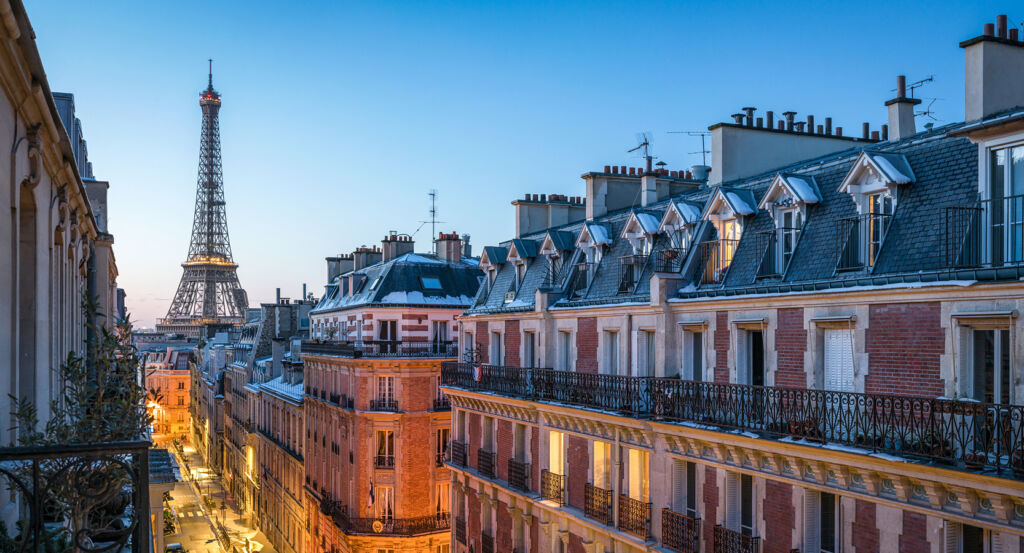
Positioned between Porte-Saint-Martin, Belleville, and République, the neighborhood occupies a northeastern pocket where Avenue Claude-Vellefaux, Rue de la Grange-aux-Belles and Rue Bichat extend from the canal toward the rising ground beyond the historic center. Brick-and-stone hospital pavilions, narrow residential streets, planted courts and long canal perspectives create pronounced changes in scale across terrain that remained beyond the dense medieval city before early modern expansion reached it. Rue de la Grange-aux-Belles establishes the primary encounter through a corridor where older institutional walls and closely packed apartment buildings preserve the physical compression of a district built incrementally around extensive enclosed properties. The Canal Saint-Martin supplies a second spatial mechanism through locks, footbridges and tree-lined quays that cut a broad linear opening across the eastern edge of the neighborhood, introducing water and long sightlines beside otherwise compact blocks. Streets around Rue Bichat and Rue Alibert tighten the fabric again through shallow intersections, corner buildings and passages whose irregular connections expose the contrast between the hospital enclosure and the city that accumulated around it. The result is a neighborhood where medicine, water infrastructure and residential Paris occupy adjoining layers, preparing a history rooted in the isolated plague hospital Henri IV established beyond the capital's crowded core.
What defines Hôpital-Saint-Louis.
Hôpital-Saint-Louis is best known for developing around the hospital Henri IV founded during the plague epidemic of 1605 and 1606 to relieve the Hôtel-Dieu, creating a purpose-built institution outside the city between the Porte du Temple and the heights of Belleville. Claude Vellefaux directed construction of the complex, completed in 1612 as a vast brick-and-stone quadrilateral measuring 120 meters along its central sides, with taller pavilions marking the corners and centers of each facade. Henri IV named the institution for Louis IX, connecting the new hospital with a royal ancestor who died during the 1270 Tunis expedition. Saint-Louis initially opened during epidemics, preserving physical separation between contagious patients and the crowded center of Paris. Vellefaux extended the hospital's infrastructure in 1613 and 1614 with a well and piston pump operated by a horse, and a 285-cubic-meter reservoir followed in 1669 to strengthen water storage. Permanent use emerged after the 1773 Hôtel-Dieu fire increased pressure on the Paris hospital system, and Saint-Louis became an independent medical establishment in 1801. Jean-Louis Alibert subsequently established a major teaching tradition in skin disease, drawing physicians and students to clinical lessons that helped make Saint-Louis central to the development of French dermatology. The collection of anatomical casts begun in 1867 under Dr. Lailler and modeler Jules Baretta gave that specialization a new teaching instrument, leading Gustave-Léon Vera to design a dedicated museum, library, consultation center and modeling workshop inaugurated on August 5, 1889 during the first International Congress of Dermatology.
Industrial and transportation change created a separate historical mechanism across the territory surrounding the hospital during the nineteenth century. The Canal Saint-Martin emerged from Napoleon Bonaparte's 1802 authorization of the Paris canal network, with engineer Pierre-Simon Girard directing a system intended to bring water into the capital and provide a navigable connection between the Bassin de la Villette and the Seine. Work on the Saint-Martin branch stretched across the succeeding political regimes before Charles X inaugurated it on November 4, 1825. Commercial boats were using the new waterway by 1826, bringing timber, grain and other cargo into an eastern Paris increasingly organized around warehouses, workshops and waterside industry. The City of Paris purchased the canal in 1861, and six pedestrian footbridges joined its infrastructure during the second half of the century as residential density increased along both banks. Transport competition from railways and roads later reduced commercial traffic, but another dramatic change nearly arrived when the Paris Council voted in December 1963 to replace the canal with an urban expressway. Opposition followed, the road project was abandoned in 1971, and a later municipal decision confirmed preservation of the waterway in 1976.
How Hôpital-Saint-Louis fits.
Hôpital-Saint-Louis works as the anchor for an exploration tracing immigrant religious life, industrial architecture and cultural reuse through three institutions clustered along the northern reaches of the Canal Saint-Martin.
Begin at Église Saint-Joseph-Artisan, whose origins lie in the Catholic mission established in 1851 for the large German-speaking population then living in Paris, with Jesuit Jean-Joseph Chable developing religious services and schools for a community that included thousands of working families. Lucien Douillard designed the church erected in 1865 and 1866, and Emperor Franz Joseph contributed three stained-glass windows depicting Saint Francis of Assisi, Saint Joseph and Saint Elizabeth of Hungary; artillery fire damaged the building during the Commune, Prince Max of Saxony acquired the church and adjoining property in 1909, and German priest Franz Stock used it during his wartime ministry to prisoners beginning in 1942. Continue to Point Éphémère, occupying a brick-and-concrete Art Deco industrial building completed in 1922 beside the canal for commercial activity tied to the working waterfront. Deputy Raymond Susset acquired the property during the 1930s and introduced a rooftop kindergarten, projection room and youth performances for workers' families, carrying industrial architecture into an unusual social program; the building later became associated with Point P before La Caserne Éphémère took possession in 2004 and established a multidisciplinary cultural center whose early concert history included Adele's first Paris performance in 2007. Conclude at Couvent des Récollets, founded for Franciscans in 1603 under Marie de Médicis and subsequently connected to the order's early missionary activity in Canada. Revolutionary closure pushed the complex through radically different functions, including a spinning operation employing more than 1,200 women and children, a forge and military occupation before an hospice arrived in 1794; hospital use continued into the twentieth century, and Reichen and Robert led the restructuring completed in 2003 that established an international residence for artists and researchers within the surviving convent buildings. The progression moves from a nineteenth-century mission created for German-speaking workers through an industrial canal building redirected toward social and cultural activity into a seventeenth-century Franciscan foundation carried through manufacturing, military medicine and artistic residence, revealing successive communities that remade the territory surrounding Hôpital-Saint-Louis.
Where your story begins.
Foresyte Travel reveals places that feel extraordinary long before you arrive.
Experience premium editorial crafted for luxury travelers.
Foresyte Travel may earn a commission when you book through the link on this page.














































































































