
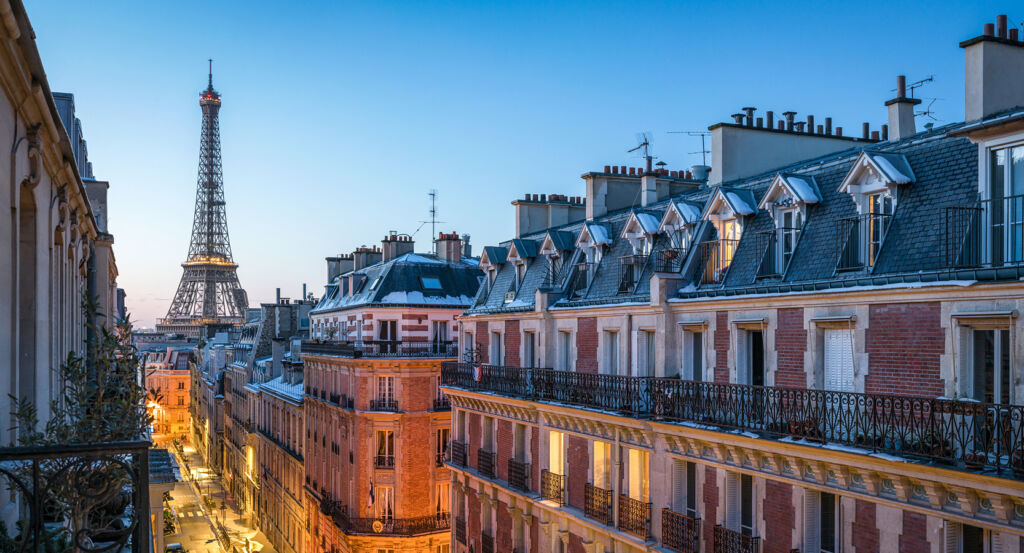
Why you should experience Hôtel Aiglon Boulevard Raspail Paris 14 in Paris, France.
Hôtel Aiglon Boulevard Raspail Paris 14 is a bohemian four-star hotel where Montparnasse's artistic rebellion, interwar cosmopolitanism, Art Deco confidence and culture of creative exchange survive inside a 1930s address that once welcomed Luis Buñuel and Alberto Giacometti.
Set along Boulevard Raspail near Boulevard Edgar Quinet and just steps from Montparnasse Cemetery, the 46-room hotel preserves the geometric façade, bow windows, floral bas-reliefs and decorative ironwork of a building conceived during the district's great twentieth-century artistic flowering. A major interior intervention beginning in the 2000s brought Cybèle Paluel Marmont together with mosaic artist Mathilde Jonquière, whose bespoke compositions introduced gold tesserae, Venetian enamel and pâte de verre into the building. The historical connection runs deeper than aesthetics, with Buñuel and Giacometti among the artists who stayed within the hotel while Montparnasse functioned as an international gathering place for painters, sculptors, filmmakers and writers. The result is a hotel where interwar architecture, surviving artistic memory and contemporary craftsmanship give Montparnasse's bohemian mythology a physical address on Boulevard Raspail.
What you should know about Hôtel Aiglon Boulevard Raspail Paris 14.
Hôtel Aiglon Boulevard Raspail Paris 14 is best known for occupying a 1930s Art Deco building on Boulevard Raspail whose 46 rooms and suites retain a direct relationship with the creative history of Montparnasse through former residents including filmmaker Luis Buñuel and sculptor Alberto Giacometti. The façade carries characteristic bow windows, floral bas-reliefs, geometric ornament and decorative balcony ironwork, while contemporary interiors continue the period style through patterned textiles and Art Deco motifs across guestrooms and suites. Interior architect Cybèle Paluel Marmont later commissioned mosaic artist Mathilde Jonquière to reinterpret that inheritance across the building, producing a street-facing composition and a series of individually designed bathroom mosaics during a project delivered in stages between 2005 and 2017. Jonquière's commission ultimately spread the artistic program throughout the accommodation floors, giving the hotel an unusually intimate form of site-specific art in which individual bathrooms participate in the building's larger decorative identity.
Mathilde Jonquière developed the Hôtel Aiglon commission through two related visual languages, beginning with figurative Herbes Folles compositions inspired by the 1930s before moving toward increasingly graphic arrangements of concentric circles representing falling water and expanding ripples. Cybèle Paluel Marmont connected those compositions directly with Boulevard Raspail by asking Jonquière to echo the movement of the trees outside, while the artist constructed the mosaics from gold tesserae, Venetian enamel and pâte de verre. Jonquière subsequently carried the craft into projects for La Grande Épicerie de Paris, Hermès, Cartier and Van Cleef & Arpels, placing the Aiglon work within a career spanning hospitality, luxury houses and large-scale decorative commissions. Together, Mathilde Jonquière, Cybèle Paluel Marmont and the surviving Art Deco fabric turn Hôtel Aiglon into a layered exercise in continuity, connecting the building's interwar decorative language with twenty-first-century French mosaic craftsmanship.
How to fold Hôtel Aiglon Boulevard Raspail Paris 14 into your trip.
Hôtel Aiglon Boulevard Raspail Paris 14 works as the anchor for an afternoon tracing Montparnasse from its artistic dead through the working studios of two sculptors who helped make the district one of the defining creative territories of twentieth-century Paris.
Begin at Montparnasse Cemetery, opened as the Cimetière du Sud on July 25, 1824 across 19 hectares, where Charles Baudelaire, Guy de Maupassant, Jean-Paul Sartre, Simone de Beauvoir and Charles Garnier rest among 1,200 trees and Constantin Brâncuși's Le Baiser. Continue to Musée Bourdelle, where Antoine Bourdelle settled in Impasse du Maine in 1885, worked for more than 40 years beneath north-facing studio windows and created Tête d'Apollon, Héraklès archer and Centaure mourant before his death in 1929 left the atelier substantially preserved. Conclude at Musée Zadkine, where Russian-born sculptor Ossip Zadkine lived and worked with artist Valentine Prax from 1928 until 1967, developing his mastery of direct carving across wood and stone within the garden studios that continue to preserve the material intimacy of an artist's Montparnasse home. The progression moves from the writers, architects and artists memorialized beneath Montparnasse soil through Bourdelle's preserved working environment into Zadkine's garden atelier, turning the district's artistic mythology back into the physical places where creative lives were actually made.
Where your story begins.
Foresyte Travel reveals places that feel extraordinary long before you arrive.
Experience premium editorial crafted for luxury travelers.














































































































