
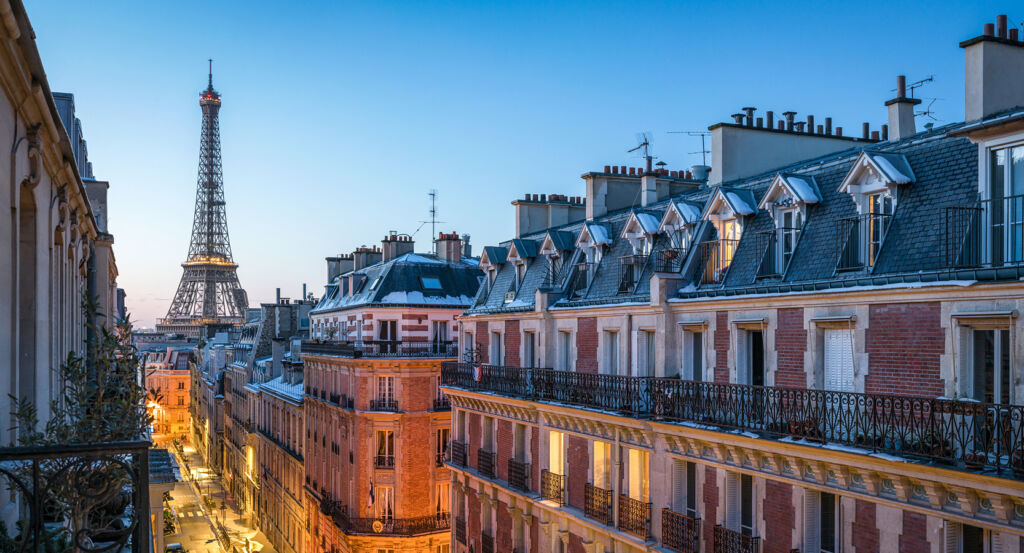
Why you should experience Hôtel Chavanel in Paris, France.
Hôtel Chavanel is a tactile four-star hotel where Madeleine's couture craftsmanship, department-store elegance, textile heritage and instinct for discreet Parisian refinement converge within an intimate house shaped by lace and contemporary design.
Set along Rue Tronchet near Boulevard Haussmann and just steps from Église de la Madeleine, the hotel emerged from a complete redesign directed by architects Anne Peyroux and Emmanuèle Thisy with owner Sophie Charlet, who made French lace the defining material of the interiors. Sophie Hallette, the family-run manufacturer supplying haute couture since 1887, brought its Leavers lace into hospitality interiors for the first time, allowing woven patterns to migrate from curtains into carpets and illuminated headboards. Peyroux and Thisy counterbalanced the delicacy of lace with wool drapery, cashmere, contemporary furniture and Krion surfaces, creating a material discussion rooted in French textile craftsmanship without turning the rooms into period exercises. The result is a hotel where Sophie Hallette's couture style and Peyroux and Thisy's architectural restraint give Madeleine's fashion culture an unusually intimate expression.
What you should know about Hôtel Chavanel.
Hôtel Chavanel is best known for a complete redesign by architects Anne Peyroux and Emmanuèle Thisy that marked Maison Sophie Hallette's first venture into interior decoration, using lace produced on the manufacturer's historic Leavers looms in Caudry as the conceptual thread running throughout the hotel. Sophie Hallette supplied floral corded Leavers pattern 56054.24/90, a design created in its studio in 1962 using a loom technique that integrated cording directly into production, replacing a process traditionally completed through hand embroidery. Ege received a special license to reproduce the pattern at enlarged scale across bespoke carpeting, while Peyroux and Thisy translated its interlacing forms into backlit headboards fabricated from Krion by Porcelanosa and balanced the lace with wool curtains and cashmere bedcovers. The current property contains 27 rooms and suites, including attic Junior Suites with hydromassage baths, while its newest renovation has shifted the palette toward seventies-inspired beige, rust, brown, orange and green.
Sophie Hallette gives the original Chavanel commission considerably deeper fashion context through a family textile house founded in 1887 and associated with generations of haute couture production from its Caudry workshops. Sarah Burton selected Sophie Hallette lace for the wedding gown she designed for Catherine Middleton in 2011, placing the same manufacturer used throughout Hôtel Chavanel within one of the twenty-first century's most widely recognized couture commissions. Anne Peyroux and Emmanuèle Thisy deliberately pushed that material beyond conventional soft furnishing, transferring the 1962 pattern among woven curtains, Ege flooring and illuminated Porcelanosa Krion to make one textile design operate across several architectural surfaces. Together, Sophie Hallette, Sarah Burton, Anne Peyroux and Emmanuèle Thisy give Hôtel Chavanel a coherent design lineage in which Caudry lace moves from couture production into architecture while preserving the craftsmanship that made the material culturally significant.
How to fold Hôtel Chavanel into your trip.
Hôtel Chavanel works as the anchor for an afternoon tracing royal memory, perfume craftsmanship and Parisian stage culture through the compact world between Madeleine and Opéra.
Begin at Chapelle Expiatoire, built over the former Madeleine Cemetery where Louis XVI, Marie-Antoinette and 500 victims of Revolutionary executions were buried, after Louis XVIII commissioned Pierre Fontaine to begin construction in 1816; completed in 1826, the chapel contains François-Joseph Bosio's Apothéose de Louis XVI, Jean-Pierre Cortot's Marie-Antoinette soutenue par la Religion and four ossuaries sealing remains from the cemetery. Continue to Musée du Parfum Fragonard, where the family company founded by Eugène Fuchs in 1926 and named for Grasse-born painter Jean-Honoré Fragonard presents a collection initiated by Jean-François Costa during the 1970s, with the Paris museum opening in 1983 and tracing fragrance through ancient vessels, pomanders, distillation equipment and the techniques of master perfumers. Conclude at Palais Garnier, where Charles Garnier's competition-winning project emerged from the 1861 architectural competition, survived a fifteen-year construction campaign shaped by the discovery of groundwater beneath the site and culminated in the January 5, 1875 inauguration of an opera house combining sculpture, painting, gilding, marble and theatrical engineering within the defining cultural commission of Napoleon III's new Paris. The progression moves from Pierre Fontaine's architecture of Bourbon remembrance through Fragonard's preservation of French fragrance craft into Charles Garnier's synthesis of the decorative arts, revealing the continuum of memory, making and performance surrounding Hôtel Chavanel.
Where your story begins.
Foresyte Travel reveals places that feel extraordinary long before you arrive.
Experience premium editorial crafted for luxury travelers.














































































































