
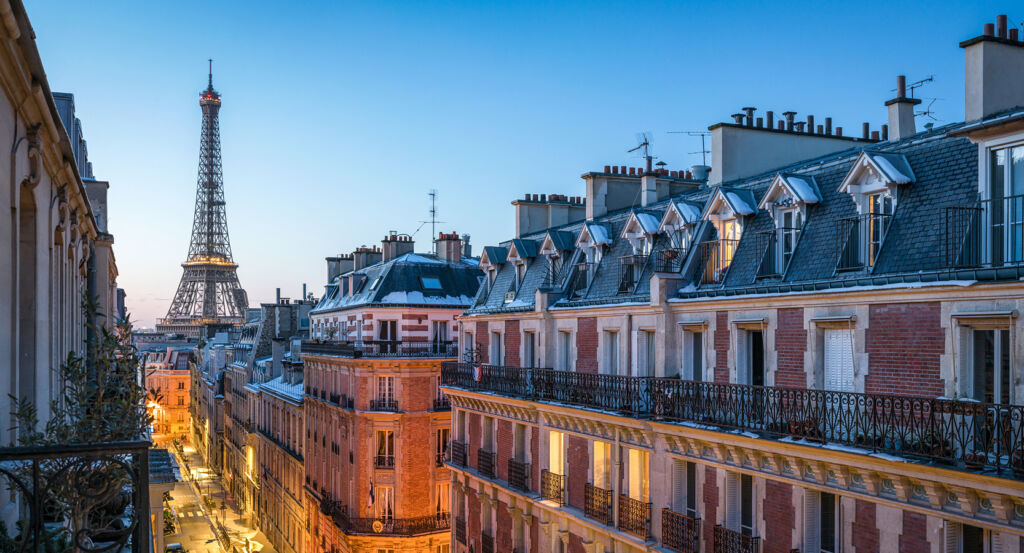
Why you should experience Hôtel Diva Opéra in Paris, France.
Hôtel Diva Opéra is a theatrical four-star hotel where Faubourg-Montmartre's music-hall exuberance, boulevard-stage culture, antiquarian curiosity and long fascination with public performance converge within a performance-minded retreat on Rue de Trévise.
Set along Rue de Trévise near Rue Richer and just steps from Folies Bergère, the hotel occupies a building dating to 1920 within the same entertainment quarter that nearly gave the celebrated theater the original name Folies Trévise before the duc de Trévise objected to the association of his family name with a performance hall. Inside, the hotel carries that theatrical inheritance into 44 guestrooms through black-and-white compositions, leather, textiles, sculptural furnishings and portraits of celebrated divas, with balconies in selected rooms opening toward Montmartre and Sacré-Coeur. Successive renovations have sharpened the concept, including a major redesign in 2012 and another complete refurbishment of the guestrooms and corridors in August 2018, when new carpets and interior finishes renewed the property's contemporary visual language. The result is a hotel where divas are more than decorative shorthand, connecting the rooms to a neighborhood whose theaters, performers and culture of performance have shaped this pocket of Paris since the nineteenth century.
What you should know about Hôtel Diva Opéra.
Hôtel Diva Opéra is best known for occupying a building dating to 1920 whose modern hospitality character was substantially recast through a 2012 renovation before another complete refurbishment of its guestrooms and corridors in August 2018 renewed carpets and interior finishes across the property. The contemporary program encompasses 44 rooms unified by black and white, leather, fabrics, upscale furniture, clean-lined forms and portraits of famous divas, while soundproofed windows and partitions were integrated into a design conceived around the intersection of technology, performance and modern Parisian aesthetics. Accommodation extends from Standard Queen and Twin rooms through Superior Queen, Twin and Triple configurations to King Executive rooms, with selected balconies framing Montmartre and Sacré-Coeur and the largest category incorporating a king bed, substantial bath and 32-inch Sony Bravia television. The same address operated for decades as Hotel Gotty Opera before appearing as Best Western Diva Opera and ultimately Hôtel Diva Opéra, preserving a continuous hotel function on Rue de Trévise while successive renovations replaced the earlier character with the property's current theatrical concept.
Cros et Cie provides the deeper continuity behind those changing hotel names, with the hospitality company established at 11 Rue de Trévise in 1957 and long retaining Hotel Gotty as its commercial character before the Diva era reshaped the property. Pierre Delecluse directed Cros et Cie through the period encompassing the 2012 transformation, while Guillaume Delecluse has also been professionally associated with Hôtel Diva Opéra, connecting the property's contemporary development to a multigenerational operating history at the same address. Best Western became part of that chronology during the intermediate Diva Opera identity, placing the newly theatrical hotel within an international affiliation before the current Hôtel Diva Opéra presentation established a more independent personality centered on its own name and visual language. Together, Cros et Cie, Pierre Delecluse, Guillaume Delecluse and the former Best Western affiliation reveal a hotel whose present character emerged through decades of continuous hospitality operation, successive identities and repeated physical reinvention rather than from a newly created Parisian address.
How to fold Hôtel Diva Opéra into your trip.
Hôtel Diva Opéra works as the anchor for an afternoon tracing the auction culture, covered-passage commerce and manufactured celebrity that made Faubourg-Montmartre one of nineteenth-century Paris's great laboratories of looking, collecting and performance.
Begin at Hôtel Drouot, inaugurated on June 1, 1852 as Paris's central auction house before the original complex outgrew its purpose, forcing sales into the former Gare d'Orsay from 1976 to 1980 while architects Jean-Jacques Fernier and André Biro reconstructed Drouot with sixteen principal salesrooms, six above-ground levels and seven basement floors; today 70 auction houses operate there and more than 230,000 objects and works pass through its sales. Continue to Passage Verdeau, where architect Jacques Prosper Deschamps completed a 75-meter neoclassical arcade in 1846 or 1847 as the northern continuation of the Panoramas-Jouffroy passage system, placing shops beneath a distinctive herringbone glass roof before Hôtel Drouot's 1852 arrival drew antiquarians and collectors into the gallery and helped establish the specialization that survives beneath its protected 1974 designation. Conclude at Musée Grévin, created when Le Gaulois founder Arthur Meyer recruited caricaturist, costume designer and stage designer Alfred Grévin as artistic director before the museum opened on June 5, 1882, with financier Gabriel Thomas joining its leadership in 1883 and later developing architectural attractions including the theater and Hall of Mirrors, while an 1886 tableau of Jean-Paul Marat incorporated the actual bathtub associated with his assassination. The progression moves from Drouot's circulation of coveted objects through Deschamps's architecture of commercial discovery into Meyer and Grévin's transformation of public figures into theatrical images, revealing the culture of collecting, display and performance that gives Hôtel Diva Opéra its unusually coherent setting in Faubourg-Montmartre.
Where your story begins.
Foresyte Travel reveals places that feel extraordinary long before you arrive.
Experience premium editorial crafted for luxury travelers.














































































































