
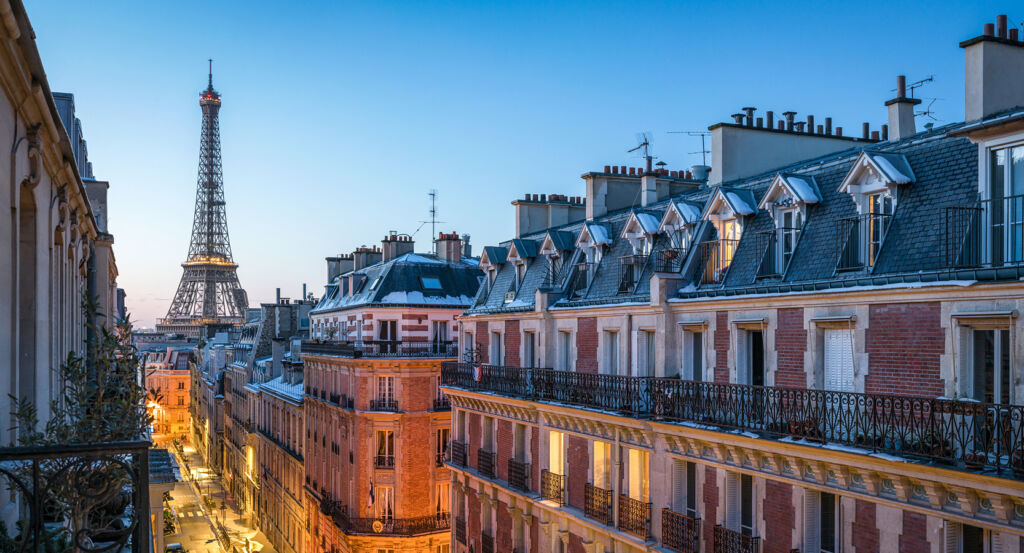
Why you should experience Hôtel Félicien Paris 16e in Paris, France.
Hôtel Félicien Paris 16e is a daring four-star hotel where Auteuil's fashion heritage, technological experimentation, material craftsmanship and discreet residential character converge within designer Olivier Lapidus's translation of haute couture into hospitality.
Set along Rue Félicien David near Avenue de Versailles and just steps from Église Notre-Dame-d'Auteuil, the hotel opened in September 2013 after a two-year renovation of a 1930s building, becoming Lapidus's first hotel project and a 34-room showcase for his couture vocabulary. Six floors progress from Black through Flannel, Ruby, Couture and Pearl to Sky, using leather, silk, flannel, pearls and metal to turn changing color and texture into the organizing structure of the house. Lapidus carried his experimentation with illuminated textiles into the property through fiber-optic curtains developed with technology previously employed alongside Cédric Brochier for a luminous dress, while designing the furniture specifically for the project. The result is a hotel where Lapidus translated techniques developed through fashion into architecture, furniture, textiles and light, giving an intimate Auteuil property the coherence of a complete designer commission.
What you should know about Hôtel Félicien Paris 16e.
Hôtel Félicien Paris 16e is best known for opening in September 2013 after a two-year renovation of a 1930s building as Olivier Lapidus's first hotel project, comprising 34 rooms including two suites and organizing six floors as successive stages in a couture collection. Lapidus named those environments Black, Flannel, Ruby, Couture, Pearl and Sky, constructing a chromatic progression from dark cocktail-dress references toward the visual purity of bridal fashion while working across leather, silk, flannel, pearls and metal. His commission extended beyond decoration into furniture designed specifically for Hôtel Félicien, unique painted-silk works assigned to guestrooms and fiber-optic curtains derived from technology Lapidus had previously explored with Cédric Brochier in the creation of a luminous dress. Brochier Technologies separately records its 2013 work with Lapidus on illuminated interior and exterior signage, laminated-glass panels, a shower partition, suite and bar curtains, and sunrise and sunset panels for the spa, giving the property's technological textiles an identifiable specialist collaborator. Hôtel Félicien concentrates Lapidus's fashion practice, custom furniture, painted silk, fiber optics, specialist fabrication and six-part chromatic sequencing within a single hospitality commission.
The Black Floor establishes Lapidus's sequence through the darkest register before Flannel introduces a textile associated directly with tailoring and Ruby shifts the collection toward saturated red, allowing the architecture to unfold according to fashion logic. Couture and Pearl progressively lighten that composition before Sky occupies the uppermost stage, where the two suites open onto private terraces with rooftop jacuzzis and Paris views, completing the transition envisioned across the six floors. Hippolyte Romain contributed a mural fresco to the original project, adding another named creative voice to interiors otherwise governed by Lapidus, while the Black Bar opened under bartender Andrew Kemp as part of the hotel's 2013 debut. Olivier Lapidus, Cédric Brochier, Hippolyte Romain and Andrew Kemp consequently establish a documented network of fashion, technological fabrication, illustration and cocktail authorship assembled specifically around Hôtel Félicien.
How to fold Hôtel Félicien Paris 16e into your trip.
Hôtel Félicien Paris 16e works as the anchor for an afternoon tracing literary creation, Impressionist collecting and postwar broadcasting through the cultural institutions of Passy and Auteuil.
Begin at Maison de Balzac, the novelist's only surviving Paris residence, where he lived under the name Monsieur de Breugnol from 1840 to 1847, corrected La Comédie humaine, and worked above medieval troglodytic spaces uncovered archaeologically in 2002. Continue to Musée Marmottan Monet, opened under the Académie des Beaux-Arts in 1934 before Michel Monet's 1966 bequest added more than 100 works by his father and ultimately established the world's largest collection of Claude Monet. Conclude at Maison de la Radio et de la Musique, where Henry Bernard won a 26-architect competition in 1953, conceived his circular broadcasting complex across 100,000 square meters, and saw Charles de Gaulle inaugurate it on December 14, 1963. The progression moves from Balzac's private act of literary creation through Michel Monet's preservation of an artistic inheritance into Bernard's vast architecture for national broadcasting, revealing the unusually rich continuum of authorship, collecting and communication surrounding Hôtel Félicien Paris 16e.
Where your story begins.
Foresyte Travel reveals places that feel extraordinary long before you arrive.
Experience premium editorial crafted for luxury travelers.














































































































