
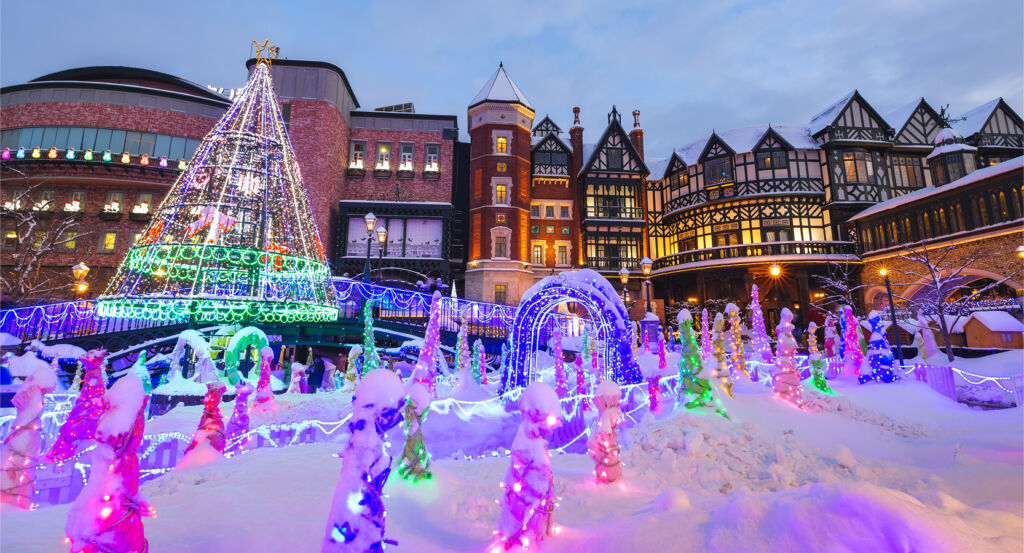
Why you should experience Hotel Gracery Sapporo in Sapporo, Japan.
Hotel Gracery Sapporo is a precision-located urban stay that is defined by immediacy and urban literacy, positioning you at the exact junction where Sapporo's transit logic, commercial flow, and everyday rhythm converge.
This hotel sits at a point where the city reveals how it actually functions. Located directly adjacent to Sapporo Station, Hotel Gracery Sapporo is not buffered from movement, it is embedded within it. Arrival is direct and unmistakably urban. You move from rail, street, and pedestrian flow into an interior that does not attempt to soften the city, but to organize your relationship to it. The lobby is compact, legible, and utilitarian in tone, designed for orientation. Circulation is clear, lighting is functional, and materials are chosen for endurance and familiarity. Nothing here competes for your attention because the hotel understands that attention is already being spent navigating the city. Public areas are transitional by design, places to check bearings, regroup, or wait briefly before moving again. This sense of operational clarity carries into the guest rooms. Layouts are efficient and tightly composed, eliminating excess while preserving comfort. Beds are supportive and dependable, designed to restore energy. Furnishings are modern and restrained, prioritizing use, storage, and ease of movement over visual identity. Windows often frame infrastructure and city geometry, rail lines, streets, neighboring buildings, grounding you in Sapporo's operational reality. Bathrooms are clean, modern, and optimized for routine, supporting fast transitions between arrival and departure. Across the property, the experience feels direct, intentional, and functionally calm. Hotel Gracery Sapporo is ideal for travelers who want Sapporo to feel immediately legible, a city engaged through proximity and clarity.
What you should know about Hotel Gracery Sapporo.
Hotel Gracery Sapporo is best known for infrastructure-adjacent hospitality, an approach that treats transit, repetition, and predictability as assets.
Being so closely integrated with Sapporo Station means the hotel does not attempt to create separation from the city's mechanics. Instead, it stabilizes them. Sound is managed not through silence but through consistency. Exterior noise becomes a steady ambient presence rather than a disruptive spike, and interior sound is absorbed quickly, allowing rest without artificial isolation. Architectural choices reinforce this balance. Materials are selected for durability and visual neutrality, creating an environment that does not fatigue attention even during high occupancy. Lighting strategy favors orientation over mood. Daylight enters rooms and corridors clearly, reinforcing awareness of time and weather, while artificial lighting remains even and steady, reducing physical fluctuation. Service culture mirrors this operational mindset. Interactions are polite, efficient, and informational, focused on logistics. Staff provide clear guidance on transit access, walking routes, dining clusters, and neighborhood patterns, reinforcing the hotel's role as a facilitator of movement. Another understated advantage of the property is how it supports repetition. Because the environment is predictable and uncluttered, guests acclimate quickly. Over multiple nights or return visits, cognitive load drops dramatically. You stop thinking about how to move through the hotel and start thinking about where to go next. The property does not attempt to express local culture through decorative cues or thematic gestures. Its character emerges from a deeper truth about urban travel: when infrastructure is aligned rather than resisted, comfort becomes procedural rather than performative.
How to fold Hotel Gracery Sapporo into your trip.
Hotel Gracery Sapporo works best when you treat it as a command position for movement, a place that allows you to enter, exit, and re-enter the city with speed and certainty.
Begin your mornings with decisiveness. Step directly into Sapporo Station's transit network and move outward, across the city, into surrounding regions, or toward Hokkaido's broader rail corridors. Because the hotel is so tightly connected to transit, distance feels reduced and options feel expanded. Midday returns are especially effective here. You can drop back in to reset, shower, reorganize, rest briefly, without expending mental energy on navigation or timing. This preserves stamina across long days of exploration or obligation. Afternoons can extend further because logistical friction is low. Museums, shopping districts, food corridors, and business zones remain easily reachable, and the certainty of a nearby base reduces the cost of spontaneity. Evenings follow the same logic. After dining or events, returning feels immediate and uncomplicated. There is no long walk, no layered transition, no decompression tax, just a return to a known, stable environment designed for recovery. Over longer stays, this rhythm compounds into strategic advantage. Time saved on logistics becomes energy available for experience. Business travelers benefit from this immediately, finding that proximity and predictability preserve focus across tight schedules. Leisure travelers gain range, able to explore widely. Anchoring your stay at Hotel Gracery Sapporo allows Sapporo to be experienced as a connected, intelligible system, not a fragmented set of attractions. The hotel does not attempt to slow you down or elevate itself above the city. It offers something more fundamental and often more valuable: clarity, proximity, and control over movement. In doing so, it delivers a stay that feels efficient, grounded, and honest, where comfort is built through alignment with how the city actually works and presence is sustained through precision.
Where your story begins.
Foresyte Travel reveals places that feel extraordinary long before you arrive.
Experience premium editorial crafted for luxury travelers.

















































































































