
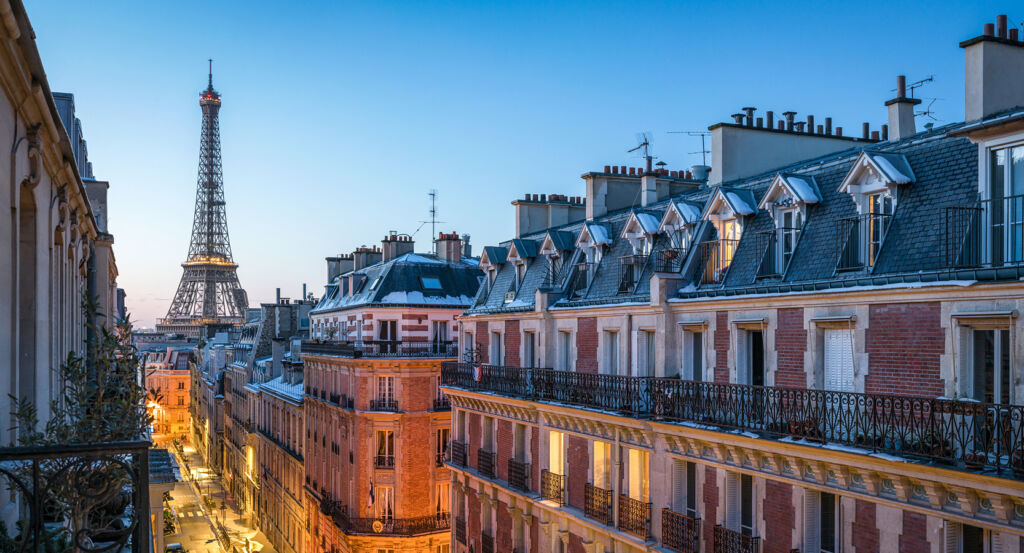
Why you should experience Hotel La Lanterne & Spa in Paris, France.
Hotel La Lanterne & Spa is an intimate four-star hotel where Quartier Latin's scholarly inheritance, antiquarian character, literary imagination and centuries of Left Bank craftsmanship converge within a contemporary interpretation of Parisian domestic style.
Set along Rue de la Montagne Sainte-Geneviève, the hotel opened in 2015 before expanding into its current 42-room configuration, with interior architecture by Les Héritiers translating the surrounding quarter through objects sourced from Parisian antiques dealers, historic engravings and purpose-made decorative elements. Two oeils-de-boeuf salvaged from a Parisian hôtel particulier became architectural features, old Quartier Latin lettering and posters entered the decorative program, and contemporary photography of Paris joined antique material throughout the guestrooms. The concept now extends across individually composed rooms where hand-painted engravings, numbered reproductions of Maurice Chevalier posters and custom textiles preserve the tension between historical reference and contemporary design. The result is a hotel where Les Héritiers turned collected fragments of Paris into a coherent interior language rooted in the intellectual and material culture of Quartier Latin.
What you should know about Hotel La Lanterne & Spa.
Hotel La Lanterne & Spa is best known for opening in 2015 as a four-star boutique property whose original 27 rooms and suite were conceived by Les Héritiers around an unusually artifact-driven interpretation of Paris, before the hotel developed into its current 42-room configuration. Les Héritiers built the interiors around objects collected from local antiques dealers, including two oval oeils-de-boeuf salvaged from a Parisian private mansion and historic Quartier Latin posters, embedding recovered architectural and graphic material directly into the design rather than treating local history as an abstract decorative theme. The guestrooms extended that approach through original Paris photography, engravings and collected objects, while the current interior program includes hand-painted antique engravings, numbered reproductions of Maurice Chevalier posters and custom textiles across several room categories. The property's evolution from its initial 2015 configuration into 42 rooms preserves Les Héritiers as the defining creative authors, giving Hotel La Lanterne & Spa an identifiable design genealogy built through architectural salvage, graphic history, photography and decorative collecting.
The hotel's name acquires a deeper visual logic through the lighting style embedded across the original project, where stylized lanterns flank beds and become recurring sculptural objects within interiors otherwise structured through restrained furniture lines, warm colors, oversized mirrors and historical imagery. Contemporary documentation additionally records a bathroom treatment reproducing an eighteenth-century Baroque candelabrum with scrolling ornament and cherubs, extending the lighting motif from physical fixtures into historical decorative imagery. The later 42-room program preserves that collecting sensibility while introducing numbered Maurice Chevalier reproductions and individually composed combinations of antique-inspired graphics, bespoke fabrics and recovered objects, allowing different accommodations to carry variations of the same visual narrative. Les Héritiers, Maurice Chevalier, the salvaged oeils-de-boeuf and the eighteenth-century candelabrum reference consequently establish a material style grounded in specific objects and images rather than a conventional inventory of hotel amenities.
How to fold Hotel La Lanterne & Spa into your trip.
Hotel La Lanterne & Spa works as the anchor for an afternoon tracing Roman performance, medieval scholarship and the architectural preservation of the Middle Ages through Quartier Latin.
Begin at Arènes de Lutèce, constructed around the late first century as a combined theater and arena measuring 130 by 100 meters, with capacity exceeding 10,000 people, before nineteenth-century works uncovered the surviving structure beginning in 1869. Continue to Collège des Bernardins, founded by Étienne de Lexington in 1245 for Cistercian scholars, later sold as national property in 1791 and converted successively into a prison, warehouse and fire station before a six-year restoration concluded in 2008. Conclude at Musée de Cluny, where the late-fifteenth-century residence constructed for the abbots of Cluny intersects with surviving Gallo-Roman baths and medieval collections, physically compressing ancient Lutetia and the intellectual culture of medieval Paris within a single complex. The progression moves from Roman mass performance through Cistercian scholarship into Cluny's convergence of antiquity and medieval culture, revealing the exceptional chronological depth surrounding Hotel La Lanterne & Spa.
Where your story begins.
Foresyte Travel reveals places that feel extraordinary long before you arrive.
Experience premium editorial crafted for luxury travelers.














































































































