
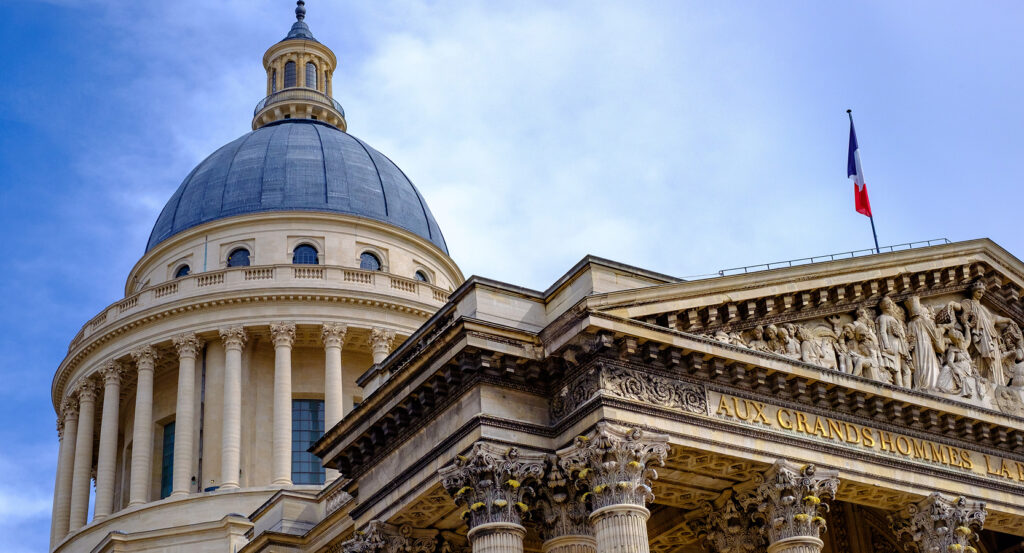
Why Montagne Sainte-Geneviève matters.
Montagne Sainte-Geneviève is a scholarly historic quarter where the Latin Quarter's intellectual character meets the elevated ground of Roman Lutetia, the cult of Paris's patron saint and institutions that have concentrated learning on the hill for centuries.
Set along Rue de la Montagne Sainte-Geneviève near Rue Descartes and just steps from Place du Panthéon, the quarter rises through sloping streets where university buildings, churches, former colleges and closely packed stone facades climb from the Seine toward the Panthéon plateau. Rue Saint-Jacques preserves the line of Lutetia's principal north-South Roman route as Rue Descartes and Rue de la Montagne Sainte-Geneviève follow steeper approaches toward the summit. Saint-Étienne-du-Mont, the Panthéon and the surviving Tour Clovis establish a distinctive skyline above streets whose narrow widths retain the scale of the medieval university district. Educational institutions occupy successive blocks across the hill, binding grand buildings to smaller passages, bookshops and former college sites extending toward the Sorbonne. The result is an elevated historic quarter where Roman topography, religious foundations and nearly nine centuries of scholarship remain physically concentrated within the same compact streets.
What defines Montagne Sainte-Geneviève.
Montagne Sainte-Geneviève is best known for becoming the intellectual center of Paris after schools established across its slopes developed into the medieval University of Paris. Roman Lutetia had already concentrated much of its Left Bank city around the hill between the first and third centuries, organizing streets around the cardo maximus followed by present-day Rue Saint-Jacques and constructing a forum, amphitheater, baths and aqueduct. The hill acquired another source of authority during the early sixth century when Clovis established the Basilica of the Holy Apostles near its summit, where Clovis, Clotilde and Geneviève were buried and the religious complex subsequently developed into the royal Abbey of Sainte-Geneviève. Teaching expanded around the hill during the twelfth century, drawing masters and students into schools whose growth preceded the formal organization of the University of Paris. Philip Augustus granted privileges to the scholarly community in 1200, papal legate Robert de Courçon supplied statutes in 1215 and Gregory IX's Parens Scientiarum confirmed university autonomy in 1231. Masters and students organized themselves into the universitas and four geographic nations as theology, medicine, canon law and the arts attracted scholars across Europe. Robert de Sorbon founded his college for theology students in 1253 on the northern slope, and Louis IX confirmed it in 1257, establishing the institution whose name eventually became synonymous with the university. Latin served as the language of teaching across this concentration of colleges, giving the surrounding district the Quartier latin name that survives long after the medieval university dispersed among successor institutions. Montagne Sainte-Geneviève consequently joined Roman urban ground, a royal abbey and an international community of masters and students into the geographic concentration of scholarship that established the Left Bank as Paris's principal academic district.
Revolutionary and Napoleonic France renewed that scholarly concentration by placing new state institutions on and around the hill. The École centrale des travaux publics was created in 1794 to address the Republic's shortage of engineers and scientific officials, took the École polytechnique name in 1795 and initially occupied dependencies of the Palais-Bourbon. Napoleon imposed military status in 1804 and moved the school into the former Collège de Navarre and Collège de Boncourt on Montagne Sainte-Geneviève, where students lived and studied under a residential military system. Gaspard Monge, Claude-Louis Berthollet and other scientists associated with the young school connected advanced mathematics, physics and chemistry with the training of engineers for artillery, mines, bridges and other state services. Students from the hill participated in the defense of Paris in March 1814, and political conflict under the Restoration led Louis XVIII to dismiss the entire student body in April 1816 before the school reopened under revised statutes in 1817. The institution remained on Montagne Sainte-Geneviève until its 1976 move to Palaiseau, extending its occupation of the former college territory across 172 years. The revolutionary school thereby continued a mechanism already established during the Middle Ages: successive regimes reused the hill's educational fabric to concentrate new forms of advanced instruction within a district whose institutions carried intellectual authority across political ruptures.
How Montagne Sainte-Geneviève fits.
Montagne Sainte-Geneviève works as the anchor for a daytime exploration of the Upper Latin Quarter using three nearby sites that move from the royal rebuilding of Geneviève's church through a parish created beside the medieval abbey into the surviving arena of Roman Lutetia.
Begin at Panthéon, born from Louis XV's 1744 vow to rebuild the deteriorating abbey church dedicated to Geneviève after recovering from serious illness at Metz. Jacques-Germain Soufflot received the project during the 1750s, developing a Greek-cross church crowned by a dome and combining classical forms with structural ambitions drawn from Gothic architecture; Louis XV laid the first stone on September 6, 1764. Soufflot died in 1780 before completion, leaving Jean-Baptiste Rondelet and other collaborators to continue the work. The Revolution changed the building's purpose in 1791, converting the unfinished church into a national burial monument, and its religious and civic functions alternated during the nineteenth century before Victor Hugo's funeral in 1885 established its lasting civic role. Continue to Saint-Étienne-du-Mont, whose predecessor arose during the thirteenth century after the parish population outgrew the church it shared with the neighboring Abbey of Sainte-Geneviève. The present building was reconstructed between 1492 and 1626, carrying its architecture across the transition from Flamboyant Gothic to Renaissance design. Its early sixteenth-century choir screen remains the sole surviving example in Paris, joining a Gothic internal structure with Renaissance carving in Saint-Leu limestone. Destruction of the old abbey church during the Revolutionary period shifted Geneviève's surviving cult to Saint-Étienne, which received relics preserved elsewhere and portions of the saint's original sarcophagus. Conclude at Arènes de Lutèce, surviving from the Roman city that spread across the hill centuries before the abbey and university. Rue Monge construction exposed part of the arena in 1869; the remains were covered again before tramway-depot construction during the 1880s brought another confrontation over the site. Victor Hugo and historian Victor Duruy joined efforts to protect the ruins, public acquisition followed and the square incorporating the arena opened in 1892. Archaeologist Louis Capitan continued restoration through 1918, securing one of only two substantial Roman building complexes still visible in Paris alongside the Thermes de Cluny. The progression moves from Soufflot's royal church converted into a national monument through Saint-Étienne-du-Mont's absorption of the abbey's religious inheritance into the rediscovered arena of Lutetia, carrying the hill backward through the civic, Christian and Roman forces that successively concentrated themselves on Montagne Sainte-Geneviève.
Where your story begins.
Foresyte Travel reveals places that feel extraordinary long before you arrive.
Experience premium editorial crafted for luxury travelers.
Foresyte Travel may earn a commission when you book through the link on this page.














































































































