
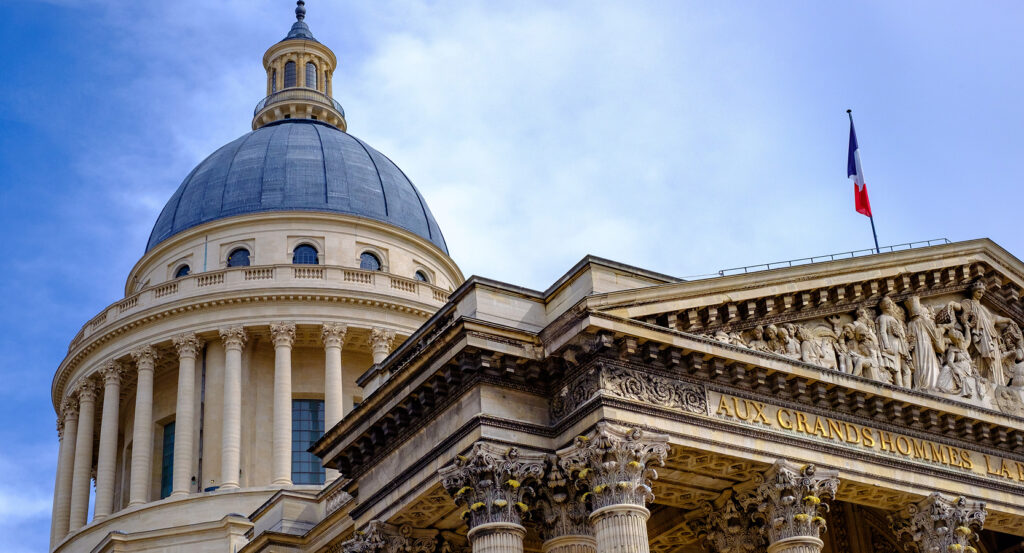
Why Panthéon matters.
Panthéon is an imposing civic monument where the Latin Quarter's scholarly character meets Soufflot's Enlightenment architecture, France's changing relationship with monarchy and republican government and a crypt devoted to figures accorded national commemoration.
Set along Place du Panthéon near Rue Soufflot and just steps from Rue Clotilde, the monument occupies the summit of Montagne Sainte-Geneviève where university buildings, ecclesiastical architecture and restrained stone facades frame an elevated forecourt above the dense streets descending toward the Seine and Luxembourg. Its Corinthian portico projects across the eastern side of the square beneath a triangular pediment as the vast dome rises above surrounding roofs and establishes a reference point across the Left Bank. Rue Soufflot extends west in a direct corridor toward Jardin du Luxembourg, giving the principal facade an unusually long approach through the Latin Quarter. The broad stone square leaves Soufflot's freestanding mass exposed on every side, separating its immense classical volumes from the compact educational and residential blocks surrounding Montagne Sainte-Geneviève. The result is a commanding urban summit where grand architecture and the intellectual geography of the Latin Quarter give national commemoration an exceptional physical setting.
What defines Panthéon.
Panthéon is best known for transforming Jacques-Germain Soufflot's church of Sainte-Geneviève into France's national mausoleum through successive political regimes that repeatedly altered the building's purpose. Louis XV became gravely ill at Metz during the War of the Austrian Succession in 1744 and vowed to rebuild the ancient church dedicated to Geneviève, patron saint of Paris, after his recovery. State finances delayed the undertaking, prompting a royal lottery before Soufflot received the commission in 1755 and Louis XV laid the first stone on September 6, 1764. Soufflot conceived a Greek-cross plan beneath a triple dome, pursuing a structural synthesis that joined classical forms with construction principles drawn from Gothic architecture. The architect died in 1780 before completion, leaving Maximilien Brébion and Jean-Baptiste Rondelet to carry the project through its final decade. Rondelet completed the dome between 1785 and 1790, closing a construction campaign that had begun under the monarchy only months before revolutionary government redirected the building. The Constituent Assembly decreed its conversion into a national Panthéon on April 4, 1791, and Quatremère de Quincy adapted the former church for its new commemorative purpose. Voltaire entered the building that July, followed by Jean-Jacques Rousseau in 1794, establishing the crypt as a burial place for figures selected for national distinction. Nineteenth-century regime changes repeatedly returned the building to religious use and then civic commemoration, producing six changes of function across the century. Victor Hugo's funeral in 1885 established the enduring civic use, and later admissions brought Émile Zola, Jean Jaurès, Jean Moulin, Pierre and Marie Curie, Simone Veil and Joséphine Baker into a continuously expanding national commemorative institution.
The vast interior became the setting for an experiment that gave Soufflot's dome a role in the history of experimental physics. Léon Foucault had demonstrated his pendulum on a smaller scale before Louis-Napoléon Bonaparte authorized him and engineer Gustave Froment to use the Panthéon in 1851. A 67-meter steel wire descended from the dome carrying a 28-kilogram brass-and-lead sphere above a circular bed of sand. A stylus attached beneath the sphere cut successive marks into the sand as the pendulum's apparent plane of oscillation shifted relative to the building, providing a public demonstration of Earth's rotation. Invitations announced the experiment with an invitation to watch the Earth turn, and crowds entered the former church to observe planetary motion through a device whose scale depended directly on the architecture surrounding it. The December 1851 coup ended the installation, yet the experiment became inseparable from the building's scientific history. Artistic commissions later filled the immense walls with another layer of nineteenth-century state patronage: Antoine-Jean Gros painted the dome, François Gérard produced the four pendentives, Pierre-Jean David d'Angers created the sculpted pediment and Pierre Puvis de Chavannes developed his cycle devoted to Geneviève. Philippe de Chennevières organized an extensive decorative campaign from 1874 that also brought Alexandre Cabanel, Jules-Eugène Lenepveu, Léon Bonnat and other official artists into the interior. Religious history, republican commemoration, experimental science and state-sponsored art accumulated inside the same architectural shell.
How Panthéon fits.
Panthéon works as the anchor for a daytime exploration across the eastern Latin Quarter using three nearby sites that move from Roman entertainment architecture through a medieval Cistercian college into Jean Nouvel's late twentieth-century institution on the Seine.
Begin at Arènes de Lutèce, the surviving amphitheater with stage architecture created during Roman Lutetia and later buried as the ancient city contracted. Haussmann-era work cutting Rue Monge exposed part of the structure in 1869, initiating excavations under Théodore Vacquer before development pressure threatened the ruins. Construction plans associated with the Compagnie Générale des Omnibus exposed further remains during the 1880s, prompting preservation efforts involving Victor Hugo and historian Victor Duruy. The public square incorporating the ruins opened in 1892, and Louis Capitan continued restoration through 1918, leaving one of the principal surviving Roman structures in Paris embedded within the modern fifth Arrondissement. Continue to Collège des Bernardins, founded in 1245 by Étienne de Lexington, abbot of Clairvaux, after Pope Innocent IV encouraged Cistercians to pursue advanced study in Paris. The complex developed around one of Europe's great Cistercian naves, residences, gardens and a church completed in 1360 as monks arrived from across Europe to study within the emerging university city. Revolutionary confiscation brought sale as national property in 1791, followed by use as a prison, warehouse, school and fire station; the church suffered major losses from Rue de Pontoise and Boulevard Saint-Germain. The Diocese of Paris acquired the surviving building in 2001, and a six-year restoration led by Hervé Baptiste with Jean-Michel Wilmotte reopened it in 2008. Conclude at Institut du monde arabe, conceived through cooperation between France and Arab states and given its Seine-side site under François Mitterrand in 1981. Jean Nouvel, Pierre Soria, Gilbert Lèzenes and Architecture Studio won the architectural competition, developing a glass-and-steel building whose southern facade incorporates geometric moucharabieh devices derived from traditional screened openings. The institution opened in 1987, received the Équerre d'Argent in 1988 and the Aga Khan Award the following year, bringing a new architectural institution devoted to Arab civilization into the university territory beside Jussieu. The progression moves from the rediscovery and preservation of Roman Lutetia through Lexington's Cistercian response to the rise of medieval Parisian scholarship into Nouvel and his collaborators' architectural project for Franco-Arab cultural exchange, spanning three distinct intellectual and architectural chapters around Montagne Sainte-Geneviève.
Where your story begins.
Foresyte Travel reveals places that feel extraordinary long before you arrive.
Enjoy editorial crafted for luxury travelers.
Foresyte may earn a commission when you book.














































































































