
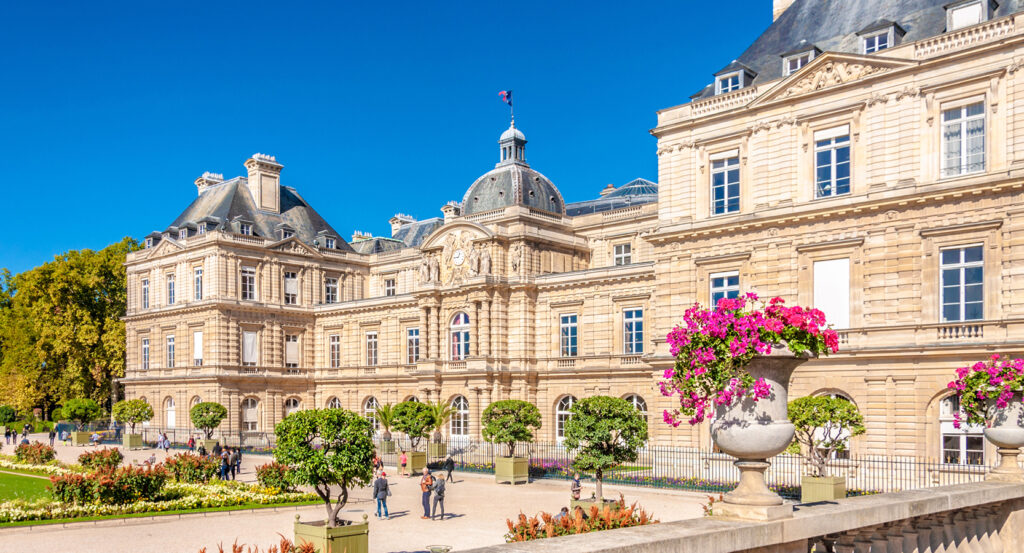
Why Jardin du Luxembourg matters.
Jardin du Luxembourg is a cultivated historic garden where the Latin Quarter's intellectual character meets a royal landscape of formal terraces, shaded promenades, sculpture and horticulture extending behind the Palais du Luxembourg.
Set between Rue de Vaugirard and Boulevard Saint-Michel near Rue Guynemer and just steps from Place Edmond Rostand, the garden occupies a 23-hectare enclosure where clipped parterres, chestnut-lined avenues, broad lawns and wooded edges separate the dense streets of the 6th Arrondissement from the institutional corridor extending south toward the Observatoire. The Palais du Luxembourg rises above the northern terraces as symmetrical paths descend toward the octagonal Grand Bassin and divide into contrasting formal and wooded sections. Long allées beneath mature trees frame quieter lawns, orchards and garden structures beyond the central parterre, giving the grounds a sequence of spaces that shifts repeatedly between architectural order and dense planting. Stone balustrades, urns and sculpture maintain a close relationship with the palace as the southern avenues extend the composition toward Avenue de l'Observatoire. The result is an expansive Parisian garden whose royal geometry, mature planting and layered public spaces preserve four centuries of adaptation without losing the clarity of its seventeenth-century origin.
What defines Jardin du Luxembourg.
Jardin du Luxembourg is best known for originating with Marie de Médicis, whose search for a residence outside the Louvre produced a palace and garden modeled through memories of her Florentine upbringing. The widowed queen purchased the Hôtel de Luxembourg from François de Piney-Luxembourg for 93,000 livres on April 2, 1612, then assembled surrounding parcels as the estate expanded south of the medieval city. Marie commissioned Salomon de Brosse to design the palace in 1615, with construction continuing into the 1630s as she acquired garden ground between 1614 and 1631. Jacques Boyceau de la Barauderie and Tommaso Francini shaped terraces and water features with precedents in Italian garden design, connecting the new landscape with the Florentine culture Marie had known before becoming queen of France. Water presented a technical challenge, and the aqueduct project begun under Henri IV was revived to supply the estate from springs near Rungis. Louis XIII laid the aqueduct's first stone in 1613, and water reached the fontainier's house beside the future Avenue de l'Observatoire ten years later after traveling thirteen kilometers through a predominantly subterranean masonry conduit. The system fed the Luxembourg grounds along with fourteen public fountains, allowing hydraulic architecture to become part of a much larger intervention in Left Bank water supply. Marie's original estate passed through Gaston d'Orléans, the duchesse de Guise and Louis XIV before the Comte de Provence inherited it during the eighteenth century. Ten hectares on the western side were sold in 1782 to finance palace work, sacrificing sections that included the Vallée des Philosophes associated with Jean-Jacques Rousseau. Revolutionary state ownership converted the former princely domain into a true public garden, beginning another phase in which royal landscape architecture became part of Parisian civic life.
The nineteenth century recast the garden through sculpture, street construction and a series of interventions that established much of its present visual order. In 1843, Interior Minister Charles Duchâtel accepted a proposal from the duc Decazes to replace female nudes around the central basin with a cycle devoted exclusively to queens of France and celebrated women. Twenty sculptures followed, including Jean-Baptiste Klagmann's Sainte Clotilde, creating an unusual state commission centered entirely on female historical figures. Other monuments accumulated across the terraces and avenues, eventually forming a collection of 102 sculptures that includes representations of Delacroix, Ingres, David, Millet, Beethoven, Chopin and Massenet. Haussmann's works then cut into the grounds through the widening of Rue de Vaugirard, construction of Boulevard Saint-Michel and the 1865 decision to develop the southern nursery and botanical garden. Opposition generated petitions carrying 12,000 signatures, yet the intervention established the boundaries that survive. The Fontaine Médicis underwent a parallel transformation in 1862 when construction of Rue de Médicis forced its relocation thirty meters toward the palace. Alphonse de Gisors added the fifty-meter basin and commissioned Auguste Ottin's sculptural group for the grotto, reshaping the structure Marie de Médicis had established 1630. The present garden consequently joins an inherited royal landscape with nineteenth-century sculpture and Second Empire reconstruction, preserving major alterations as visible components of the same public ground.
How Jardin du Luxembourg fits.
Jardin du Luxembourg works as the anchor for a daytime exploration through the southern 6th Arrondissement and adjoining Observatoire district using three nearby sites that move from Counter-Reformation architecture through a sculptor's preserved working environment into the scientific institution that fixed the Paris meridian.
Begin at Saint-Sulpice, constructed above a smaller medieval sanctuary through a campaign strongly associated with Daniel Gittard's 1660 plans and Jean-Nicolas Servandoni's eighteenth-century facade. Servandoni won the facade competition in 1732 after beginning work on the Chapelle de la Vierge three years earlier, bringing his experience in theatrical design into one of Paris's largest churches. An astronomical gnomon established in 1743 with astronomers from the Observatoire de Paris used sunlight crossing a meridian line to support precise observations, and Aristide Cavaillé-Coll rebuilt the great organ in 1862 before musicians including Charles-Marie Widor and Marcel Dupré became associated with the instrument. Eugène Delacroix added another artistic chapter through paintings in the Chapelle des Saints-Anges. Continue to Musée Zadkine, the Rue d'Assas house and studio occupied by Ossip Zadkine and Valentine Prax from 1928. Zadkine called the property his “folie d'Assas,” and the garden, small house and working spaces became the setting for a major change in his sculpture as direct carving expanded into plaster and clay models intended for bronze. His 1931 journey to Greece strengthened an engagement with ancient sculpture and mythology visible in works including Ménades, Naissance de Vénus, Orphée marchant and Diane. Solo exhibitions in London in 1928, the Venice Biennale in 1932 and exhibitions in Brussels and New York in 1933 accompanied his growing international reputation during the years after the move to Rue d'Assas. Conclude at Observatoire de Paris, founded in 1667 under Louis XIV and Colbert and constructed by Claude Perrault between 1667 and 1672. Astronomers fixed the north-south orientation before Perrault developed the building, making that line its axis of symmetry and establishing the Paris meridian. The rectangular structure terminates in two octagonal towers, its four elevations correspond to the cardinal directions and later scientific buildings expanded across the grounds for instruments including the Carte du Ciel and grand equatorial installations. More than three and a half centuries of uninterrupted scientific activity have carried the institution from royal astronomy into modern astrophysics and time measurement. The progression moves from Gittard and Servandoni's architectural campaign and Saint-Sulpice's astronomical instrument through Zadkine and Prax's working home into Perrault's purpose-built center for royal astronomy, connecting religious, artistic and scientific institutions across the streets south of Jardin du Luxembourg.
Where your story begins.
Foresyte Travel reveals places that feel extraordinary long before you arrive.
Experience premium editorial crafted for luxury travelers.
Foresyte Travel may earn a commission when you book through the link on this page.














































































































