
Why Hôtel Léopold matters.
Hôtel Léopold is an intimate hotel where Montparnasse's artistic character meets a longstanding boulevard Raspail address, the cultural memory of the Années folles and a 2019 reinvention built around the district's creative inheritance.
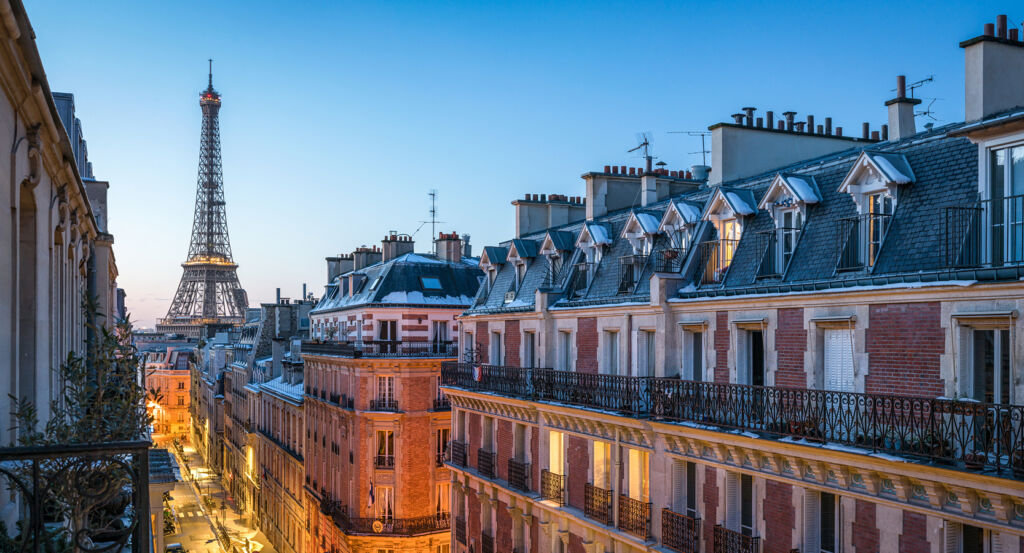
Set along Boulevard Raspail near Boulevard Edgar Quinet and just steps from Raspail Métro station, the hotel occupies the southern edge of historic Montparnasse where Haussmannian street walls approach the cafés, studios and theater streets clustered around Boulevard du Montparnasse. The narrow seven-story building preserves the vertical proportions of its older Parisian fabric, with its street façade rising directly from the boulevard and a quieter courtyard occupying the interior of the parcel. Floral wallpapers, velvet upholstery, antique furnishings and softly toned walls establish a domestic scale across interiors reconstructed during the property's transition from Hôtel de la Paix Montparnasse. A library, mirrors and an antique fireplace deepen the residential composition through objects chosen to recall the private salons associated with interwar Paris. The result is a hotel whose modest historic building became the setting for a concentrated interpretation of Montparnasse during the district's most consequential artistic period.
What defines Hôtel Léopold.
Hôtel Léopold is best known for transforming the longstanding Hôtel de la Paix Montparnasse into a four-star property conceived around the artistic culture that made Montparnasse internationally consequential during the early twentieth century. The hotel at 225 Boulevard Raspail operated for decades under the Hôtel de la Paix name before the building entered a major reinvention during the late 2010s. A complete renovation in 2019 altered that established property and accompanied its emergence as Hôtel Léopold. The change joined one of the first pair of boutique hotels developed by Anouk and Louis Solanet before they formally created Orso Hotels in 2020. Louis Solanet brought a family background in hospitality and real estate to the enterprise, and Anouk Solanet entered the business after a career in law as the couple developed a collection of independently conceived Paris hotels. Léopold became an early laboratory for the approach they subsequently extended through Orso, whose properties were organized around individual concepts tied closely to their locations. The Montparnasse hotel drew its central historical reference from the Années folles, when the surrounding district concentrated painters, sculptors, writers and expatriates around studios, academies and cafés. La Coupole and La Closerie des Lilas supplied specific cultural reference points for the hotel's interpretation of that period, connecting its interior conception with institutions that helped make interwar Montparnasse an international artistic center. Hôtel Léopold marked more than a name change for the former Hôtel de la Paix: the 2019 reconstruction recast a longstanding neighborhood hotel as one of the formative properties in a Parisian independent-hotel group built around geographically specific concepts.
How Hôtel Léopold fits.
Hôtel Léopold works as an anchor for an outing connecting the independent academy that helped internationalize modern art in Montparnasse, a preserved Art Deco atelier containing Alberto Giacometti's reconstructed workspace and the home-studio through which Valentine Prax secured Ossip Zadkine's artistic legacy for Paris.
Begin at Académie de la Grande Chaumière, founded in 1904 as an independent Montparnasse art school where Swiss painter Martha Stettler became a central director alongside Alice Dannenberg. Its open studios rejected the rigid academic system governing traditional French art education and admitted women artists during an era when many institutions restricted their access. Antoine Bourdelle joined the academy in 1909, and successive generations brought Amedeo Modigliani, Marc Chagall, Alberto Giacometti, Foujita, Alexander Calder and Louise Bourgeois through its studios. The institution's continuing emphasis on drawing, painting and sculpture from live models preserves a working practice extending across more than 120 years. Continue to Institut Giacometti, established inside the former home and studio of Art Deco designer Paul Follot at 5 Rue Victor-Schoelcher, in the Montparnasse district where Alberto Giacometti spent his working life. The listed hôtel particulier retains restored decorative work from Follot's occupation, placing one artist's architectural environment around another artist's preserved material world. Giacometti's reconstructed studio contains his furniture, personal objects and walls painted by his own hand alongside works rarely displayed elsewhere. The Fondation Giacometti also uses the 350-square-meter institute for exhibitions and art-historical research, joining the sculptor's surviving working materials with scholarship devoted to modernism and the artists and writers surrounding his career. Conclude at Musée Zadkine, formed from the Montparnasse home and studios where Russian-born sculptor Ossip Zadkine and painter Valentine Prax lived and worked. Zadkine reached Paris in 1910 and entered the artistic circles surrounding Matisse, Picasso, Apollinaire and Modigliani before developing a sculptural career spanning direct carving, Cubist experimentation and expansive postwar work. His 1950 commission for Rotterdam produced The Destroyed City, shaped by the devastation he encountered after returning from wartime exile in the United States. Prax secured the Paris legacy by donating major holdings to the city in 1978 and later bequeathing the remainder of her estate, leading to the museum's inauguration in 1982. The progression moves from an academy that loosened the institutional boundaries of art education through the preserved working environment of one of modern sculpture's central figures and culminates in an artist's home transformed through his widow's stewardship into a permanent municipal collection.
Where your story begins.
Foresyte Travel reveals places that feel extraordinary long before you arrive.
Enjoy editorial crafted for luxury travelers.














































































































