
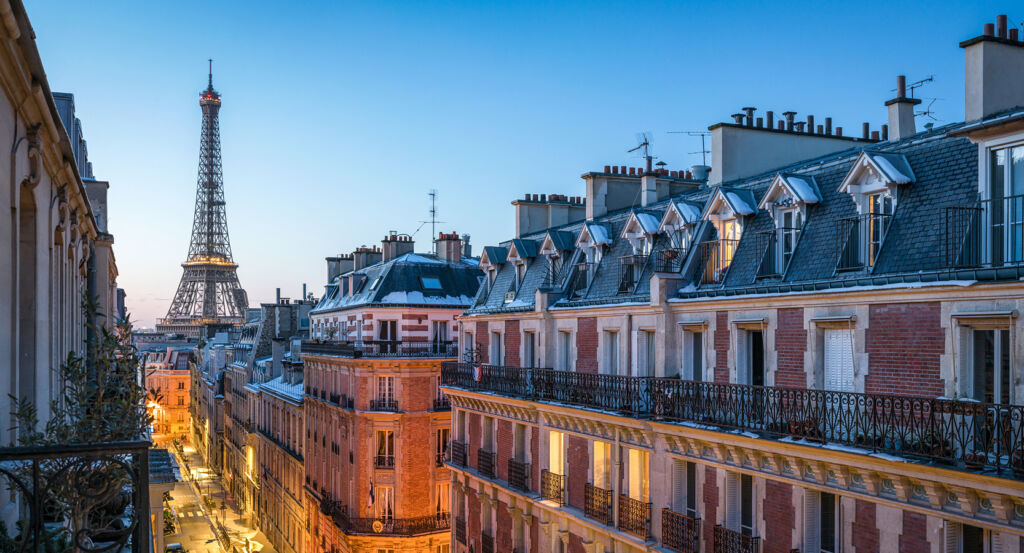
Why you should experience Hôtel Maison Malesherbes in Paris, France.
Hôtel Maison Malesherbes is a refined four-star hotel where Saint-Augustin's bourgeois elegance, Haussmannian inheritance, cultivated collecting culture and enduring tradition of private Parisian domesticity converge within an intimate nineteenth-century residence.
Set along Place Saint-Augustin near Boulevard Malesherbes and just steps from Église Saint-Augustin, the hotel occupies a nineteenth-century bourgeois house whose 23 guestrooms and single suite preserve the scale of a private residence within one of the 8th Arrondissement's most architecturally composed quarters. Four pastel palettes of yellow, pink, blue and green shape the accommodations through floral details, clean lines and a romantic bohemian vocabulary, while most rooms frame views toward the domed church that dominates Place Saint-Augustin. Standard accommodations range from a 12-square-meter single to 15-to-18-square-meter doubles, 19-square-meter Superior rooms add Nespresso service and bathrobes, and the 35-square-meter suite combines a queen bed and convertible sofa with separate bathtub and shower. The result is a hotel where pastel interiors, intimate proportions and views toward Église Saint-Augustin give the architectural formality of western Paris the atmosphere of a private bourgeois house.
What you should know about Hôtel Maison Malesherbes.
Hôtel Maison Malesherbes is best known for occupying a nineteenth-century bourgeois residence containing only 23 guestrooms and one suite, an unusually compact accommodation program conceived around the atmosphere of a private Parisian house rather than the spatial repetition of a larger urban hotel. The property develops that residential character through four pastel color families, yellow, pink, blue and green, alongside floral elements, harmonious tones and carefully differentiated rooms, while most accommodations preserve direct perspectives toward Église Saint-Augustin across the surrounding quarter. The inventory progresses from 12-square-meter Single rooms through 15-to-18-square-meter Standard doubles and 19-square-meter Superior doubles or twins before reaching a 35-square-meter suite accommodating three people, more than twice the area of the smallest category and the only configuration pairing a queen bed with a convertible sofa. A lobby bar, small salon and enclosed patio divide the ground floor into a sequence of intimate communal rooms, reinforcing the property's stated conception as a bourgeois maison while maintaining the functional style of a contemporary four-star hotel. The nineteenth-century building, 24-key scale, four-color accommodation program, 35-square-meter suite and sequence of domestic social spaces establish Hôtel Maison Malesherbes as a hospitality interpretation of the private residences that accompanied the development of Haussmann-era western Paris.
Victor Baltard provides the strongest architectural context for the hotel's immediate setting through Église Saint-Augustin, whose construction between 1860 and 1871 required an innovative iron structural system to accommodate a constrained site created during Haussmann's transformation of Paris. Église Saint-Augustin rises directly across the surrounding quarter as one of Baltard's defining experiments in combining exposed metal construction with grand ecclesiastical architecture, giving the views from Maison Malesherbes a direct relationship with the engineering ambitions of the Second Empire. Boulevard Malesherbes and the surrounding 8th Arrondissement simultaneously became a setting for the private mansions, collectors and prosperous households exemplified by Édouard André and Nélie Jacquemart, whose nearby residence was constructed by Henri Parent between 1869 and 1876 and later filled with artworks acquired across Europe and the Near East. Victor Baltard, Henri Parent, Édouard André and Nélie Jacquemart place Hôtel Maison Malesherbes within a concentrated nineteenth-century narrative of engineering, private architecture and collecting culture, giving the hotel's bourgeois-house character unusually coherent historical surroundings.
How to fold Hôtel Maison Malesherbes into your trip.
Hôtel Maison Malesherbes works as the anchor for an afternoon tracing the architectural experimentation, Revolutionary memory and private collecting culture that shaped the 8th Arrondissement during successive transformations of Paris.
Begin at Église Saint-Augustin, where Victor Baltard developed one of Second Empire Paris's most ambitious experiments in metal-supported religious architecture, reconciling an irregular urban parcel with a grand church whose dome became the defining architectural presence surrounding Place Saint-Augustin. Continue to Chapelle Expiatoire, where Louis XVIII commissioned Pierre Fontaine to create a memorial on the former Madeleine Cemetery, burial place of Louis XVI, Marie-Antoinette and 500 people guillotined during the Revolution, with construction beginning in 1816 and reaching completion in 1826 under Charles X. Conclude at Musée Jacquemart-André, where Henri Parent constructed Édouard André's mansion between 1869 and 1876 before André and Nélie Jacquemart devoted their marriage to building an international art collection, eventually bequeathing the residence to the Institut de France and enabling its inauguration as a museum by President Raymond Poincaré on December 8, 1913. The progression moves from Baltard's structural experimentation through Pierre Fontaine's architectural memorial to the Revolution into Henri Parent's setting for one of Paris's defining private collections, revealing the engineering, political memory and bourgeois patronage surrounding Hôtel Maison Malesherbes.
Where your story begins.
Foresyte Travel reveals places that feel extraordinary long before you arrive.
Experience premium editorial crafted for luxury travelers.














































































































