
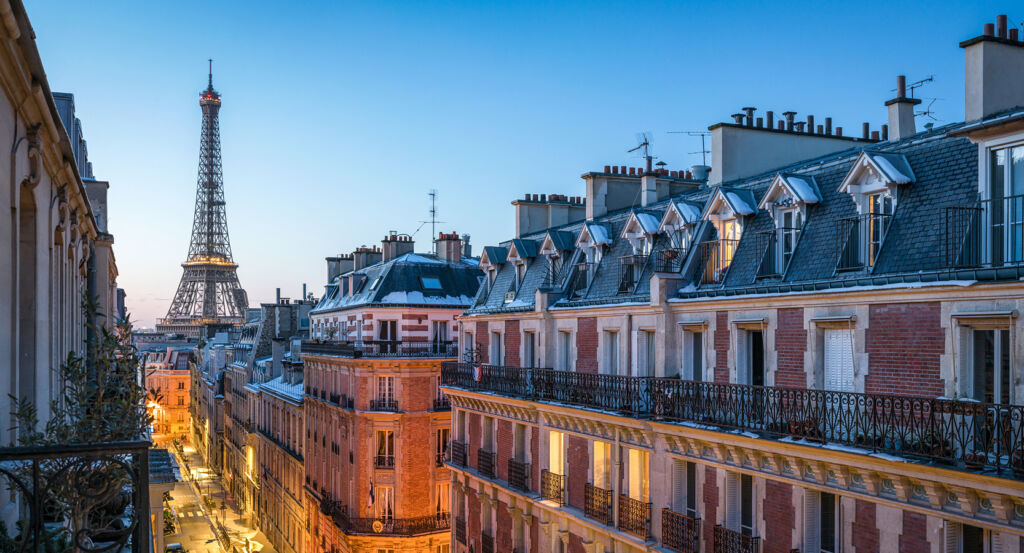
Why you should experience Hotel Mercure Paris Bastille Saint Antoine in Paris, France.
Hotel Mercure Paris Bastille Saint Antoine is a convivial four-star hotel where Quinze-Vingts's market culture, artisan inheritance, railway reinvention and enduring neighborhood sociability converge within an intimate retreat near Bastille.
Set along Rue Crozatier near Rue du Faubourg Saint-Antoine and just steps from Marché d'Aligre, the hotel contains only 34 guestrooms across five floors, creating a markedly intimate scale within a quarter shaped by food merchants, craft workshops and the former railway infrastructure of eastern Paris. Classic rooms measure 16 square meters, Privilege accommodations expand to 19 square meters and selected rooms open onto private terraces, while the compact interior program gives way above to a rooftop designed for breakfast, drinks and open-air relaxation. The fifth-floor terrace extends across 200 square meters, introducing deck seating and Paris rooftop views to a property whose strongest experiences are deliberately oriented toward outdoor space and the surrounding neighborhood. The result is a hotel where private terraces, a substantial rooftop and 34-room intimacy connect contemporary hospitality with the market rhythms and social character of eastern Paris.
What you should know about Hotel Mercure Paris Bastille Saint Antoine.
Hotel Mercure Paris Bastille Saint Antoine is best known for pairing an unusually compact 34-room inventory with an 200-square-meter rooftop terrace, giving its principal outdoor space nearly six square meters for every guestroom in the property. Accor currently divides the accommodation program among four configurations, with 16-square-meter Classic doubles and twins, 19-square-meter Privilege rooms and 16-square-meter Terrace rooms, while selected accommodations incorporate private balconies or terraces in addition to the communal rooftop above. The rooftop occupies the fifth floor and functions across different parts of the day as a breakfast terrace, bar extension and open-air gathering space, with Accor specifically incorporating the setting into both its morning service and summer bar program. A refurbishment undertaken during the mid-2010s modernized a property whose management had previously described elements of its interiors as carrying a 1970s aesthetic and identified renovation as the next stage in its development, while subsequent hotel materials foregrounded renovated bathrooms, contemporary guestrooms and the rooftop as defining features. The 34-room scale, four accommodation configurations, 19-square-meter Privilege category, private outdoor rooms and 200-square-meter communal rooftop establish Hotel Mercure Paris Bastille Saint Antoine as a small-format Mercure whose spatial character depends disproportionately on terraces and open-air hospitality.
Norbert Imbert currently directs the hotel, where Accor serves a breakfast buffet from 6:30 and supplements the main service with local products while allowing the rooftop to become part of the morning experience during suitable weather. Mercure extends that outdoor emphasis through Privilege rooms with private terraces and a fifth-floor bar program, giving Norbert Imbert's 34-room property multiple layers of exterior space despite its compact urban footprint. Accor also connects the hotel directly with Metro Line 14's extension to Orly Airport, placing the property less than 30 minutes from the airport by direct metro while retaining walking access to Gare de Lyon and the transportation network surrounding Bastille. Norbert Imbert, Mercure's terrace-led accommodation program, the fifth-floor rooftop and Metro Line 14 collectively shape a contemporary hotel whose small scale combines neighborhood intimacy with unusually direct access to the wider Paris transportation system.
How to fold Hotel Mercure Paris Bastille Saint Antoine into your trip.
Hotel Mercure Paris Bastille Saint Antoine works as the anchor for an afternoon tracing the market culture, artisanal production and railway reinvention that continue to define eastern Paris.
Begin at Marché d'Aligre, where the present Halle Beauvau dates to 1843 and anchors one of the capital's few daily markets, combining covered food stalls with an open-air produce market and flea-market traditions that preserve the commercial sociability long associated with the surrounding quarter. Continue to Viaduc des Arts, where a railway viaduct opened in 1859 was reclaimed after the line's closure and restored between 1990 and 2000 with architect Patrick Berger, turning its masonry vaults into workshops that currently support 41 craftspeople working across fashion, decoration, jewelry, restoration and design. Conclude at Coulée verte René-Dumont, created beginning in 1988 by Philippe Mathieux and Jacques Vergely along the same former railway alignment, where 4.5 kilometers of viaducts, tunnels, trenches and gardens transformed transportation infrastructure decommissioned in 1969 into a planted route through eastern Paris. The progression moves from the trading traditions preserved at Marché d'Aligre through the working craftspeople occupying a nineteenth-century railway viaduct into the landscape architecture created above the former tracks, revealing the continuum of commerce, making and reinvention surrounding Hotel Mercure Paris Bastille Saint Antoine.
Where your story begins.
Foresyte Travel reveals places that feel extraordinary long before you arrive.
Experience premium editorial crafted for luxury travelers.














































































































