
Why Hotel Muguet matters.
Hotel Muguet is a family-run hotel where École Militaire's residential character meets three generations of Parisian hospitality, a complete 1992 reconstruction and an independent enterprise rooted at the same Rue Chevert address since the postwar period.
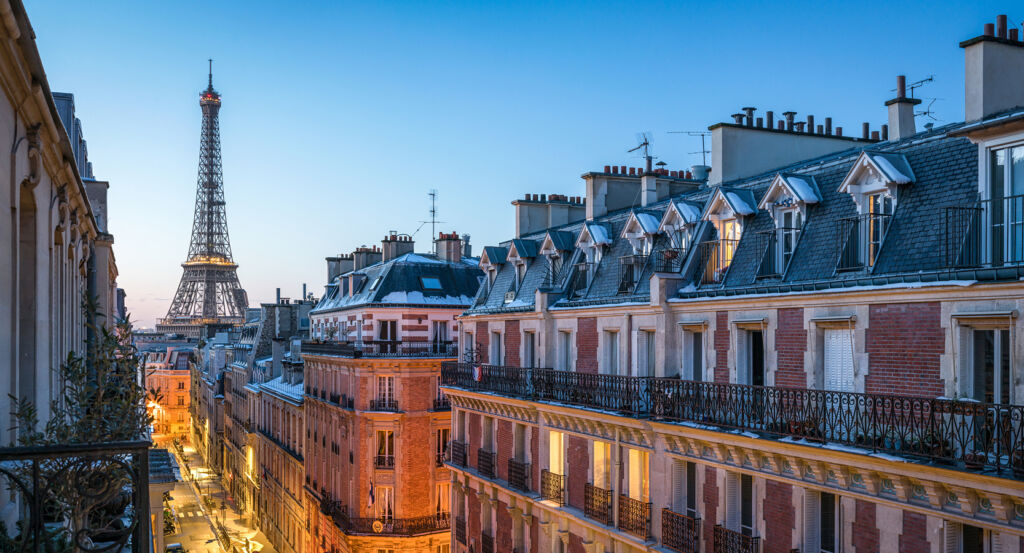
Set along Rue Chevert near Avenue de la Motte-Picquet and just steps from Place Salvador Allende, the hotel occupies a quiet 7th Arrondissement block where narrow residential streets connect the École Militaire district with the formal avenues extending across western Paris. Its masonry façade rises through regularly spaced openings and wrought-iron balconies beneath an upper level incorporated into the Paris roofscape. The interiors combine carved headboards, patterned textiles, botanical wall treatments and contemporary furnishings across spaces substantially reconfigured during the property's late twentieth-century reconstruction. Upper levels extend sightlines across the surrounding roofs toward major monuments rising beyond the compact Rue Chevert streetscape. The result is a hotel whose intimate physical scale and multigenerational stewardship preserve a form of independent Paris hospitality developed continuously by one family since 1967.
What defines Hotel Muguet.
Hotel Muguet is best known for passing through three generations of the same family since MICHELINe and Élie Lherbeil acquired the property in 1967 and converted an older model of long-stay Paris lodging into an increasingly modern independent hotel. The corporate enterprise behind the address had been created in 1957, establishing a hospitality business at 11 Rue Chevert a decade before the Lherbeils began the family chapter. MICHELINe and Élie inherited a property whose clientele consisted largely of French employees lodging for extended periods and sharing a communal kitchen. Élie also became known locally for sheltering stray cats, with as many as twenty living in the courtyard during one period, giving the early family hotel an unusually domestic character. Catherine succeeded her parents in 1992 and immediately undertook the most consequential physical intervention in the property's modern history. Nine months of closure accompanied a reconstruction that removed virtually every interior element beyond the load-bearing walls. The completed project moved Hotel Muguet from two-star to three-star classification and replaced its inherited long-stay configuration with a hotel designed around shorter individual stays. Catherine subsequently guided the business through the arrival of internet distribution, moving an operation once dependent on telephone reservations into websites and third-party booking platforms. Charline Pelletier joined Catherine at age twenty-eight before assuming the directorship at thirty-seven, carrying the property into a third family generation. Charline Pelletier is president of Hotel Muguet, preserving the connection between the operating company and the family whose stewardship began in 1967. The sequence gives Rue Chevert an independent hotel shaped by one decisive architectural reconstruction and a succession from grandparents to daughter to granddaughter across nearly six decades.
How Hotel Muguet fits.
Hotel Muguet works as the residential anchor for an outing connecting an eighteenth-century mansion preserved through Auguste Rodin's extraordinary donation, a modernist international headquarters created by three major architects and a nineteenth-century church whose engineering joined classical form with an internal metal structure.
Begin at Musée Rodin, housed in the Hôtel Biron, the rocaille mansion Jean Aubert designed for financier Abraham Peyrenc de Moras between 1727 and 1737. Henri Matisse, Jean Cocteau, Isadora Duncan and Clara Westhoff belonged to the artistic tenants who occupied the property after 1905, and Westhoff's connection with Rainer Maria Rilke led Auguste Rodin to the building. Rodin rented four ground-floor spaces in 1908 and occupied the entire mansion from 1911. A 1916 law accepted his donations of sculpture, drawings and antiquities to France and assigned Hôtel Biron to the future museum, which opened in 1919. Continue to Maison de l'UNESCO, the international organization's modernist headquarters designed by Bernard Zehrfuss, Marcel Breuer and Pier Luigi Nervi under the supervision of a committee including Walter Gropius, Le Corbusier and Lucio Costa. Its principal Y-shaped structure rests on 72 concrete pilotis, combining Nervi's structural engineering with a plan conceived for international administration and diplomacy. Isamu Noguchi created the Japanese garden, and the art collection grew to more than 1,000 works by figures including Pablo Picasso and Alexander Calder. A later meditation space by Tadao Ando extended the complex's architectural authorship into another generation of international modernism. Conclude at Église Saint-François-Xavier, begun in 1861 under Adrien Lusson and completed under Joseph Uchard in 1873 as the surrounding western Left Bank underwent major nineteenth-century development. Its neo-Renaissance façade is flanked by square towers and carries Gabriel-Jules Thomas's sculpted fronton depicting Francis Xavier baptizing people in Asia. An internal metal structure supports the vault directly on the lateral walls, eliminating the structural requirement for conventional flying buttresses. Jean-Marie Bonnassieux created the Virgin in the axial chapel, adding another major Second Empire sculptural commission to the building. Monument Historique protection in 2018 recognized the church in its entirety. The progression moves from an eighteenth-century private mansion secured for the nation by an artist through an international modernist headquarters built around architectural collaboration and culminates in a nineteenth-century church where metal engineering operates behind a historically derived exterior.
Where your story begins.
Foresyte Travel reveals places that feel extraordinary long before you arrive.
Enjoy editorial crafted for luxury travelers.














































































































