
Why Hyde Park matters.
Hyde Park is a vast royal park where Knightsbridge's ceremonial character meets centuries of royal landscape making, equestrian tradition and an extraordinary concentration of open water, grassland and mature trees at the western edge of Central London.
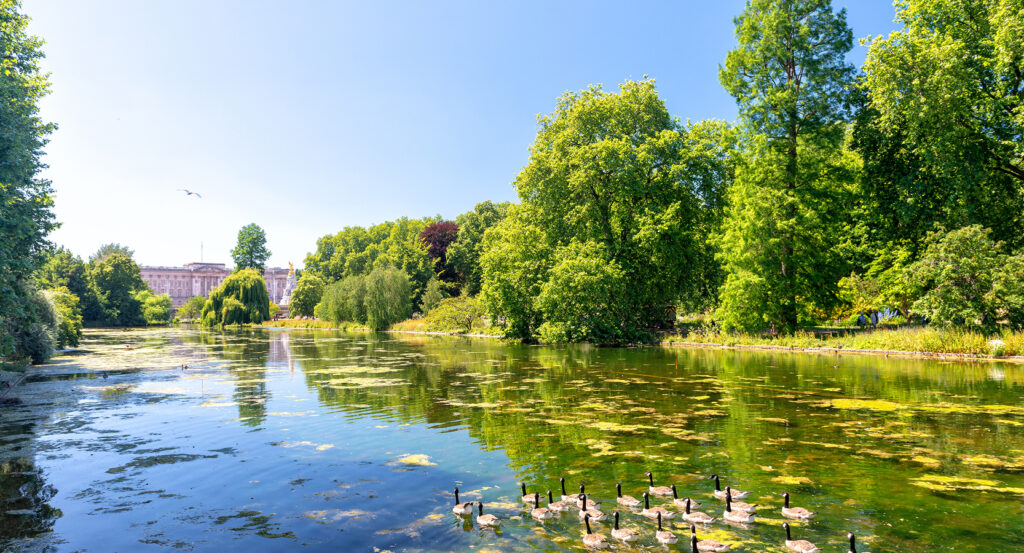
Set along Knightsbridge near Park Lane and just steps from Exhibition Road, the park occupies 350 acres between some of Central London's densest residential and commercial districts, with broad lawns and tree-lined routes unfolding around the Serpentine. Queen Caroline's eighteenth-century landscaping remains fundamental to the physical setting, with the dammed Westbourne forming an irregular lake whose naturalistic outline broke from the straight formal waters fashionable in earlier European gardens and subsequently influenced park design elsewhere. Long paths, open grass and mature avenues establish the primary encounter at metropolitan scale, allowing movement on foot, bicycle and horseback to cross terrain whose openness changes markedly between wooded edges, waterside stretches and expansive lawns. Rotten Row adds a second mechanism through a sandy riding track descended from William III's seventeenth-century route between Kensington Palace and Whitehall, a journey protected after the king ordered 300 oil lamps installed along the dangerous road in 1690. The result is a park where royal engineering, landscape experimentation and centuries of public movement remain embedded in an immense green composition at the center of London.
What defines Hyde Park.
Hyde Park is best known for evolving from a monastic estate acquired by Henry VIII into a public royal park that became a setting for recreation, national performance and mass political assembly. Henry took the land from Westminster Abbey in 1536 and incorporated it into his royal hunting grounds, beginning a period in which access remained controlled by the Crown. James I opened the park selectively to courtiers and members of fashionable society after his accession in 1603 before Charles I opened it to the general public in 1637, fundamentally changing its relationship with London. The park assumed an emergency function during the Great Plague of 1665 when people escaping infected districts of the city established a temporary camp there. Charles I had also commissioned the Ring, a circular carriage drive that became a fashionable arena for riding and social display, establishing an association between Hyde Park and public performance long before its nineteenth-century mass events. The Prince Regent staged an immense celebration there in 1814 during festivities associated with the defeat of Napoleon, including a re-creation of the Battle of Trafalgar on the Serpentine. Joseph Paxton's Crystal Palace transformed the park again for the Great Exhibition of 1851, when more than 100,000 objects from over 15,000 contributors were assembled beneath its glass and iron structure and six million admissions were recorded during the exhibition's run. The building subsequently moved to Sydenham, yet the event established Hyde Park as a setting capable of accommodating international performance on a scale far beyond its earlier role as royal hunting ground and fashionable promenade. The sequence from Tudor enclosure through Stuart public access, plague refuge and Victorian exhibition ground established the park as an unusually adaptable piece of royal land within the expanding capital.
Political assembly created another consequential history as Hyde Park became one of Britain's most important stages for organized demands for representation and civil rights. Reform League demonstrators marched toward the park on 23 July 1866 after Home Secretary Spencer Walpole prohibited their planned meeting, and clashes followed when police closed the gates and sections of the crowd broke through the railings. The confrontation strengthened pressure surrounding parliamentary reform, and the Reform Act followed in 1867 before the Parks Regulation Act of 1872 formalized the right to organize meetings within the park under regulated conditions. Speaker's Corner developed at the northeastern edge as the most enduring expression of that culture of public address, attracting speakers associated with socialist, labor and suffrage movements. William Morris, Karl Marx and Vladimir Lenin became connected with its tradition of political oratory, extending the space beyond parliamentary reform into debates over economic and social organization. Women's suffrage organizations repeatedly mobilized Hyde Park during the early twentieth century, culminating in the Women's Sunday demonstration of 21 June 1908, when processions converged on the park and 300,000 people assembled in support of votes for women. Sylvia Pankhurst and fellow campaigners subsequently maintained the association between Speaker's Corner and suffrage activism through further rallies. Hyde Park's political significance developed through the physical occupation of public ground, turning a former royal hunting preserve into a nationally consequential arena for speech, assembly and campaigns seeking changes in British law.
How Hyde Park fits.
Hyde Park works as the anchor for a daytime exploration through three nearby Mayfair sites connecting Georgian estate development, nineteenth-century Catholic revival and two radically different eras of musical creation.
Begin at Grosvenor Chapel, where Sir Richard Grosvenor laid the foundation stone on 7 April 1730 after leasing the site at a peppercorn rent to four developers led by builder Benjamin Timbrell. Completed by April 1731, the chapel adopted a restrained classical composition influenced by contemporary churches including James Gibbs's St. Martin-in-the-Fields, with two tiers of arched windows, a western portico and galleries surrounding an interior originally organized around box pews. John Ninian Comper radically altered that Georgian arrangement in 1912, bringing the communion rails forward, creating a new sanctuary, installing a rood above giant Ionic columns and adding stained glass carrying his characteristic strawberry emblem. Continue to Farm Street Church, conceived after Catholic Emancipation as the Jesuits sought a permanent London church and opened in 1849 following the initiative of English Jesuit superior Randal Lythgoe. The site's secluded position behind Mayfair streets answered contemporary restrictions and sensitivities surrounding Catholic building, yet the church was conceived on an ambitious scale for a congregation of 900. Farm Street operated until 1966 as the Jesuits' Central London church without parish status, developing particular associations with preaching, confession, converts and artistic patronage before becoming a parish within the Diocese of Westminster. Conclude at Handel Hendrix House, where George Frideric Handel leased 25 Brook Street in 1723 and remained until his death in 1759, composing, rehearsing performers and conducting musical business within the Georgian rooms. Jimi Hendrix occupied the adjoining upper-floor flat at 23 Brook Street from July 1968 to March 1969, using it for interviews, rehearsals and songwriting during his London career. Stanley Sadie revived proposals for a Handel museum in 1959, later establishing the Handel House Trust with Julie Anne Sadie; the Handel House Museum opened in 2001, Hendrix's restored flat followed in 2016, and the subsequent Hallelujah Project restored further areas of Handel's residence. The progression moves from Grosvenor patronage and Comper's remaking of a Georgian chapel through the Jesuits' post-Emancipation establishment in Mayfair into adjoining homes occupied by Handel and Hendrix more than two centuries apart, revealing surrounding streets shaped by religious patronage, architectural reinvention and sustained artistic production.
Where your story begins.
Foresyte Travel reveals places that feel extraordinary long before you arrive.
Enjoy editorial crafted for luxury travelers.
Foresyte may earn a commission when you book.














































































































