
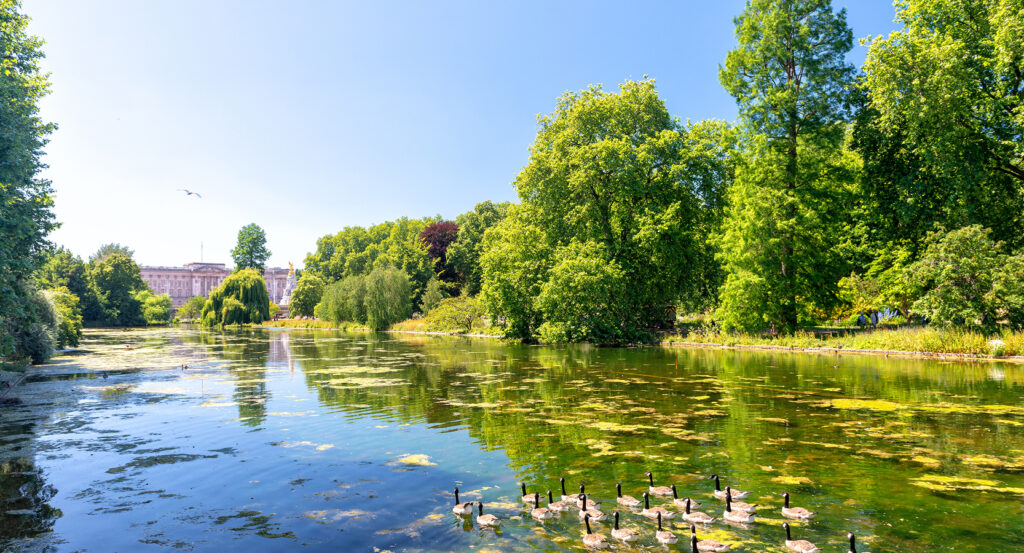
Why The Serpentine matters.
The Serpentine is a sweeping ornamental lake where Hyde Park's royal landscape character meets Georgian naturalism, open water and a sinuous shoreline that transformed the visual structure of one of London's great public parks.
Set within Hyde Park near West Carriage Drive and just steps from the broad lawns that descend toward its banks, the lake occupies a long natural valley extending westward into Kensington Gardens as the Long Water. Curving shores prevent the full body of water from resolving into a single view, allowing trees, lawns, bridges and distant architecture to enter and disappear as the path follows its perimeter. Rowing boats and pedal boats carry movement onto the surface, shifting the encounter from shoreline observation to an open-water perspective across the surrounding park. Waterfowl gather around reed beds and quieter edges, and broad stretches of sky above the lake create an unusual sense of visual distance within Central London. The result is a body of water that reorganizes Hyde Park around changing views, recreation and ecology, preserving the eighteenth-century principle that an engineered lake should read as part of the terrain itself.
What defines The Serpentine.
The Serpentine is best known for Queen Caroline's transformation of the Westbourne valley into one of Britain's earliest artificial lakes designed to appear natural. Henry VIII had acquired the land forming Hyde Park from Westminster Abbey in 1536, bringing into royal ownership terrain where monastic ponds supplied fresh water and fish. Queen Caroline initiated a comprehensive remaking of the western royal landscape during the reign of George II, annexing close to 300 acres from Hyde Park to expand Kensington Gardens and commissioning major changes across the adjoining ground. Charles Wither, Surveyor-General of His Majesty's Woods, oversaw creation of the lake in 1730-31, and Charles Bridgeman developed the wider garden design around it. Existing ponds along the Westbourne were merged as the stream was dammed, producing a continuous body of water whose irregular outline followed the valley instead of adopting the straight geometry prevalent in artificial lakes of the period. Bridgeman simultaneously employed a ha-ha to divide Kensington Gardens from Hyde Park without interrupting long views across the terrain, joining concealed boundary engineering with the new water composition. The serpentine form proved influential across British landscape design, with similarly naturalistic artificial lakes subsequently appearing in parks and country estates elsewhere. Queen Caroline's project altered more than the appearance of Hyde Park: it helped establish irregular water, concealed boundaries and continuous terrain as powerful instruments in the development of the English landscape garden.
The lake's hydrology underwent another fundamental transformation as London expanded around the royal parks and the Westbourne ceased to function as a suitable exposed watercourse. Increasing contamination eventually drove the river underground, severing the direct natural supply on which the original Georgian composition had depended. Replacement water was subsequently brought from the Thames before another supply arrangement drew water from a well in St. James's Park, turning maintenance of the ornamental lake into a managed hydraulic operation. The Royal Parks changed that system again in 2011 through the introduction of boreholes, establishing a new source beneath the metropolitan landscape. The eastern end retains the physical logic of the original dam, with water passing underground at Dell Bridge before the buried Westbourne continues toward the Thames. This sequence of buried river, imported supply and groundwater extraction has allowed the eighteenth-century outline to survive despite the disappearance of the hydrological conditions from which it emerged. The Serpentine preserves Queen Caroline's landscape intervention through an engineered water system that has repeatedly adapted to the growth and environmental pressures of London.
How The Serpentine fits.
The Serpentine works as the anchor for a park route through three nearby sites that move from the institutional history of open-water swimming through Edwardian literary sculpture and into Victorian commemoration on the southern edge of Kensington Gardens.
Begin at Serpentine Lido, where organized swimming developed into one of the lake's longest continuing recreational traditions through the Serpentine Swimming Club, formed in 1866 and now recognized by The Royal Parks as Britain's oldest swimming club. George Lansbury, serving as First Commissioner of Works, directed construction of the Lido Pavilion in 1930 after the Sunlight League pressed for mixed bathing and sunbathing; Major Colin Cooper contributed £5,000 toward the project, and women gained open access to swimming there as part of the new arrangement. Continue to Peter Pan Statue beside the Long Water, where J. M. Barrie converted his literary relationship with Kensington Gardens into a permanent sculptural commission in 1912. Barrie had lived at 100 Bayswater Road and drew on the park for The Little White Bird and the mythology that developed into Peter Pan; he personally funded the bronze and placed it at the fictional point where Peter reaches the shore in his bird-nest boat. Conclude at Albert Memorial, commissioned by Queen Victoria after Prince Albert died of typhoid in 1861 and designed by Sir George Gilbert Scott in the High Victorian Gothic tradition. Unveiled in 1872, the memorial took inspiration from medieval Eleanor Crosses, and John Henry Foley's gilded figure of Albert followed in 1875, holding the catalogue of the Great Exhibition that the prince had helped organize in Hyde Park. The progression moves from Serpentine Lido's institutionalization of public swimming through Peter Pan Statue's conversion of Kensington Gardens into literary geography and into Albert Memorial's union of royal commemoration with the legacy of the Great Exhibition, extending The Serpentine through distinct layers of London's recreational, literary and imperial history.
Where your story begins.
Foresyte Travel reveals places that feel extraordinary long before you arrive.
Enjoy editorial crafted for luxury travelers.
Foresyte may earn a commission when you book.














































































































