
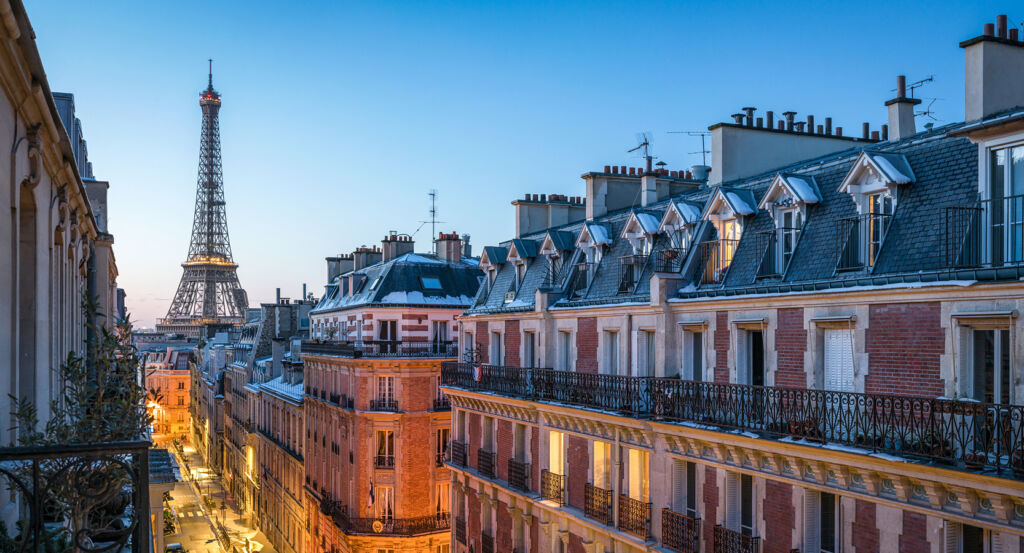
Why you should experience Idol Hotel in Paris, France.
Idol Hotel is a music-driven boutique hotel where Europe's instrument-making district, Saint-Lazare's metropolitan rhythm, 1960s-to-1980s soul culture and Julie Gauthron's exuberant design converge inside a 32-room tribute to jazz, funk and Black American music.
Set along Rue d'Édimbourg near Rue de Moscou and just steps from Gare Saint-Lazare, the four-star hotel was completely reinvented after hotelier Yann Gasparini took over the property and commissioned artist and interior designer Julie Gauthron to translate his lifelong passion for jazz, soul and funk into architecture. Gauthron approached individual rooms like record sleeves and stage sets, building intensely differentiated environments around saturated color, patterned carpeting, mirrored surfaces, velvet and musical references extending from Stevie Wonder and Nina Simone to Marvin Gaye and the psychedelic visual language surrounding late twentieth-century popular music. The contemporary property contains 32 rooms and suites equipped with Elipson Bluetooth Hi-Fi systems, while categories including Light My Fire, Moon Blue, Lady Soul, Joy, Blue Sunshine, My Chérie Amour and Feeling Good turn song titles and musical moods into distinct accommodation identities. The result is a hotel where sound, graphic design and color operate as the primary architectural style within a district historically connected with musicians through nearby Rue de Rome and its concentration of instrument makers.
What you should know about Idol Hotel.
Idol Hotel is best known for being completely reinvented by hotelier and record collector Yann Gasparini with artist and interior designer Julie Gauthron as a 32-room celebration of Black American music spanning soul, jazz and funk from the 1960s through the 1980s. Gasparini conceived the musical character from his own immersion in jazz and soul-funk, while Gauthron translated that collection into interiors inspired by album artwork and music-video environments, creating individual visual worlds whose names reference songs and musical culture through Light My Fire, Moon Blue, Lady Soul, Joy, Give Me the Night, Blue Sunshine, My Chérie Amour and Feeling Good. Elipson Bluetooth Hi-Fi speakers appear throughout the accommodation program, making sound equipment a functional extension of the concept alongside Nespresso machines, Nuxe products, minibars and individually controlled air conditioning. Feeling Good develops the suite program around a private hammam, while Blue Sunshine and My Chérie Amour incorporate illuminated bathtubs, extending Gauthron's theatrical use of light and color directly into the bathing spaces. Idol Hotel consequently operates as a remarkably concentrated collaboration between Gasparini's musical knowledge and Gauthron's visual authorship, with the 32-room scale allowing individual songs, performers, colors and design gestures to retain distinct identities rather than becoming a generalized music theme.
Julie Gauthron provides the strongest visual authorship throughout Idol Hotel, translating Yann Gasparini's soul-funk and jazz references into saturated palettes, graphic patterns and room compositions conceived with the visual immediacy of vinyl sleeves and music videos. Yann Gasparini provides the musical structure behind Gauthron's interiors through his personal relationship with jazz, soul and funk, establishing the 1960s-to-1980s repertoire that determines the hotel's names, atmosphere and cultural references. Elipson carries that musical premise into the guestrooms through Bluetooth Hi-Fi equipment, allowing the French audio manufacturer's speakers to make listening part of the functional room program rather than leaving music solely within the decorative concept. Nuxe complements Gasparini and Gauthron's physical approach through French skincare products placed across the accommodation categories, while Pommery appears within the hotel's dedicated packages through half-bottles of Pop Champagne paired with suites including Feeling Good.
How to fold Idol Hotel into your trip.
Idol Hotel works as the anchor for an afternoon tracing Romantic painting, nineteenth-century musical society and private artistic collections through the neighborhoods surrounding Saint-Lazare.
Begin at Musée de la Vie Romantique, where painter Ary Scheffer settled on Rue Chaptal in 1830 and established studios that became gathering places for George Sand, Frédéric Chopin, Eugène Delacroix, Franz Liszt, Gioachino Rossini and other figures who shaped the artistic culture of Nouvelle Athènes. Continue to Musée Gustave Moreau, where Symbolist painter Gustave Moreau commissioned architect Albert Lafon in 1895 to enlarge his family residence with vast upper-floor studios intended to preserve thousands of paintings, watercolors and drawings before the museum opened in 1903. Conclude at Musée national Jean-Jacques Henner, occupying the mansion painter Guillaume Dubufe purchased as his home and studio in 1878 before Marie Henner acquired it from his heirs in 1921, commissioned Marcel Legendre to convert the residence and opened the museum in 1924. The progression moves from Scheffer's music-filled Romantic salons through Moreau's self-authored artistic archive into Dubufe and Henner's private studio world, creating a cultural sequence that places Idol Hotel's own relationship between music, visual art and authored interiors within the creative history of northwestern Paris.
Where your story begins.
Foresyte Travel reveals places that feel extraordinary long before you arrive.
Experience premium editorial crafted for luxury travelers.














































































































