
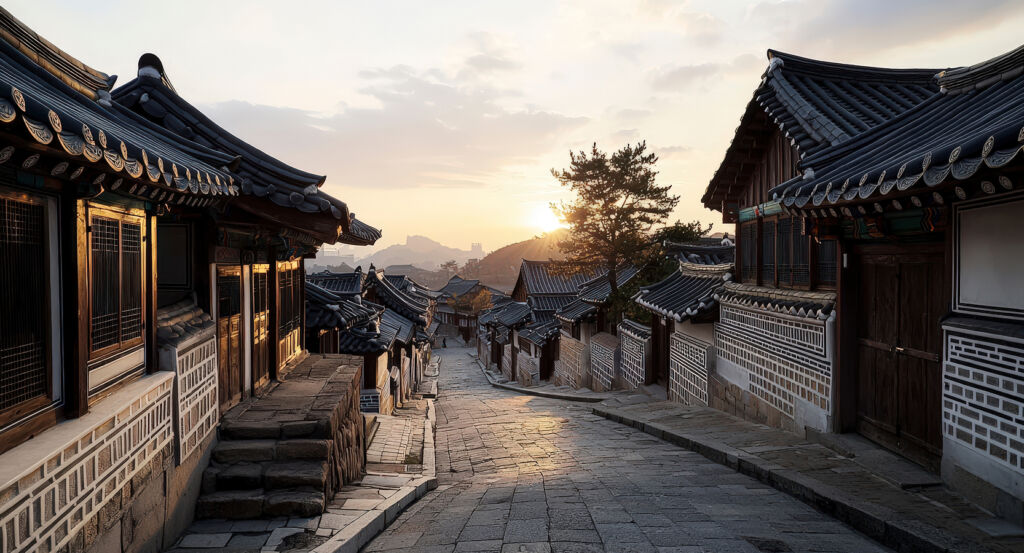
Why Insa-dong Culture Street matters.
Insa-dong Culture Street is a traditional arts corridor where Insa-dong's Joseon-era scholarly heritage meets Seoul's historic art trade, the preservation of Korean calligraphy and craftsmanship, and the concentration of galleries, antique dealers and teahouses within the capital's former administrative center.
Running along Insadong-gil between Anguk-dong and Jongno 2-ga, the cultural corridor occupies the heart of Jongno-gu, a short walk from Anguk Station and Tapgol Park, with narrow commercial alleys extending toward the historic residential quarters of northern Seoul. Low-rise shopfronts alternate with traditional Korean buildings, galleries and contemporary commercial structures. Pedestrian passages connect the main thoroughfare with enclosed courtyards containing restaurants, craft workshops and teahouses. Korean-language signs distinguish storefronts along the route, reinforcing the street's association with traditional cultural commerce. The result is a historic shopping district where Korean artistic production, specialized retail businesses and pedestrian public space remain closely connected.
What defines Insa-dong Culture Street.
Insa-dong Culture Street is best known for its traditional Korean art galleries, antique shops, calligraphy supplies and role in preserving Seoul's historic artistic commerce. During the Joseon dynasty, the surrounding district formed part of Hanyang, the royal capital established in 1394 under King Taejo. Its proximity to the principal royal and administrative quarters encouraged the settlement of government officials, scholars and members of the educated elite. The area contained government offices associated with public administration and the regulation of official conduct. Dohwaseo, the royal painting bureau, maintained a historical association with the district through the training and examination of court painters. Artistic production formed an important component of Joseon government, with painters commissioned to produce portraits, ceremonial images and visual representations of court activities. The surrounding commercial streets subsequently developed businesses associated with painting, mounting, paper and other specialized artistic supplies. During the Japanese colonial period, the dispersal of aristocratic household collections contributed to the growth of antique dealing in Central Seoul. Dealers acquired paintings, ceramics, furniture and other objects associated with Korea's historical artistic traditions. Following liberation in 1945 and the Korean War, the district developed further as a center for galleries, antiquarian booksellers and traditional craft merchants. Its concentration of specialist businesses attracted collectors, artists and scholars interested in Korean painting and material culture. During the later twentieth century, redevelopment pressures threatened the continuity of traditional businesses within Seoul's expanding commercial center. Seoul designated Insa-dong a Street of Traditional Culture in 1988, recognizing its importance as a center of Korean artistic commerce. In 2002, the municipal government designated Insa-dong as Seoul's first cultural district, establishing a structure for preserving and promoting its specialized commercial character. These measures strengthened the relationship between traditional cultural businesses and the district's development as a pedestrian-oriented destination.
Dohwaseo's association with professional painting provides a historical foundation for the artistic businesses distributed throughout the street's galleries and adjoining alleys. Korean calligraphy shops contain brushes, inkstones, handmade paper and other implements associated with brush-based writing and painting. Hanji, the traditional Korean paper manufactured from the inner bark of paper mulberry trees, appears in stationery, decorative objects and specialized artistic supplies. Shops selling ceramic wares contain celadon, white porcelain and contemporary interpretations of forms developed during the Goryeo and Joseon periods. Antique dealers display wooden furniture, lacquerware and decorative objects associated with historical Korean domestic interiors. Commercial galleries present ink painting, calligraphy, sculpture and works by contemporary Korean artists. Traditional mounting workshops preserve techniques used to prepare paintings and calligraphic works for hanging scrolls and framed display. Teahouses occupy converted hanok buildings and enclosed courtyards, incorporating timber beams, tiled roofs and interior arrangements associated with Korean domestic architecture. Their menus include green tea, jujube tea, citron tea and other preparations connected with Korean tea customs. Traditional restaurants serve dishes such as bibimbap, jeon and seasonal Korean set meals in dining rooms distributed through the adjoining alleys. Street vendors prepare hotteok, the filled pancakes associated with Korean street food, alongside other portable snacks. Weekend pedestrian restrictions create additional space for outdoor stalls and cultural performances. The district's commercial arrangement encourages movement between specialist shops, small galleries and enclosed architectural spaces. Its combination of artistic trades and food businesses preserves the relationship between traditional craftsmanship and Seoul's urban commercial development.
How Insa-dong Culture Street fits.
Insa-dong Culture Street works as the cultural centerpiece for a Jongno itinerary connecting contemporary Korean craftsmanship, Buddhist religious architecture and the preservation of royal residential traditions within Seoul's historic center.
Begin at Ssamziegil, the craft and shopping complex situated along the central section of Insadong-gil. Opened in 2004, the four-story building organizes small commercial premises around an open central courtyard. A continuous sloping walkway connects its levels, allowing pedestrians to ascend through the complex along a gradually rising route. Its shops specialize in handmade jewelry, ceramics, stationery and other objects produced by Korean craftspeople and designers. Workshops provide opportunities to observe traditional and contemporary craft techniques. The building's architectural arrangement integrates small-scale commercial spaces with public circulation and exhibition areas. Continue to Jogyesa Temple, the principal temple of the Jogye Order of Korean Buddhism, situated northeast of the street. The institution developed from Gakhwangsa, established in 1910 during efforts to reorganize Korean Buddhist institutions in the modern period. Its principal worship hall, Daeungjeon, contains Buddhist images and ceremonial furnishings associated with Korean temple traditions. The grounds contain mature trees, stone monuments and spaces used for religious observances. Jogyesa plays an important role in celebrations associated with Buddha's Birthday, including lantern displays and public ceremonies. Its location connects the surrounding commercial district with the institutional history of Korean Buddhism. Conclude at Unhyeongung Palace, the former residence associated with Heungseon Daewongun, father of King Gojong. The compound became an important political residence during the nineteenth century, particularly after Gojong ascended the throne in 1863. Its surviving buildings incorporate timber construction, tiled roofs and courtyards characteristic of upper-class Joseon residential architecture. Norakdang served as a ceremonial building and hosted the wedding celebrations of King Gojong and Queen Min in 1866. Noandang functioned as a reception and administrative space associated with Heungseon Daewongun's political activities. The preserved compound provides an architectural record of royal household life during the final decades of the Joseon dynasty. The progression moves from contemporary craft commerce through Korean Buddhist institutions and culminates in nineteenth-century royal domestic architecture, connecting Insa-dong Culture Street with the artistic, religious and political history of Central Seoul.
Where your story begins.
Foresyte Travel reveals places that feel extraordinary long before you arrive.
Enjoy editorial crafted for luxury travelers.
Foresyte may earn a commission when you book.

















































































































