
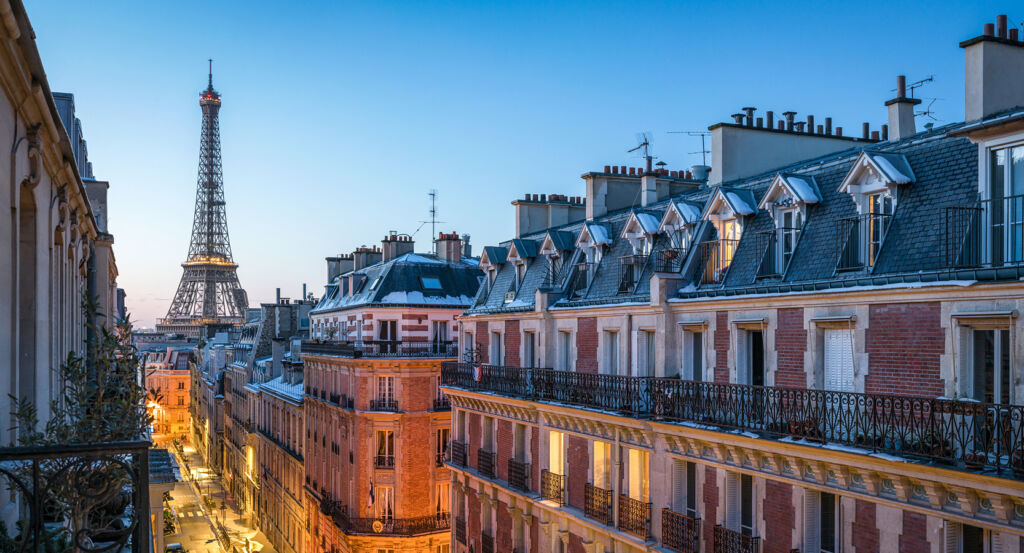
Why you should experience Kimpton St. Honoré Paris in Paris, France.
Kimpton St. Honoré Paris is an Art Nouveau luxury hotel where Gaillon's grand-boulevard character, Parisian department-store history, Charles Zana's contemporary French design and California-inflected hospitality converge inside the former Samaritaine de Luxe.
Set along Boulevard des Capucines near Rue Daunou and just steps from Palais Garnier, the five-star hotel occupies the former luxury branch commissioned by Samaritaine founders Ernest Cognacq and Marie-Louise Jaÿ from architect Frantz Jourdain, whose 1917 building survives through an Art Nouveau façade ornamented with floral ironwork, copper and mosaic alongside its historic staircase and elevator. Charles Zana reworked the interiors for Kimpton's 2021 opening, drawing from 1930s Art Deco and the residential proportions of Parisian apartments through custom furniture, parquet, carefully selected artworks, balconies and studio-style windows. The contemporary property contains 123 rooms and 26 suites, while Montecito introduces a planted interior patio, Sequoia crowns the building with 360-degree rooftop perspectives and the subterranean MAISON CODAGE spa incorporates an 11-meter heated pool. The resulting house layers Jourdain's early twentieth-century architecture with Zana's contemporary interpretation while preserving a direct connection to the commercial and collecting culture that made the Samaritaine name central to Paris.
What you should know about Kimpton St. Honoré Paris.
Kimpton St. Honoré Paris is best known for opening on August 23, 2021 as Kimpton Hotels & Restaurants' first property in France inside the Samaritaine de Luxe, the luxury department store Ernest Cognacq commissioned from Frantz Jourdain in 1917 to serve an affluent Opéra clientele and house his growing collection of eighteenth-century art. Jourdain designed the Boulevard des Capucines building with Georges Bourneuf following construction begun during World War I, developing an Art Nouveau composition of floral railings, copper colonnettes, vegetal capitals and mosaic bands depicting climbing plants and blue hydrangeas, while the interior staircase and elevator continued the same botanical vocabulary. Ernest Cognacq began mounting temporary exhibitions from his private collection inside Samaritaine de Luxe by 1925, acquired eighteenth-century wood paneling for a permanent museum project in 1927 and left the collection to the City of Paris when he died in 1928, establishing the foundation of the present Musée Cognacq-Jay. The building later passed through commercial and office uses before its reconstruction as a five-star hotel, with Charles Zana undertaking a complete interior renovation that organized 149 accommodations into 123 guestrooms and 26 suites inspired by 1930s Art Deco and Parisian apartments. Zana preserved the discussion with Jourdain's architecture through balconies, studio windows, custom furniture and selected artworks, while Kimpton retained the historic staircase and elevator as defining elements of the original department store.
Montecito develops the strongest contemporary cultural counterpoint through interiors by Humbert & Poyet and a culinary program led by Executive Chef Nicolas Pastot, created with Paris-based American chef and cookbook author Carrie Solomon, Revival chef Patrick Prager and Paris Society as advisers. The restaurant interprets the multicultural cooking of America's Pacific coast through local ingredients, French technique and Mexican, Japanese and Levantine influences, while its broad dining room surrounds a patio planted with a living wall. MAISON CODAGE carries the French creative program underground through personalized treatments beside an organically shaped indoor pool measuring 11 meters long and 1.2 meters deep, complemented by sauna, hammam and fitness facilities. Sequoia completes the vertical progression on the roof, opening the former department store toward 360-degree perspectives across the Paris skyline. Together, Frantz Jourdain, Charles Zana, Humbert & Poyet, Nicolas Pastot and MAISON CODAGE connect architecture, interior design, gastronomy and wellness across a building whose cultural history began more than a century before Kimpton arrived.
How to fold Kimpton St. Honoré Paris into your trip.
Kimpton St. Honoré Paris works as the anchor for an afternoon tracing perfume, decorative arts and opera through the institutions surrounding Boulevard des Capucines.
Begin at Musée du Parfum Fragonard, housed inside the former Éden-Théâtre complex near Square de l'Opéra-Louis-Jouvet, where Fragonard presents historic perfume bottles, pomanders, travel cases and distillation equipment alongside the techniques that shaped French fragrance production. Continue to Musée des Arts Décoratifs, whose collections inside the Louvre's Marsan wing trace furniture, jewelry, fashion, graphic design, glass, ceramics and interior decoration across centuries of French creative production. Conclude at Palais Garnier, where Charles Garnier's winning design from the 1861 competition became the new Paris opera house under Napoleon III, with construction extending until its 1875 inauguration and architecture combining marble, sculpture, painting, gilding and an auditorium conceived as much for nineteenth-century social ritual as performance. The progression moves from perfume craftsmanship through decorative-art collecting into Garnier's synthesis of architecture and theater, creating a cultural sequence that places Kimpton St. Honoré Paris and Frantz Jourdain's Samaritaine de Luxe within the broader history of design surrounding the Opéra district.
Where your story begins.
Foresyte Travel reveals places that feel extraordinary long before you arrive.
Experience premium editorial crafted for luxury travelers.














































































































