
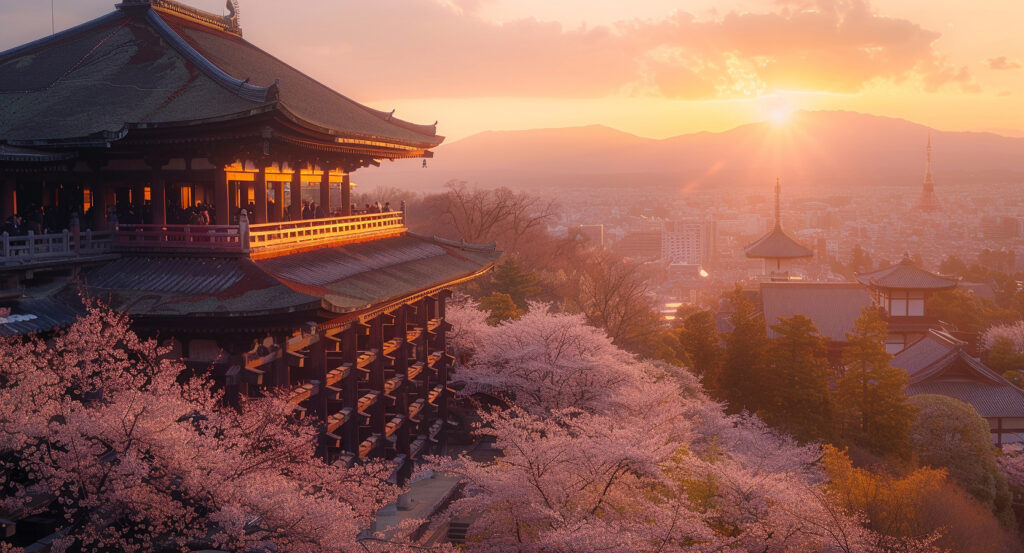
Why you should experience Nio-mon Gate in Kyoto, Japan.
Nio-mon Gate is the ceremonial heartbeat of Kiyomizu-dera, a radiant threshold between the everyday and the eternal.
Standing at the top of the cobbled Sannenzaka approach, this towering vermilion structure marks the moment Kyoto begins to feel ancient again. The gate seems to shimmer in the morning light, its lacquered beams glowing against the green folds of Mount Otowa. As you pass beneath it, incense drifts through the air, mixing with the faint scent of rain-soaked cedar. Two fierce guardian statues, the Niō, flank the entrance, muscles coiled, eyes ablaze, frozen mid-protection. They stand not in menace, but in balance: one with its mouth open, uttering the cosmic “A,” the other closed, forming the “Un.” Together, they symbolize the beginning and end of all things. To walk between them is to symbolically step through the boundary of time, from the noise of Kyoto's streets into a realm shaped by spirit, wood, and wind. Nio-mon Gate doesn't just frame the temple; it frames the act of reverence itself.
What you should know about Nio-mon Gate.
Nio-mon Gate, sometimes called the “Deva Gate,” has guarded Kiyomizu-dera for centuries, surviving fires, wars, and the steady touch of countless pilgrims' hands.
The original structure dates back to the early 16th century, though it was destroyed and rebuilt multiple times, most recently in the 17th century under the Tokugawa shogunate. Its vivid vermilion hue isn't merely aesthetic, it's protective. The natural pigment, made from mercury and cinnabar, was believed to ward off evil and insects alike, ensuring the sanctity and preservation of the wood. The two guardian deities inside were sculpted in the Kamakura period, carved from cypress with startling realism, veins, tendons, and expressions so lifelike they seem to breathe. Their purpose was not to frighten but to protect the sacred grounds from corruption, both physical and spiritual. The gate's symmetry captures Buddhist cosmology: harmony between creation and dissolution, strength and serenity. Look closely and you'll see the details, the curling lotus petals carved into the base, the phoenix motifs fluttering along the roof beams, the deep patina of centuries caught in the grain of the wood. Few visitors realize that Nio-mon also served as the temple's visual anchor for travelers approaching Kyoto from the east, a promise of salvation gleaming like fire above the trees.
How to fold Nio-mon Gate into your trip.
To experience Nio-mon Gate is to begin your journey through Kiyomizu-dera with awareness, not of where you're going, but of what you're crossing into.
Arrive just after sunrise if you can, when the morning light spills through the gate's open lattice and the air carries the faint chill of mountain mist. Stand still at the threshold and take in the view: the gate behind you, Kyoto unfurling below in pale gold, and the temple halls ahead rising into the forest. Step slowly between the Niō guardians, a quiet acknowledgment of entering sacred ground. Run your hand lightly along the balustrade; the wood is warm even in winter, smoothed by centuries of touch. From the gate, the path climbs toward the Three-Storied Pagoda and the Main Hall, each structure unfolding like chapters in a single prayer. If you visit at dusk, when the temple lights ignite, Nio-mon Gate glows like an ember, its red beams mirrored in the lantern-lit streets below. It becomes a beacon, calling you home to stillness. Whether you pass through once or a hundred times, Nio-mon Gate always feels new, as though time itself pauses for your arrival. In a city that lives and breathes history, this gate remains one of its most eloquent pauses, a threshold carved in devotion and guarded by eternity.
Where your story begins.
Foresyte Travel reveals places that feel extraordinary long before you arrive.
Experience premium editorial crafted for luxury travelers.

















































































































