
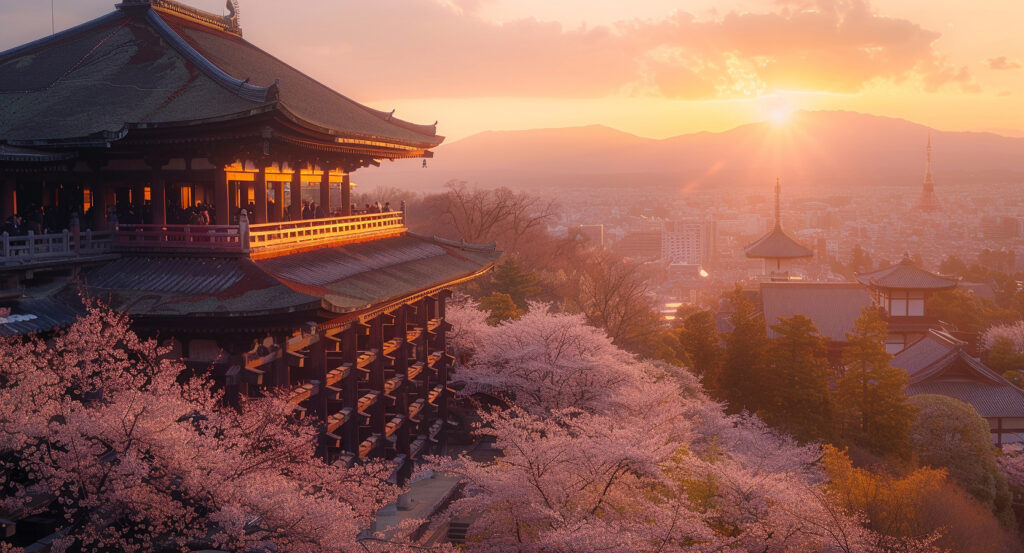
Why you should experience Otowa-no-taki Falls in Kyoto, Japan.
Otowa-no-taki Falls, or Otowa Waterfall, is the heart that beats beneath Kiyomizu-dera Temple, a sacred spring whose whisper has echoed through Kyoto for more than twelve centuries.
Tucked into a shadowed ravine at the base of the temple's great wooden stage, the waterfall flows with quiet constancy, its sound a gentle metronome for faith. Sunlight filters through cedar branches and turns the falling streams to silver, while pilgrims gather with ladles of bamboo to drink from its crystal waters. The air here feels cooler, almost electric, a mixture of purity, reverence, and the faint scent of moss rising from wet stone. You hear it before you see it: the rhythmic cascade, the soft laughter of visitors, the occasional chime of a temple bell drifting down from above. To stand before the Otowa-no-taki Falls is to feel Kyoto's soul in motion, not in grandeur or ceremony, but in simplicity. The water never shouts; it whispers. And somehow, that's what makes it eternal.
What you should know about Otowa-no-taki Falls.
The waterfall predates the temple that bears its name.
Long before the founding of Kiyomizu-dera in 778, this spring was already revered as a sacred natural site, believed to flow from the heart of Mount Otowa. When the monk Enchin received a vision of the Kannon Bodhisattva, the goddess of mercy, he followed the sound of these falling waters and discovered the spring tucked among cedars. It was here he built the first sanctuary that would evolve into one of Japan's most venerated temples. The name “Kiyomizu”, meaning “pure water”, comes directly from this source. The waterfall divides into three separate streams, each symbolizing a blessing: longevity, wisdom, and success in love. Yet tradition teaches restraint, to drink from all three is to court greed, and thus lose the favor of the divine. The architecture surrounding the waterfall, with its carved stone basins and wooden eaves, was later constructed to guide pilgrims in safe reverence while preserving the purity of the spring. The same water has flowed uninterrupted for over a thousand years, surviving fires, wars, and the shifting boundaries of belief. Today, it continues to draw both the devout and the curious, each seeking something intangible, not fortune, but clarity.
How to fold Otowa-no-taki Falls into your trip.
Visiting Otowa-no-taki Falls is the quiet reward of your journey through Kiyomizu-dera, the still point after awe.
Descend from the temple's main veranda via the stone steps that lead into the shaded forest. The shift in temperature and light is immediate, the heat of the crowd gives way to the cool, rhythmic drip of water and the scent of damp wood. At the base, you'll find the three falling streams, each caught in thin arcs over bronze ladles resting on long poles. Join the slow-moving line of visitors, each person waiting with patience and reverence. When it's your turn, take the ladle gently, let it fill, and raise it to your lips in one steady motion. The water tastes im clean, cold, mineral, alive. Don't rush. Pause to listen as it falls back into the basin, the sound soft but endless. Afterward, step aside and take in the scene: monks in saffron robes moving quietly between visitors, maple leaves flickering red above the wooden bridges, the faint echo of chanting from the halls above. Visit in the early morning or near twilight if you can, when the air glows gold and the temple lanterns begin to shimmer. Otowa-no-taki Falls is not just a feature of Kiyomizu-dera; it is its breath, the living current that has carried faith, patience, and purity across centuries. Drink once, and you'll remember its taste long after you've left Kyoto.
Where your story begins.
Foresyte Travel reveals places that feel extraordinary long before you arrive.
Experience premium editorial crafted for luxury travelers.

















































































































