
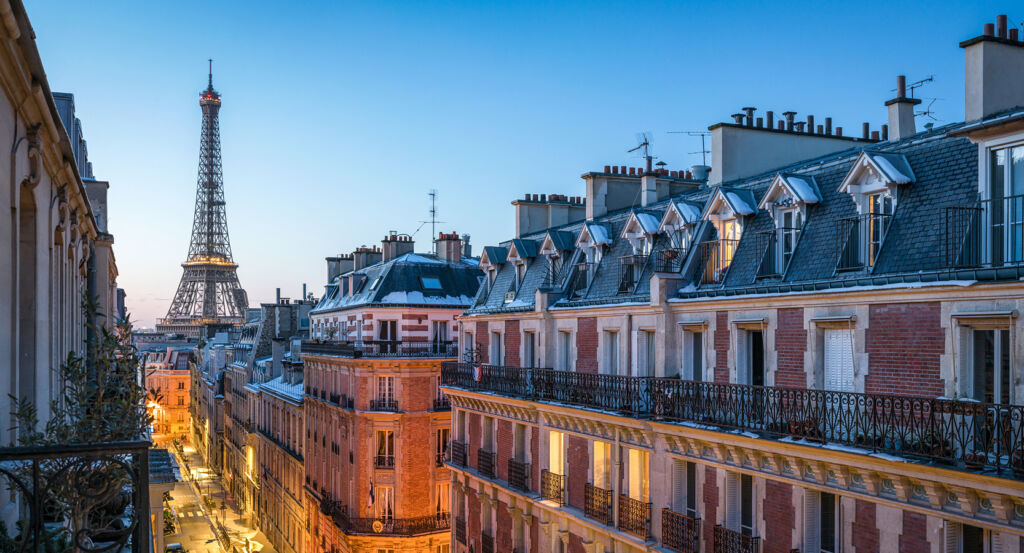
Why you should experience Le Lampika Hotel in Paris, France.
Le Lampika Hotel is an artistic boutique hotel where Montparnasse's creative character, interwar studio culture, Art Deco inheritance and enduring relationship with writers and artists converge inside a recently renovated address overlooking Place Denfert-Rochereau.
Set along Place Denfert-Rochereau near Avenue du Général Leclerc and just steps from Rue Daguerre, the four-star hotel occupies a building dating from the interwar period whose renovated façade draws directly from Art Deco and Art Moderne while retaining a compact period Parisian elevator inside. The property contains 40 rooms across eight categories, most with open Paris views, while interiors emphasize restrained contemporary lines and natural materials across accommodations beginning with 11-square-meter Single rooms and extending through larger Deluxe and connecting configurations. A seventh-floor breakfast room raises the social spaces above the surrounding rooftops before an eighth-floor planted terrace introduces panoramic views, an honesty bar and a dedicated Mölkky playing area reserved for hotel residents. The result is a hotel where interwar architectural character, contemporary design and rooftop hospitality reconnect a Place Denfert-Rochereau address with the creative character that made southern Montparnasse one of twentieth-century Paris's defining artistic territories.
What you should know about Le Lampika Hotel.
Le Lampika Hotel is best known for comprehensively renovating an interwar building at 28 Place Denfert-Rochereau into a 40-room, four-star hotel whose preserved architectural fabric and new rooftop program draw directly from the artistic history of Montparnasse. The building dates from the 1915-to-1939 period, while the hotel identifies Art Deco and Art Moderne as the principal references for its renewed façade and retains a compact period Parisian elevator as part of the surviving interior character. The 40-room inventory is organized across eight categories, with an 11-square-meter Single using a 120-by-200-centimeter bed, the 14-square-meter Superior Double using a 140-by-200-centimeter bed, the 15-square-meter Superior Large Bed using a 160-by-200-centimeter bed and communicating Superior rooms combining two 14-square-meter spaces for four to five occupants. The renovation also reorganized the upper floors around a seventh-floor breakfast room overlooking Paris and an eighth-floor planted rooftop reserved for hotel residents, where complimentary beverages, panoramic seating and a Mölkky court establish an unusually developed outdoor program for a 40-room property. The hotel's position on Place Denfert-Rochereau places that contemporary program within an urban setting renamed for Colonel Pierre Philippe Denfert-Rochereau, whose defense of Belfort during the Franco-Prussian War subsequently inspired the square's Lion de Belfort and its modern identity.
Montparnasse provides the cultural foundation for the hotel's design identity, with Le Lampika Hotel explicitly connecting its neighborhood story to Pablo Picasso, Alberto Giacometti, Amedeo Modigliani and Constantin Brâncuși, artists whose studios contributed to the district's international creative reputation during the twentieth century. Ernest Hemingway, André Breton, André Gide, Louis Aragon and Oscar Wilde extend that narrative into literature, reinforcing the hotel's interpretation of the surrounding streets as a meeting ground between visual art and writing rather than treating Art Deco solely as decorative vocabulary. Rue Daguerre supplies a continuing neighborhood counterpart through its market, independent shops, restaurants and cafés, while Denfert-Rochereau station places Métro lines 4 and 6 and RER B immediately beside the property. Together, Picasso, Giacometti, Hemingway, Rue Daguerre and the preserved interwar architecture give Le Lampika Hotel a coherent relationship with its setting, connecting the 40-room renovation with the artists, writers and street culture that established Montparnasse as an international creative center.
How to fold Le Lampika Hotel into your trip.
Le Lampika Hotel works as the anchor for an afternoon exploring the scientific, wartime and artistic history concentrated around Denfert-Rochereau and Montparnasse.
Begin at Observatoire de Paris, whose Claude Perrault building was constructed between 1667 and 1672 and remains part of the oldest observatory still operating, with the Paris meridian once serving as the French reference line before the 1884 international adoption of Greenwich. Continue to Musée de la Libération de Paris, inaugurated at Denfert-Rochereau on August 25, 2019 for the 75th anniversary of the Liberation and occupying Claude-Nicolas Ledoux's 1787 pavilions above the command post where Colonel Henri Rol-Tanguy established his headquarters on August 20, 1944, 20 meters below ground. Conclude at Fondation Cartier pour l'art contemporain, whose former Boulevard Raspail home opened in 1994 inside Jean Nouvel's eight-story glass-and-steel building and garden conceived by German artist Lothar Baumgarten, among the major architectural interventions associated with contemporary Montparnasse. The progression moves from seventeenth-century astronomy through the command center of the 1944 Paris uprising into late twentieth-century architecture and contemporary art, revealing the unusually dense intellectual and creative history surrounding Le Lampika Hotel.
Where your story begins.
Foresyte Travel reveals places that feel extraordinary long before you arrive.
Experience premium editorial crafted for luxury travelers.














































































































