
Why Meiji Jingu matters.
Meiji Jingu is a vast Shinto sanctuary where Yoyogi's sacred character meets imperial commemoration, grand shrine architecture and a 70-hectare forest created through one of modern Japan's most ambitious acts of collective landscape building.
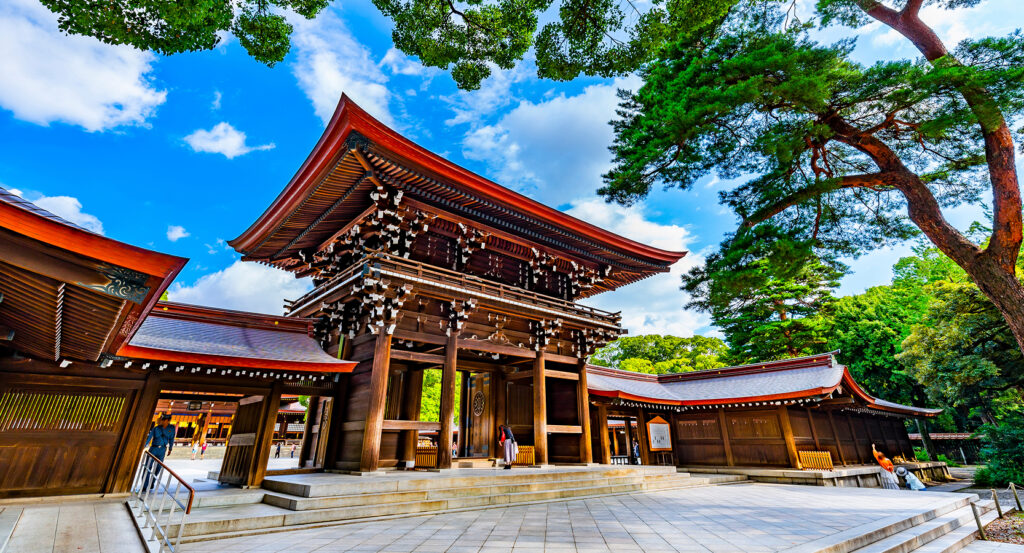
Set within Yoyogi near the JR Yamanote Line and just steps from Harajuku Station, the shrine occupies an immense wooded precinct whose principal approaches progressively separate its central sanctuary from the surrounding districts of Harajuku, Shinjuku and Shibuya. Towering torii establish successive thresholds along broad gravel avenues that curve beneath a dense canopy before converging on the innermost architectural enclosure. The approach tightens at Minami Shinmon, where the surviving 1920 gate introduces a sequence of courtyards rising toward the worship halls and honden. Rooflines remain low against the forest, allowing timber architecture, gravel, copper and vegetation to establish the precinct's dominant physical scale even with Central Tokyo immediately beyond its perimeter. The result is a sanctuary whose extraordinary spatial authority comes from the union of ceremonial architecture and landscape, with the long movement inward functioning as an essential part of encountering the shrine.
What defines Meiji Jingu.
Meiji Jingu is best known for enshrining Emperor Meiji and Empress Shoken within a national commemorative project completed in Yoyogi on November 1, 1920. Emperor Meiji died in 1912 and Empress Shoken in 1914, prompting widespread calls for a shrine dedicated to the imperial couple whose lives coincided with Japan's political, technological and international transformation during the Meiji period. Yoyogi carried a direct association with them through an imperial garden they had frequented, helping establish the site for the inner precinct. The government created a construction bureau in 1915, and architect Ito Chuta became a central figure in the architectural planning alongside Ando Tokizo and Oe Shintaro. Their shrine complex employed nagare-zukuri, distinguished by a roof extending farther over the front of the sanctuary, and arranged the principal torii, Minami Shinmon, worship halls and honden along a ceremonial sequence that rises toward the most sacred ground. The project reached far beyond professional designers: 100,000 trees arrived from across Japan, and 110,000 volunteers participated in creating the surrounding woodland. Air raids in 1945 destroyed the honden and much of the principal architectural complex, leaving Minami Shinmon among the structures that survived. Reconstruction under architect Sumi Takashi culminated in 1958, retaining surviving buildings within a renewed composition and introducing copper roofing to the rebuilt structures for greater resistance to fire. Thirty-six structures spanning the surviving Taisho fabric and postwar reconstruction received national Important Cultural Property designation in 2020, the shrine's centennial year. Meiji Jingu joins two major periods of Japanese architectural history within one precinct: a Taisho-era national project shaped around commemoration of the Meiji imperial couple and a postwar rebuilding campaign that restored the sanctuary after wartime destruction.
Empress Shoken's international humanitarian work gives the shrine another historical mechanism extending far beyond Yoyogi. She promoted women's education and social welfare during the Meiji period, then established a fund for international relief through the International Red Cross in 1912. The Empress Shoken Fund has continued supporting Red Cross and Red Crescent activities internationally, carrying her name into humanitarian programs more than a century after its creation. Poetry provides a more intimate connection between the enshrined couple and religious practice inside Meiji Jingu. Emperor Meiji composed 100,000 waka during his lifetime and Empress Shoken 30,000, using the traditional 31-syllable form to address subjects extending from personal conduct to society and the wider world. Thirty poems selected from their work replace conventional fortune slips in the shrine's omikuji, placing their writing directly into contemporary acts of worship. Annual ceremonies deepen that continuity: Shokenkotaigo-sai commemorates the empress in April, Meijitenno-sai commemorates the emperor in July and the November rites mark both the shrine's enshrinement anniversary and Emperor Meiji's birthday. Humanitarian action, poetry and ritual extend commemoration beyond the shrine buildings, preserving distinct aspects of the imperial couple's lives through institutions and practices that remain active in the present.
How Meiji Jingu fits.
Meiji Jingu works as the anchor for a Jingumae route through three nearby sites that move from a twentieth-century commemorative shrine through a private institution central to Tokyo's international contemporary-art culture and into the physical legacy of Japan's two Tokyo Olympic eras.
Begin at Togo Shrine, created after Admiral Togo Heihachiro's death in 1934 when public donations and requests for his commemoration led Navy Minister Osumi Mineo to establish the Togo Gensui Kinenkai Foundation and pursue construction of a shrine in his honor. Togo had entered the Satsuma naval forces during the final Tokugawa years, studied in Britain for seven years from 1871 and later commanded the Combined Fleet during the Russo-Japanese War; from 1914 to 1921 he also directed the education of Crown Prince Hirohito, the future Emperor Showa. The Harajuku shrine places that military and imperial history inside a precinct created through the same broad twentieth-century culture of public commemoration that reshaped this part of western Tokyo. Continue to WATARI-UM, The Watarium Art Museum, whose institutional origins began with Shizuko Watari's Gallery Watari in 1972. Her program brought artists including Nam June Paik, Donald Judd, Sol LeWitt, Andy Warhol, Joseph Beuys, On Kawara and Keith Haring into sustained contact with Tokyo audiences, and works acquired through those activities became the foundation of the museum collection. Swiss architect Mario Botta received the commission in 1985 and spent five years developing his first museum building for the triangular Jingumae property, producing the striped granite-and-concrete structure that opened as WATARI-UM in September 1990. Conclude at Japan Olympic Museum, where the Japanese Olympic Committee presents the country's Olympic history beside the grounds associated with Tokyo's 1964 and 2020 Games. Its displays connect Japan's participation in the Olympic movement with athletes, Olympic villages and the people responsible for staging the Games, and the exterior Monument Area includes scaled versions of the cauldrons from Tokyo 1964, Sapporo 1972 and Nagano 1998 alongside a monument to Kano Jigoro. Tokyo 1964 became Japan's first Olympic Games and a major symbol of the country's postwar recovery; Tokyo 2020 followed decades later after an unprecedented one-year postponement and largely spectator-free competition during the COVID-19 pandemic. The progression moves from Togo Shrine's public commemoration of a Meiji naval figure through WATARI-UM, The Watarium Art Museum's internationalization of Jingumae's postwar art culture into Japan Olympic Museum's preservation of Japan's Olympic history, extending Meiji Jingu outward into a district repeatedly reshaped by commemoration, cultural exchange and national institutions.
Where your story begins.
Foresyte Travel reveals places that feel extraordinary long before you arrive.
Enjoy editorial crafted for luxury travelers.
Foresyte may earn a commission when you book.

















































































































