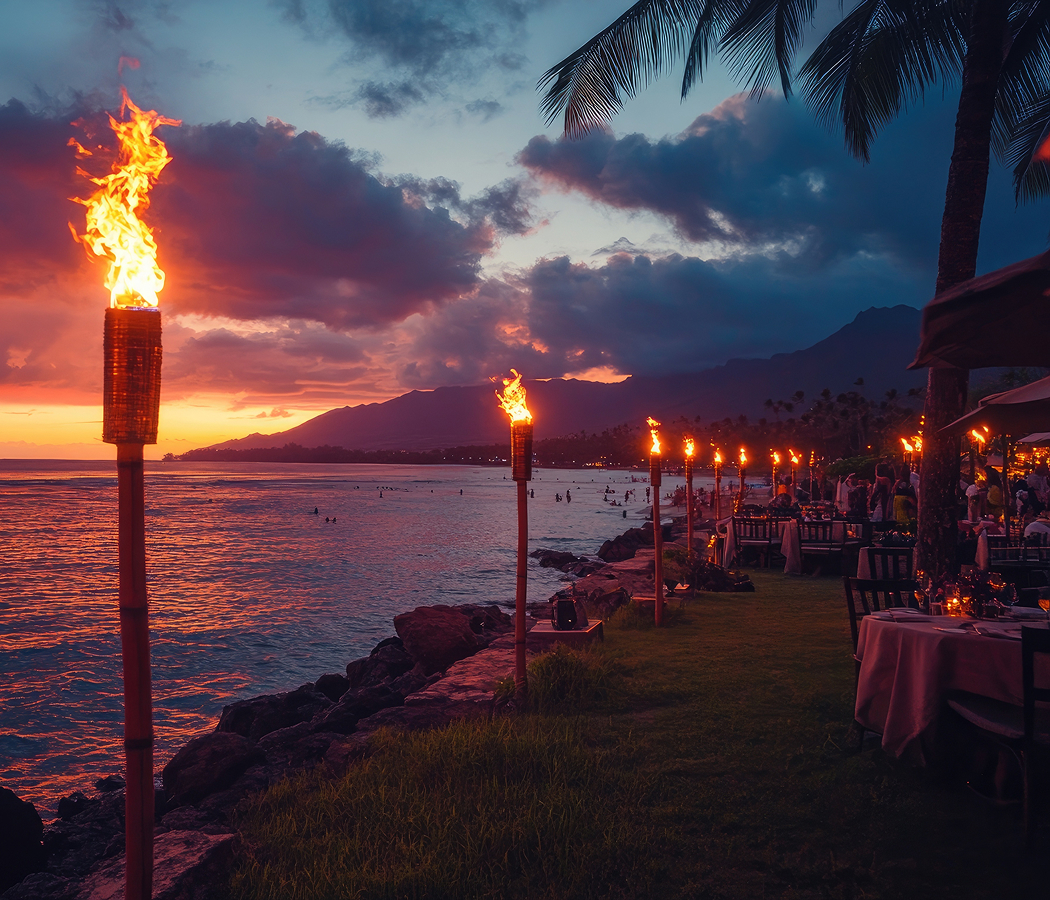
Why Moana Surfrider, A Westin Resort & Spa, Waikiki Beach matters.
Moana Surfrider, A Westin Resort & Spa, Waikiki Beach is Hawaii's oldest beachfront resort hotel, where Waikiki's royal coastal heritage meets the architectural origins of modern Hawaiian hospitality and more than a century of cultural and commercial transformation.
Standing directly along Waikiki Beach between Kalākaua Avenue and the Pacific Ocean, Moana Surfrider occupies a prominent section of Honolulu's historic resort waterfront, with the Royal Hawaiian Center extending northwest and the commercial corridor of Central Waikiki immediately inland. The property's original colonial-style building combines Ionic columns, decorative timberwork, ornamental balconies and broad covered lanais, creating an architectural composition distinguished by its symmetrical frontage and tropical adaptation of European design. Arrival through the historic porte-cochère leads into a high-ceilinged lobby whose central axis opens toward the ocean, establishing a direct visual connection between the urban streetscape and the beachfront. Beyond the lobby, an expansive courtyard organized around a mature banyan tree creates a shaded gathering place, with surrounding terraces connecting the historic building to the open shoreline. The result is an architecturally significant coastal resort whose original design, preserved public spaces and relationship with Waikiki Beach establish the physical foundation for its exceptional place in Hawaiian hospitality history.
What defines Moana Surfrider, A Westin Resort & Spa.
Moana Surfrider, A Westin Resort & Spa, Waikiki Beach is best known for opening on March 11, 1901, as Waikiki's first purpose-built beachfront hotel, establishing the commercial foundation for the district's subsequent development into an international resort destination. Honolulu businessman Walter Chamberlain Peacock incorporated the Moana Hotel Company in 1896, pursuing a hospitality development on a coastline previously associated primarily with Hawaiian royalty, residential estates and traditional agricultural land. Architect Oliver G. Traphagen designed the original building, and the Lucas Brothers completed construction through an investment of $150,000. The project incorporated Hawaii's first electric-powered passenger elevator, demonstrating the technical ambition of a development conceived for affluent travelers arriving through Honolulu's expanding maritime connections. Peacock sold the property to Alexander Young in 1905, transferring ownership to an established Honolulu hotel entrepreneur whose interests included the Alexander Young Hotel and the neighboring Seaside Hotel. The property's expansion accelerated during the following decade, with two additional floors and Renaissance Revival concrete wings completed during 1917-1918, transforming the original building into a substantially larger beachfront institution. Matson Navigation Company subsequently became central to its development, connecting hotel investment with the shipping organization responsible for bringing substantial numbers of mainland American travelers to Hawaii. Matson constructed the neighboring SurfRider Hotel in 1952, extending the accommodation complex during the rapid expansion of postwar Pacific travel. Sheraton acquired Matson's Waikiki hotel holdings in 1959, introducing an international hospitality organization into the property's ownership history. Japanese businessman Kenji Osano acquired the Moana and SurfRider properties through Kyo-Ya Company in 1963, establishing an ownership relationship that continued through successive periods of redevelopment. Kyo-Ya constructed an additional high-rise Surfrider building in 1969, substantially increasing the property's physical scale and creating the three-building composition associated with the modern resort. Hawaiian architect Virginia D. Murison directed a $50 million restoration completed in March 1989, recovering the original building's early architectural character and integrating the separate hotel structures into the Sheraton Moana Surfrider. The restoration received major historic preservation distinctions, including the National Preservation Honor Award, reinforcing the property's architectural significance within Hawaii's hospitality heritage. Starwood Hotels & Resorts completed a further $30 million renovation and introduced the Westin affiliation on June 1, 2007, extending the building's history through another international hospitality organization. A comprehensive renovation completed during 2026 coincided with the hotel's 125th anniversary, renewing its principal interiors and restoring the Surfrider name to the former Diamond Wing. These successive developments connect the origins of Waikiki tourism with maritime commerce, international investment, architectural preservation and the continued adaptation of Hawaii's earliest beachfront hotel.
How Moana Surfrider fits.
Moana Surfrider, A Westin Resort & Spa, Waikiki Beach works as the starting point for a walk through Waikiki's indigenous healing traditions, the development of Hawaiian surfing and the preservation of the district's public coastal culture.
Begin at the Healer Stones of Kapaemahu, a protected group of four substantial volcanic stones associated with the arrival of Tahitian healers in Waikiki centuries before Western settlement. Hawaiian oral tradition names the healers Kapaemahu, Kapuni, Kinohi and Kahaloa, whose healing knowledge earned them considerable respect among the surrounding community. The healers were māhū, individuals associated in Hawaiian tradition with both masculine and feminine spiritual qualities. Their departure prompted the placement of four stones transported from Kaimukī, creating a sacred site intended to preserve their healing knowledge and spiritual power. The stones were buried beneath a bowling alley in 1941 and recovered in 1963, before a major restoration in 1997 established their protected ceremonial enclosure. A new interpretive plaque installed in 2023 restored recognition of the healers' māhū heritage. Continue to the Duke Kahanamoku Statue, a bronze sculpture commemorating the Hawaiian Olympic champion whose achievements helped establish surfing as an internationally recognized sport. Sculptor Jan Gordon Fisher created the nine-foot monument in 1990, depicting Kahanamoku with outstretched arms beside a surfboard and ceremonial spears. Kahanamoku won Olympic swimming gold medals in Stockholm in 1912 and Antwerp in 1920, establishing his international athletic reputation before promoting surfing through demonstrations in Australia, California and other destinations. His association with the Hui Nalu swimming and surfing organization connected competitive athletics with the traditional Hawaiian watermanship practiced along Waikiki's coastline. The sculpture's orientation toward Kalākaua Avenue creates a public commemorative setting, with floral lei frequently placed across its outstretched arms. Conclude at Kūhiō Beach Hula Mound, an outdoor performance setting associated with the preservation of Hawaiian dance and music within Waikiki's public beachfront landscape. The performance area supports traditional hula presentations accompanied by Hawaiian music, giving cultural practitioners a public setting for sharing chants, movements and compositions rooted in Hawaiian history. Hula developed as an important means of transmitting genealogy, religious knowledge and historical memory before undergoing major changes following the arrival of Christian missionaries during the nineteenth century. King David Kalākaua subsequently encouraged its public revival during his reign from 1874 to 1891, restoring ceremonial performance to the Hawaiian royal court. The beachfront program continues this relationship between public performance and cultural transmission through presentations involving local hālau hula and musicians. The progression moves from the sacred healing traditions preserved at Kapaemahu through Duke Kahanamoku's international influence on surfing and culminates in the public performance of hula, connecting three distinct expressions of Hawaiian cultural knowledge along Waikiki's historic shoreline.
Where your story begins.
Foresyte Travel reveals places that feel extraordinary long before you arrive.
Enjoy editorial crafted for luxury travelers.