
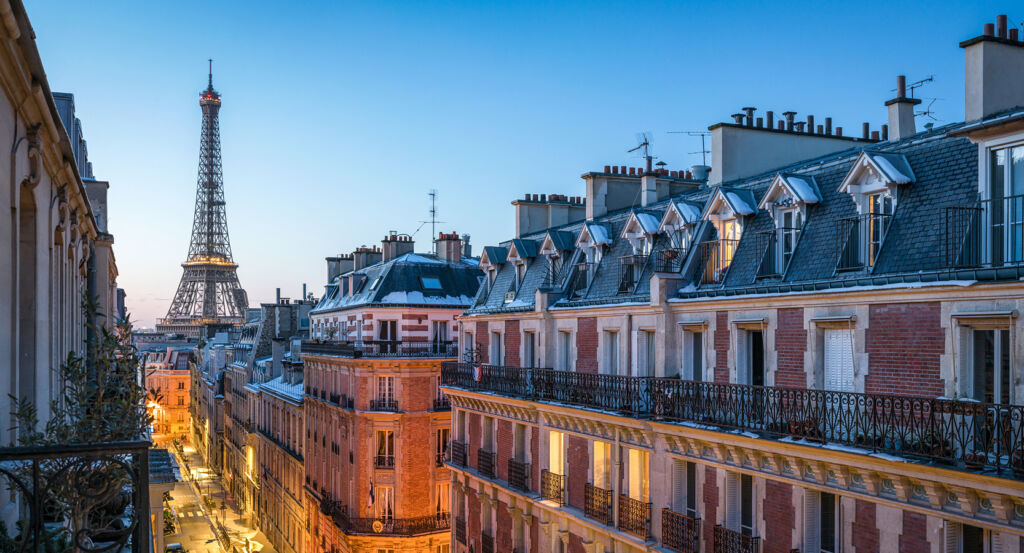
Why Muette matters.
Muette is a composed enclave where the Bois de Boulogne meets the old village of Passy through garden-lined avenues, secluded villas and steep streets descending toward the Seine.
Positioned between Passy, Auteuil, and the Bois de Boulogne, the neighborhood occupies a western Paris pocket where Chaussée de la Muette, Avenue Mozart and Rue de Passy cross terrain historically divided among royal hunting ground, vineyards, estates and the slopes above the river. Broad avenues near Ranelagh give way to enclosed residential lanes and older streets around Passy, creating pronounced shifts between nineteenth-century urban planning and fragments of the former village. Chaussée de la Muette establishes the primary encounter through a tree-lined approach joining the Bois with the commercial spine of Rue de Passy, preserving the east-west orientation long associated with the royal domain. Jardin du Ranelagh deepens the physical character through six hectares of planted ground developed from part of the former Château de la Muette estate after Passy entered Paris in 1860, opening an expansive green interval between residential avenues. The descent toward Rue Raynouard and the Seine introduces retaining walls, gardens and sharply changing elevations inherited from the hillside settlement that preceded the modern Arrondissement. The result is a neighborhood whose calm residential scale overlays royal hunting territory and an independent village, preparing a history centered on the château whose successive incarnations shaped this corner of western Paris.
What defines Muette.
Muette is best known for developing around the royal Domaine de la Muette, whose hunting lodge beside the Bois de Boulogne became a château under Charles IX 1572 and passed through successive generations of the French monarchy. Charles gave the property to his sister Marguerite de Valois, who later transferred it to the future Louis XIII. The Duchesse de Berry occupied La Muette from 1716 and received Peter the Great there before the Regent transferred the estate to Louis XV after her death. Ten royal children were born at the château between 1724 and 1734, and Jacques Gabriel and Ange-Jacques Gabriel subsequently rebuilt the residence during a period that also brought Madame de Pompadour and Madame du Barry into its history. Louis XVI and Marie-Antoinette used La Muette during the opening years of their marriage, and Antoine-Augustin Parmentier received royal permission to cultivate potatoes on sandy ground within the domain. The estate entered aviation history in November 1783 when Pilâtre de Rozier and François Laurent d'Arlandes departed from its grounds in a Montgolfier balloon on the first successful human free flight, watched by spectators including Benjamin Franklin and members of the royal family. Revolutionary seizure ended the royal domain, and the National Assembly ordered its sale in 1792, dividing its park and separating the château into La Muette and Petite Muette.
The nineteenth and early twentieth centuries supplied a separate mechanism for converting the former domain into the residential geography surrounding Muette. Piano manufacturer Sébastien Érard acquired one surviving château wing in 1820, beginning a family association that continued through his nephew Pierre Érard and Pierre's widow, who reunited much of La Muette and Petite Muette after 1865. Passy entered Paris in 1860, bringing the former commune into the enlarged capital as development accelerated across its estates and gardens. The Franqueville heirs eventually released substantial sections of the reassembled Muette property for residential subdivision, and the last remnants of the historic château disappeared 1926. Baron Henri de Rothschild had already purchased 22,000 square meters from the family in 1912 for a new residence on nearby ground, commissioning a château whose facade carries twenty-four carved theatrical heads and whose gardens emerged from a 1914 competition won by Raoul Saint-Martin, a pupil of Achille Duchêne. Rothschild's heirs sold the property to the Organisation for European Economic Co-operation in 1948, bringing the former aristocratic residence into postwar diplomacy. The Convention converting that organization into the OECD was signed at the château on December 14, 1960 and entered into force on September 30, 1961, giving Muette a twentieth-century international role on territory whose earlier development had been driven by monarchy and private estates.
How Muette fits.
Muette works as the anchor for a daytime exploration connecting a novelist's hillside refuge, a private collection transformed by successive bequests and a circular broadcasting complex created to concentrate French radio within a single architectural project.
Begin at Maison de Balzac, where Honoré de Balzac occupied part of a Passy house from 1840 to 1847 as he worked through the mature years of La Comédie humaine. The site reaches further into the former village: excavations in 2002 revealed late medieval troglodytic dwellings beneath the property, surviving from an era when cultivators, winegrowers and quarry workers populated Passy, and the eighteenth-century boundary marker on Rue Berton once divided Passy from Auteuil. Balzac rented rooms in an outbuilding reached from present-day Rue Raynouard, and his Passy years encompassed La Cousine Bette, Le Cousin Pons and completion of the first sixteen volumes of the Furne edition of La Comédie humaine. Continue to Musée Marmottan Monet, where Jules Marmottan's 1882 acquisition of a mansion built for the duc de Valmy developed into a collecting project carried forward by his son Paul, who specialized in art of the Consulate and Empire and bequeathed the property to the Académie des Beaux-Arts in 1932. The museum opened in 1934, then changed decisively when Victorine Donop de Monchy transferred works inherited from Georges de Bellio between 1940 and 1947, including Claude Monet's Impression, Sunrise; Michel Monet's 1966 bequest added more than one hundred works by his father, establishing the world's largest Monet collection and prompting construction of a dedicated gallery beneath the garden. Conclude at Maison de la Radio et de la Musique, Henry Bernard's vast circular broadcasting complex inaugurated by Charles de Gaulle on December 14, 1963 after a competition sought a single home for French national radio. Bernard organized a 100,000-square-meter complex in glass and aluminum around its circular form, concentrating technical production, studios and performance spaces beside the Seine; a rehabilitation begun in 2009 later reworked studios and circulation before reaching completion in 2022, extending the building's original technological purpose into contemporary broadcasting and concert production. The progression moves from Balzac turning a remnant of old Passy into a working refuge through the Marmottan family and later benefactors assembling a collection of international art-historical consequence into Bernard concentrating national broadcasting inside a purpose-built architectural complex, tracing three distinct forms of cultural production across Muette and its immediate surroundings.
Where your story begins.
Foresyte Travel reveals places that feel extraordinary long before you arrive.
Enjoy editorial crafted for luxury travelers.
Foresyte may earn a commission when you book.














































































































