
Why Musée Picasso matters.
Musée Picasso is a richly layered art museum where the Marais's aristocratic character meets Pablo Picasso's vast artistic estate, a seventeenth-century hôtel particulier and one of the world's most extensive collections devoted to a single artist.
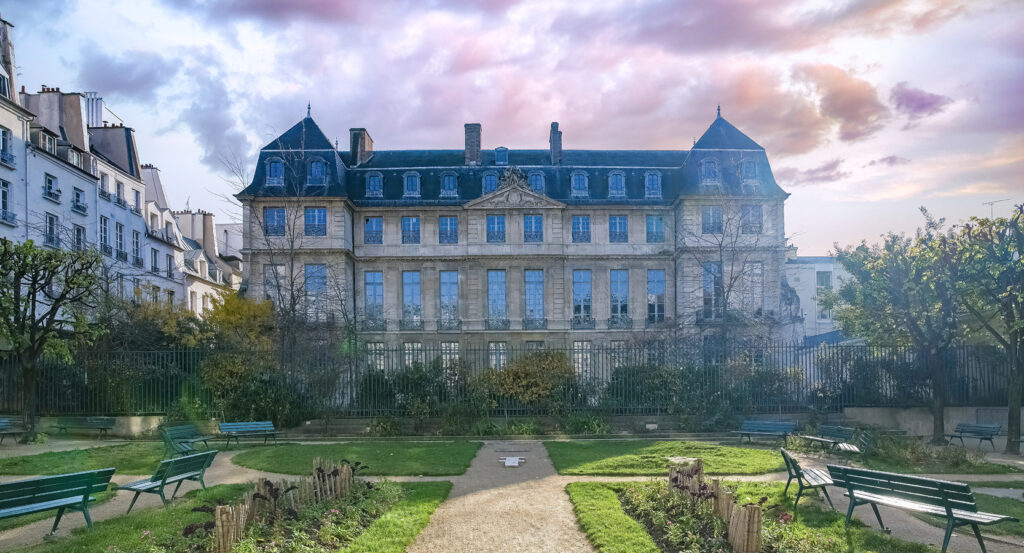
Set along Rue de Thorigny near Rue Vieille-du-Temple and just steps from Rue de la Perle, the museum occupies Hôtel Salé within a dense Marais enclave where enclosed courtyards, former aristocratic residences and narrow streets preserve the district's seventeenth-century scale. A forecourt separates the street from Jean Boullier de Bourges's limestone residence, allowing its projecting wings and sculpted architectural front to unfold gradually beyond the entrance. The ceremonial staircase rises through an exceptionally elaborate interior volume enriched with sculpture by Gaspard and Balthazar Marsy and Martin Desjardins. Garden-facing rooms and layered interior sequences reveal the depth of a property built between court and garden on ground once belonging to the Saint-Anastase religious community. The result is a rare union of artist and architecture where Picasso's work occupies a residence created during one of the Marais's most consequential periods of aristocratic construction.
What defines Musée Picasso.
Musée Picasso is best known for holding more than 5,000 works by Pablo Picasso alongside over 200,000 archival pieces, forming a collection created through an unusual intersection of inheritance law, cultural policy and the artist's own lifelong retention of his work. Picasso's death on April 8, 1973 left thousands of works distributed through his studios and residences, making settlement of the estate a cultural question of exceptional scale. French legislation developed in 1968 under André Malraux had established the dation en paiement, permitting inheritance taxes to be satisfied through works of major artistic or historical importance. Picasso's heirs used that mechanism in 1979 for the first major transfer that formed the museum collection, giving the French state a representative body of works selected directly from the artist's estate. Michel Guy, Secretary of State for Culture, had already chosen Hôtel Salé in 1974 as their future home with support from Picasso's family. Jacqueline Picasso's heirs completed a second major dation in 1990, strengthening holdings from Picasso's final period through paintings, sculptures, drawings and notebooks. Picasso's heirs transferred his personal archives to the state in 1992, adding more than 200,000 items accumulated across his life and studios. The collection now encompasses 297 paintings, 368 sculptures and three-dimensional works, 1,719 drawings and notebooks, more than 2,370 prints, matrices and posters, 92 demonstrated books and more than 17,000 photographs. Picasso's personal art collection adds another exceptional dimension through works by Cézanne, Gauguin, Matisse, Renoir, Braque, Modigliani, Miró and other artists he acquired, exchanged with colleagues or retained throughout his life. The museum consequently joins Picasso's finished art with working studies, personal possessions, correspondence, photography and works he himself collected, allowing the institution to span both the production and intellectual environment of his career.
Hôtel Salé gives that collection a separate historical mechanism rooted in the striking rise and collapse of seventeenth-century financier Pierre Aubert de Fontenay. Aubert accumulated wealth during the 1630s and 1640s before becoming a royal councillor and secretary and acquiring a lucrative role in collection of the salt tax, the source of the residence's enduring Salé name. On May 16, 1656 he purchased 3,700 square meters from the Saint-Anastase community for 40,000 livres and commissioned the young Jean Boullier de Bourges to create a residence suited to his newly elevated position. Construction finished late in 1659, producing a double corps de logis and paired sequences of rooms associated with the architectural experimentation of the Mazarin period. Gaspard and Balthazar Marsy joined Martin Desjardins on the sculptural program, concentrating an exceptional display of stucco figures, garlands, Corinthian pilasters and classical divinities around the ceremonial staircase. Aubert expanded the property in 1660 by acquiring neighboring structures toward Rue Vieille-du-Temple, including ground occupied by the jeu de paume used by the Théâtre du Marais, where Pierre Corneille had presented early plays. Aubert's fortunes collapsed with Nicolas Fouquet in 1663, sending the residence into six decades of disputes among creditors and beginning a long succession of institutional and private occupants. The City of Paris acquired Hôtel Salé in 1962, historic-monument protection followed in 1968 and restoration began in 1974 after its selection for the Picasso collection. Roland Simounet subsequently adapted the residence for museum use, and Musée Picasso opened in 1985, joining a seventeenth-century financier's ambitious residence with a collection created through one of twentieth-century France's most consequential cultural inheritance mechanisms.
How Musée Picasso fits.
Musée Picasso works as the anchor for a daytime exploration through the Marais using three nearby museums that move from Parisian urban history through an eighteenth-century collection assembled by department-store founders into the apartment where Victor Hugo spent sixteen formative years.
Begin at Musée Carnavalet, established after the City of Paris acquired Hôtel Carnavalet in 1866 during Haussmann's remaking of the capital. The residence itself reaches 1548 to 1560, when it was constructed for Parlement president Jacques des Ligneris, and François Mansart added wings and raised its Rue de Sévigné entrance in 1660 before Madame de Sévigné lived there from 1677. The museum opened on February 25, 1880 as the oldest municipal museum in Paris and expanded into Hôtel Le Peletier de Saint-Fargeau in 1989. Its holdings now exceed 600,000 items, combining archaeology, architectural fragments, paintings, sculpture, signs, photography, furniture and personal objects into a history extending from prehistoric settlement through modern Paris. Continue to Musée Cognacq-Jay, whose collection grew from the fortune Ernest Cognacq and Marie-Louise Jay created through La Samaritaine. Cognacq began exhibiting his collection at Samaritaine de Luxe in 1925 and purchased eighteenth-century paneling in 1927 for the museum he intended to establish nearby. His death in 1928 left antiques adviser Edouard Jonas and the City of Paris to complete the project, inaugurated by President Gaston Doumergue on June 4, 1929. Closure of Samaritaine de Luxe eventually displaced the collection, and the restored sixteenth-century Hôtel Donon became its home in 1990, placing paintings, furniture and decorative arts assembled by two modern retailers inside a residence begun for royal building official Médéric de Donon in 1575. Conclude at Maison de Victor Hugo, occupying the second-floor apartment of Hôtel de Rohan-Guéménée where Hugo lived from 1832 to 1848. He wrote Ruy Blas, Les Voix intérieures and Les Rayons et les Ombres there and began work associated with Les Misérables, La Légende des Siècles and Les Contemplations. Paul Meurice proposed the museum in 1901 ahead of Hugo's centenary, assembled his own collection with material acquired from Juliette Drouet's estate, secured support from Hugo's descendants and financed additional commissions and interior work. The museum opened on June 30, 1903, converting Hugo's former Place des Vosges apartment into an institution built through the collaboration of his literary executor and family. The progression moves from Carnavalet's preservation of Paris during nineteenth-century reconstruction through Cognacq and Jay's conversion of retail wealth into an eighteenth-century art collection into Meurice's reconstruction of Hugo's intellectual and domestic world, extending the Marais through three distinct approaches to preserving the city's cultural past.
Where your story begins.
Foresyte Travel reveals places that feel extraordinary long before you arrive.
Experience premium editorial crafted for luxury travelers.
Foresyte Travel may earn a commission when you book through the link on this page.














































































































