
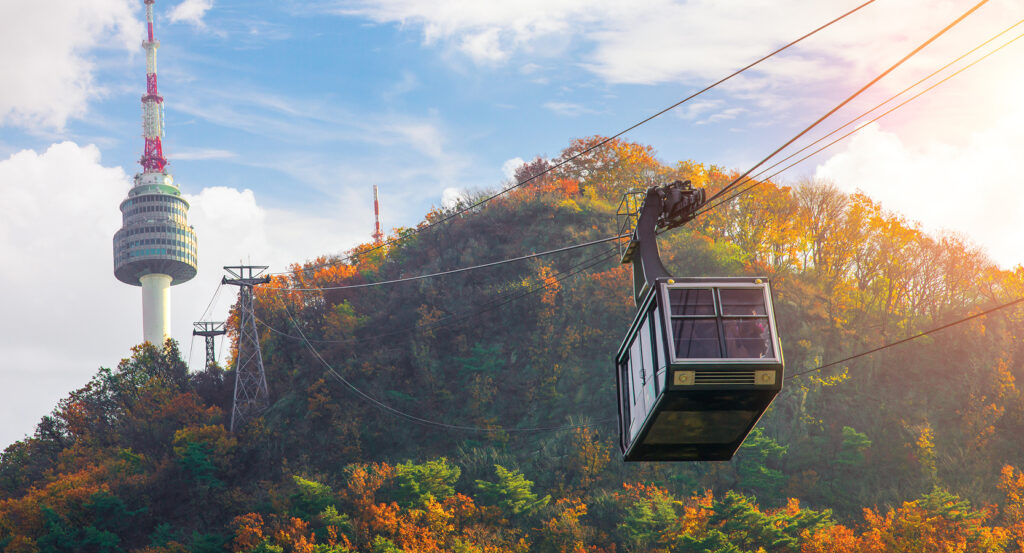
Why you should experience Namsan Dulle-gil Trail in Seoul, South Korea.
Namsan Dulle-gil Trail is Seoul's living lung, a winding sanctuary of trees, temples, and tranquil paths that breathe calm into the center of the city.
Here, skyscrapers dissolve into forest, and traffic fades into birdsong. The trail coils up and around Mt. Namsan like a ribbon of green light, connecting stone stairways, wooden decks, and hidden lookouts that reveal Seoul from every angle. In spring, cherry blossoms drift through the air like confetti; in autumn, the mountain burns gold and crimson. Walkers, joggers, and photographers share the same rhythm, slow, steady, intentional. Along the way, you pass pavilions where elders practice tai chi, and shaded benches where couples rest hand in hand, framed by views that seem painted. The Namsan Park Trail isn't a hike in the usual sense, it's a meditation in motion, a reminder that even in one of the world's busiest cities, nature still holds the higher ground.
What you should know about Namsan Dulle-gil Trail.
Namsan Dulle-gil Trail traces the geography and spirit of Seoul's history, part natural refuge, part cultural museum.
Mt. Namsan, meaning “South Mountain,” was designated as one of the city's sacred guardian peaks during the Joseon Dynasty, forming the southern point of Seoul's ancient geomantic circle. The trails that climb its slopes follow routes once used by royal messengers and guards protecting the southern gates. In 1940, during the Japanese occupation, parts of the mountain were cut and reshaped, but the park was reborn after Korea's liberation as a national symbol of restoration. Officially declared a public park in 1948, Namsan became the city's largest green refuge, now covering more than 2.3 million square meters of forested land. The network of trails totals over 7 kilometers, with multiple entry points, from Myeong-dong, Hoehyeon, Itaewon, and Huam-dong, converging near the summit where Namsan Tower rises. Few visitors realize that the trail system is also home to several historical relics: sections of the Seoul Fortress Wall, the Beacon Tower used for ancient fire signals, and the Baekbeom Square Memorial, honoring Korean independence hero Ahn Jung-geun. Native flora thrives here, pine, cherry, zelkova, and maple, along with wildflowers that change each month. The park's designers intentionally preserved uneven slopes and stone paths to maintain the mountain's natural flow, ensuring that each step carries the quiet authenticity of centuries walked before.
How to fold Namsan Dulle-gil Trail into your trip.
Namsan Dulle-gil Trail works as a slow ascent, not a climb to conquer, but a journey to reconnect.
Begin at the Myeong-dong entrance, where wooden signs point toward the forest path that gently winds up the mountain. The lower trails are shaded and peaceful, ideal for morning walks; as you climb higher, the view opens to reveal the city stretching along the Han River. Follow the route marked by stone walls, remnants of the Seoul Fortress, their ancient blocks glowing in sunlight. Stop at the Beacon Tower Pavilion for a quiet rest, or the Baekbeom Square lookout, where memorials and flowerbeds form one of Seoul's most contemplative spaces. If you visit in spring, cherry blossoms canopy the trail in white and pink; in fall, the forest explodes into rust and gold, carpeting the paths in color. For night walkers, the path is softly lit, leading you toward the illuminated glow of Namsan Tower above. Pair your hike with a cable car descent for a perfect balance of nature and skyline, or extend your journey through the Namsangol Hanok Village at the mountain's base, where traditional houses echo the calm of the forest. Bring water, good shoes, and time, because this isn't a walk to rush. The Namsan Park Trail in Seoul isn't just a path through trees; it's a walk through centuries, where every step bridges the wild and the human, the ancient and the infinite.
Where your story begins.
Foresyte Travel reveals places that feel extraordinary long before you arrive.
Experience premium editorial crafted for luxury travelers.

















































































































