
Why Nelson's Column matters.
Nelson's Column is a commanding commemorative monument where Trafalgar Square's ceremonial character meets Victorian public sculpture, naval commemoration and an architectural composition created to project Horatio Nelson above one of London's defining civic spaces.
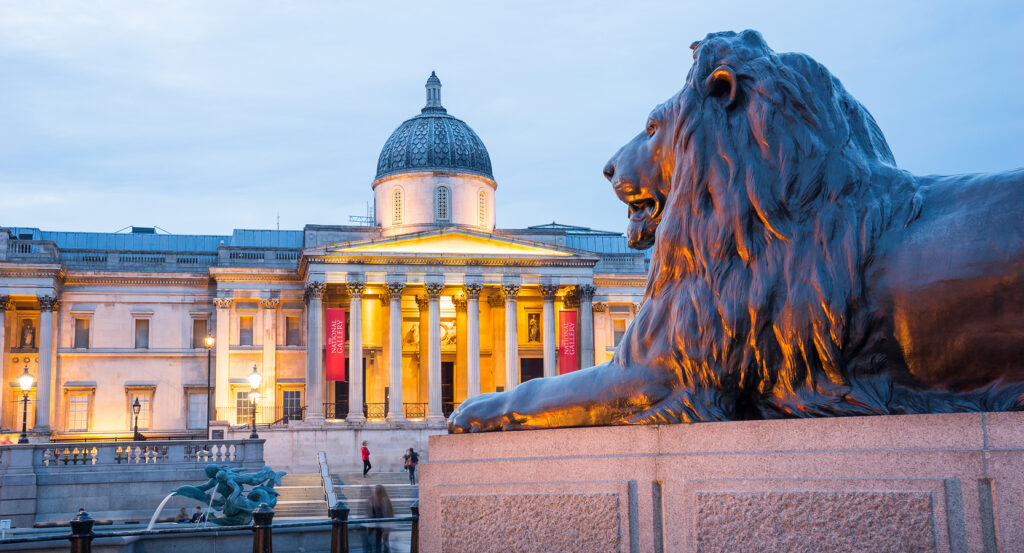
Set within Trafalgar Square near Whitehall and just steps from Northumberland Avenue, the monument occupies the southern axis of a Grade I public square shaped from John Nash's metropolitan improvements and subsequently formalized through Sir Charles Barry's terraces, retaining walls and fountains. William Railton designed the memorial as a 44-metre fluted granite Corinthian column rising from a substantial pedestal, with a bronze capital supporting Edward Hodges Baily's stone figure of Nelson and establishing a vertical counterpoint to the surrounding horizontal architecture. Four bronze reliefs transform the pedestal into the primary close-range encounter, with Musgrave Lewthwaite Watson, William F. Woodington, John Ternouth and John Edward Carew depicting St. Vincent, the Nile, Copenhagen and Nelson's death at Trafalgar across separate sculptural panels. Sir Edwin Landseer's four immense bronze lions deepen that encounter at ground level, their reclining bodies cast by Carlo Marochetti and positioned around the monument decades after the column itself was raised. The result is a memorial where Railton's classical architecture, Baily's elevated figure, four narrative reliefs and Landseer's lions convert Nelson's naval career into a sculptural composition inseparable from the nineteenth-century creation of Trafalgar Square.
What defines Nelson's Column.
Nelson's Column is best known for commemorating Admiral Horatio Nelson through a monument conceived more than three decades after his death at the Battle of Trafalgar and constructed through a national subscription campaign. Parliamentary discussion of a national Nelson monument had begun by 1818, but a Nelson Memorial Committee was not formed until 1838, when voluntary subscriptions financed a design competition for a monument intended for the newly developing Trafalgar Square. William Railton won the competition with a Corinthian column proposal, and government approval followed despite Barry's concern that its scale would compromise the architectural relationship between his planned upper terrace and William Wilkins's National Gallery. Concrete foundations were begun in 1839, fixing the monument's position before Barry could overturn the decision. Granite for the fluted shaft came from Froggin Tor in Devon, and the bronze Corinthian capital was cast at Woolwich Arsenal. Edward Hodges Baily carved the crowning figure from Craigleith sandstone, depicting Nelson in naval uniform with his empty right sleeve pinned across his chest and a sword at his side. The statue was raised in November 1843, completing the dominant vertical element of a square whose wider formal layout remained under construction. Railton's monument emerged from the intersection of public subscription, government approval, competitive architectural design and disagreement over metropolitan planning, placing a memorial to one naval commander at the visual center of Barry and Nash's reconstructed Charing Cross.
Sculptural additions turned the completed column into a broader account of Nelson's naval career during the following quarter-century. The pedestal received four large bronze reliefs depicting major engagements associated with Nelson, with the panels cast from captured guns and assigned to separate sculptors. Watson produced the Battle of Cape St. Vincent, Woodington treated the Battle of the Nile, Ternouth represented Copenhagen and Carew depicted Nelson's death at Trafalgar, shifting attention from the solitary figure above to episodes of battle around the monument's base. Landseer received the commission for four guardian lions, yet years elapsed before the sculptures reached Trafalgar Square. Marochetti cast all four from Landseer's single model, and the bronze animals were installed in 1867, giving the stepped plinth the powerful ground-level composition now associated with the memorial. Grade I designation in 1970 subsequently recognized the architectural and historic significance of the completed ensemble. Conservation has continued into the twenty-first century through periodic inspections, stone repair and bronze treatment, including work using scarce Craigleith sandstone matching the stone from which Baily's Nelson was carved. The monument that began with Railton's competition design acquired its familiar form incrementally, with architecture, relief sculpture and animal sculpture accumulating across almost three decades.
How Nelson's Column fits.
Nelson's Column works as the anchor for a daytime exploration through three nearby sites connecting Georgian church architecture, Stuart court culture and Benjamin Franklin's long London residence.
Begin at St. Martin-in-the-Fields, where James Gibbs rebuilt an older parish church between 1722 and 1726 in a design combining a giant Corinthian temple portico with a steeple rising immediately behind it. Portland stone defines the exterior, and the interior develops a giant order beneath a segmental tunnel vault with galleries extending into the columned composition, creating a church whose architectural influence subsequently reached Britain, North America and other parts of the English-speaking world. John Nash's West Strand improvements later cleared surrounding structures and exposed Gibbs's building to the open urban setting that became Trafalgar Square, fundamentally changing how its eighteenth-century architecture was encountered. Continue to Banqueting House, completed in 1622 after James I commissioned Inigo Jones to replace earlier royal entertainment halls at Whitehall Palace. Jones drew on architecture studied in France and Italy to create a classical double-cube hall above a vaulted undercroft, and Charles I later commissioned Peter Paul Rubens to produce nine immense ceiling canvases celebrating James I; completed in Antwerp in 1634 and installed in 1636, they remain the only Rubens ceiling scheme surviving in its original location. Charles I walked beneath those paintings on 30 January 1649 before reaching the scaffold erected outside the building for his execution, and the Banqueting House survived the 1698 fire that destroyed most of Whitehall Palace. Conclude at Benjamin Franklin House, the Georgian lodging house where Franklin lived for much of his London residence between 1757 and 1775 as a colonial representative, scientist and political intermediary during the deteriorating relationship between Britain and its American colonies. Margaret Stevenson operated the household, and her son-in-law William Hewson later established an anatomy school associated with the property, a history unexpectedly confirmed centuries later by human and animal remains discovered beneath the building. The house survived severe twentieth-century deterioration, passed to the Friends of Benjamin Franklin House and opened publicly on Franklin's 300th birthday in 2006 as his only surviving former home. The progression moves from Gibbs's influential Georgian church through Jones and Rubens's surviving fragment of Stuart Whitehall into Franklin's preserved London household, placing Nelson's Victorian memorial within surrounding streets shaped by architecture, monarchy and the political worlds that preceded nineteenth-century Trafalgar Square.
Where your story begins.
Foresyte Travel reveals places that feel extraordinary long before you arrive.
Enjoy editorial crafted for luxury travelers.
Foresyte may earn a commission when you book.














































































































