
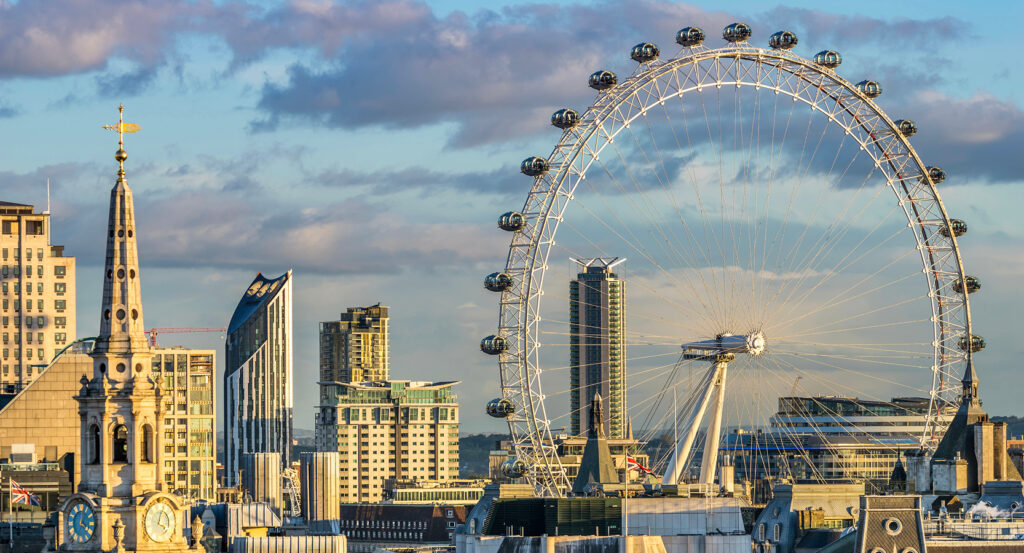
Why you should experience Novotel London Blackfriars in London, England.
Novotel London Blackfriars is a contemporary hotel where Bankside's industrial inheritance, cultural resurgence, architectural experimentation and Thames-side creative energy converge along one of Southwark's principal routes toward the river.
Set along Blackfriars Road near The Cut and just steps from Southwark Station, the hotel stands within the historic approach to Blackfriars Bridge, whose first crossing opened in 1769 as William Pitt Bridge before acquiring its present name from the medieval Dominican friary on the opposite bank. Blackfriars Road developed as the southern continuation of that crossing, driving urban growth through an area subsequently shaped by nineteenth-century manufacturing, engineering workshops and railway infrastructure. The surrounding district entered another cultural era as Bankside's former industrial buildings became settings for major arts institutions and performance spaces, fundamentally recasting this stretch of Southwark around design and culture. The result is a hotel where Blackfriars Bridge, the Dominican friars and Bankside's industrial-to-cultural evolution place contemporary hospitality within several centuries of Southwark history.
What you should know about Novotel London Blackfriars.
Novotel London Blackfriars is best known for opening in 2012 as part of Accor's expansion of the Novotel brand in Central London, establishing a 182-room property at 46 Blackfriars Road within the rapidly evolving Bankside and Southwark hospitality district. The opening formed part of a significant British growth period for Accor, whose Novotel brand traces its origins to Paul Dubrule and Gérard Pélisson and the first Novotel at Lille Lesquin in 1967, a property whose standardized modern-hotel concept became fundamental to the development of the group that evolved into Accor. Novotel London Blackfriars translated that international brand lineage into a purpose-developed Southwark hotel positioned between the Thames, Waterloo and the cultural institutions of Bankside, extending a network that had grown from a single French roadside hotel into one of Accor's principal global marques. The property later became associated with Accor's Planet 21 environmental program and was shortlisted in the Guardian Sustainable Business Awards, placing the London hotel within the group's early attempts to connect large-scale international hospitality with measurable environmental initiatives. Accor, Novotel, Paul Dubrule, Gérard Pélisson and the 2012 London opening connect the Blackfriars property with more than five decades of European hotel development and the international expansion of one of France's most consequential hospitality companies.
Jamboree Foodfest & Bar supplied the property with a distinct restaurant character built around internationally influenced dishes and a deliberately informal concept, becoming the principal dining venue associated with Novotel London Blackfriars for much of its operating history. Accor developed Jamboree around globally inspired culinary references expressed through named dishes including The Raging Bull, The Jerk and Morris Major, extending the international character of the Novotel brand into the restaurant program. The hotel also participated in a broader generation of Novotel properties through which Accor experimented with technology-led hospitality, contemporary public spaces and increasingly flexible approaches to urban hotel design during the 2010s. Together, Accor, Novotel and Jamboree Foodfest & Bar position Novotel London Blackfriars within the French group's continuing evolution from the standardized hotel model pioneered by Dubrule and Pélisson toward a more locally responsive generation of metropolitan properties.
How to fold Novotel London Blackfriars into your trip.
Novotel London Blackfriars works as the anchor for an afternoon tracing industrial architecture, Shakespearean performance and Victorian engineering through Bankside.
Begin at Tate Modern, where Sir Giles Gilbert Scott's Bankside Power Station was constructed between 1947 and 1963 before closing in 1981, then transformed by Herzog & de Meuron into a museum that opened on May 11, 2000 and subsequently expanded through the architects' Switch House project. Continue to Shakespeare's Globe, where American actor and director Sam Wanamaker's campaign to reconstruct Shakespeare's 1599 playhouse ultimately produced the 1,570-capacity open-air theater inaugurated by Queen Elizabeth II in 1997, four years after Wanamaker's death. Conclude at Kirkaldy Testing Museum, preserving the extraordinary mechanical-testing legacy of Scottish engineer David Kirkaldy, whose nineteenth-century Universal Testing Machine subjected structural materials to precisely measured forces as Victorian engineering increasingly demanded empirical understanding of iron and steel. The progression moves from Scott and Herzog & de Meuron's immense architecture of power through Wanamaker's reconstruction of Shakespearean performance into Kirkaldy's experimental engineering, revealing the industrial and cultural intelligence surrounding Novotel London Blackfriars.
Where your story begins.
Foresyte Travel reveals places that feel extraordinary long before you arrive.
Experience premium editorial crafted for luxury travelers.














































































































