
Why Odaiba Seaside Park matters.
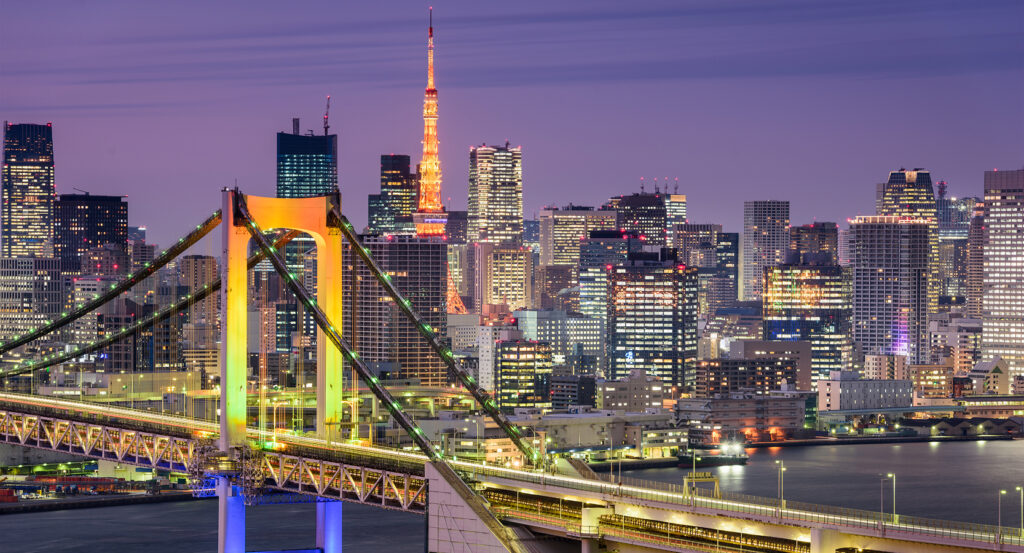
Odaiba Seaside Park is a broad waterfront park where Daiba's reclaimed-island character meets an artificial urban beach, protected Tokyo Bay water and direct views across the harbor toward Central Tokyo.
Set along the northern shore of Daiba near the waterfront commercial district and just steps from Odaiba-kaihinkoen Station, the park curves around a sheltered inlet facing the towers of the mainland and the suspension span crossing the bay. An artificial beach extends 800 meters along the water, using pale sand brought from Kozushima in the Izu Islands to create a shoreline inside one of the world's largest metropolitan ports. Boardwalks and planted edges trace the inlet as the beach bends toward the surviving nineteenth-century fort island offshore, giving pedestrians long sightlines across water that remains visually enclosed by historic earthworks and modern infrastructure. The shoreline opens most dramatically after sunset, when illuminated bridges and the mainland skyline turn the protected bay into a foreground for Tokyo's vertical cityscape. The result is a waterfront whose recreational landscape depends on an unusual collision of artificial beach engineering, reclaimed urban land and the surviving defensive geography of Edo Bay.
What defines Odaiba Seaside Park.
Odaiba Seaside Park is best known for returning public access to a section of Tokyo Bay whose geography originated with the Tokugawa shogunate's emergency coastal defenses after Commodore Matthew Perry arrived in 1853. The shogunate responded by constructing offshore batteries intended to protect Edo from naval attack, with western gunnery specialist Egawa Tarozaemon Hidetatsu involved in selecting positions and directing the fortification program. Construction began on the first three batteries in August 1853, and officials inspected them after completion in July 1854. Six batteries were completed under the defensive program, leaving a chain of artificial islands whose Japanese designation, daiba, eventually supplied the modern district's name. Third Battery and Sixth Battery survived later harbor transformation, with Third Battery opening as Daiba Park on July 7, 1928 and Sixth Battery remaining isolated offshore as a protected historic site. Odaiba Seaside Park entered that inherited maritime landscape on December 1, 1975, occupying 510,809.79 square meters, of which 435,395 square meters are water. Its creation belonged to Tokyo's wider marine-park program, which sought to restore public contact with a port increasingly shaped by reclamation and industrial development. Later construction of the artificial beach added a deliberately accessible shoreline to the enclosed water between Daiba and the surviving batteries. A recreational park created in the twentieth century occupies water whose nineteenth-century reshaping had been driven by fear of foreign naval power, turning the physical remnants of Edo's coastal defense into part of contemporary Tokyo's public waterfront.
International competition introduced a different chapter when Odaiba Seaside Park became a Tokyo 2020 venue for events conducted directly through its waterfront. Organizers installed a temporary competition site with a planned capacity of 5,500 for Olympic triathlon and 10-kilometer marathon swimming, followed by Paralympic triathlon. Individual Olympic triathlons used a 1.5-kilometer swim in the bay before athletes moved onto a 40-kilometer cycling course and 10-kilometer run, and the Games also introduced the mixed relay format with a 300-meter swim, 6.8-kilometer cycling segment and 2-kilometer run for each athlete. Preparing the site focused attention on water quality in the enclosed bay. Tokyo Metropolitan Government agencies examined pollution associated with combined sewer overflows after rainfall, advanced storage and high-speed filtration infrastructure and evaluated underwater screens intended to reduce contamination reaching the competition water. The postponed Games finally brought the events to Daiba in 2021, temporarily converting a metropolitan recreation shoreline into an Olympic and Paralympic competition field without constructing a permanent stadium around it. That episode gave the park another function in Tokyo Bay's changing history, with the same protected water used simultaneously as public shoreline, managed marine environment and international sporting venue.
How Odaiba Seaside Park fits.
Odaiba Seaside Park works as the anchor for a Daiba and Aomi route through three nearby sites that move from the surviving physical defenses of late Tokugawa Edo through the planned public realm of the waterfront subcenter and into Japan's national effort to place contemporary science in direct conversation with society.
Begin at Daiba Park, the preserved Third Battery whose earthworks provide the clearest surviving explanation for the district's name. Perry's 1853 arrival triggered the shogunate's fortification project, and construction of the first three offshore batteries began that August under a program in which Egawa Tarozaemon Hidetatsu applied knowledge acquired through Dutch studies and western gunnery. Third Battery survives as a square earthwork projecting into the bay, with traces of gun emplacements, ammunition storage, barracks and furnaces preserving the internal organization of a defensive island completed before the collapse of the Tokugawa government; its conversion into a metropolitan park in 1928 gave public access to infrastructure originally built to prevent hostile access to Edo. Continue to Symbol Promenade Park, the long pedestrian system created to bind Daiba, Aomi and Ariake into the emerging waterfront subcenter. Its West, Center and East promenades cross roads and reclaimed land through a sequence of plazas and bridges, with Yume-no-Ohashi reaching a maximum width of 60 meters and using lighting derived from Edo firefighters' coats and lanterns. West Promenade adds a work created by French sculptor Marc Couturier: the 27-meter Flame of Freedom was presented by France in connection with the French Year in Japan, placing international public art inside the planned circulation spine of the late twentieth-century waterfront. Conclude at Museum of Emerging Science and Innovation, whose development transformed another parcel of the waterfront into a national institution devoted to science and technology. The 1995 Basic Law on Science and Technology and 1996 Basic Plan for Science and Technology preceded the 1998 decision by three government bodies to establish Tokyo Academic Park in the waterfront subcenter, where the Japan Science and Technology Corporation developed a public institution for advanced scientific exhibitions, research exchange and new exhibition techniques. Astronaut Mamoru Mohri became its first director in 2000, the building was completed in March 2001 and Museum of Emerging Science and Innovation opened on July 9 that year; its cumulative attendance reached 20 million in May 2025, and a museum-wide refurbishment is scheduled to begin October 1, 2026 before reopening on April 23, 2027. The progression moves from Daiba Park's physical survival of the shogunate's response to foreign naval power through Symbol Promenade Park's organization of the reclaimed waterfront into Museum of Emerging Science and Innovation's national investment in scientific exchange, tracing how Daiba and Aomi repeatedly turned engineered territory toward new public purposes.
Where your story begins.
Foresyte Travel reveals places that feel extraordinary long before you arrive.
Enjoy editorial crafted for luxury travelers.
Foresyte may earn a commission when you book.

















































































































